
Thailand, Vietnam exchange 2026-2031 roadmap, target US$25bn bilateral trade
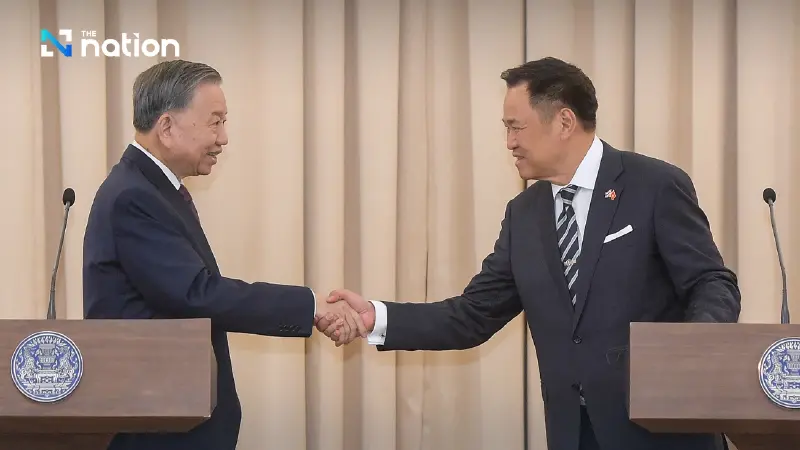


Thailand and Vietnam have exchanged a 2026-2031 action plan to implement their Comprehensive Strategic Partnership, with Prime Minister Anutin Charnvirakul and Vietnamese leader To Lam pledging to expand trade to US$25 billion while deepening cooperation in security, supply chains, technology and regional development.
- Thailand and Vietnam have exchanged a 2026-2031 action plan to guide their Comprehensive Strategic Partnership.
- A primary economic goal of the plan is to increase annual bilateral trade between the two nations to US$25 billion.
- The roadmap also aims to expand cooperation in other key areas, including security, investment, technology, and supply-chain connectivity.
Thailand, Vietnam launch new strategic roadmap
Thailand and Vietnam on Thursday exchanged a 2026-2031 action plan to turn their Comprehensive Strategic Partnership into concrete cooperation, with both countries pledging to push bilateral trade to US$25 billion per year while expanding ties in security, investment, technology and regional development.
Prime Minister and Interior Minister Anutin Charnvirakul and Vietnamese leader To Lam witnessed the exchange of key cooperation documents at Government House at 11.35am, following a plenary meeting between senior officials from both countries.
To Lam, General Secretary of the Central Committee of the Communist Party of Viet Nam and President of the Socialist Republic of Viet Nam, is on an official visit to Thailand with his wife, Ngo Phuong Ly, as guests of the Thai government.
The visit comes as Thailand and Vietnam prepare to mark the 50th anniversary of diplomatic relations on August 6, 2026. The two countries upgraded ties to a Comprehensive Strategic Partnership in 2025, while the new 2026-2031 action plan is intended to guide practical cooperation in politics, security, economics, supply chains, science and technology, and people-to-people exchanges.

Four cooperation documents exchanged
Government spokesperson Ratchada Thanadirek said the two leaders witnessed the exchange of four memoranda of understanding and cooperation documents.
The most important document was the Plan of Action on Implementing the Comprehensive Strategic Partnership between Thailand and Viet Nam 2026-2031, which sets the direction for the next phase of bilateral cooperation.
The second document was an exchange of diplomatic notes between Thailand’s Ministry of Higher Education, Science, Research and Innovation and Vietnam’s Ministry of Science and Technology. The notes confirm that the two ministries will serve as lead agencies in implementing and coordinating cooperation under the bilateral agreement on science, technology and innovation.
The third was an MoU on collaboration to develop an aircraft maintenance, repair and overhaul, or MRO, centre at U-Tapao International Airport between the Eastern Economic Corridor Office and Vietjet Group.
The fourth was an MoU between the Academy of Public Administration and Governance of Vietnam and Khon Kaen University.

Trade target and supply-chain links in focus
Economic cooperation formed a major part of the talks, with both sides agreeing on the need to work more closely amid global economic uncertainty.
The leaders agreed to accelerate efforts to raise bilateral trade to US$25 billion per year and continue promoting two-way investment. Thailand and Vietnam have set a target of lifting bilateral trade to US$25 billion by 2027, after two-way trade reached US$22.1 billion in 2025 and US$8.6 billion in the first four months of 2026.
The two countries also agreed to drive the “Three Connects” strategy, covering supply-chain connectivity in future industries, local economic connectivity and green strategy connectivity, while also giving importance to energy security.
The strategy reflects a broader shift in Thailand-Vietnam economic ties, with both countries seeking to position themselves as complementary production and investment bases rather than direct competitors. Thailand’s strengths in upstream industries, industrial materials, research and regional headquarters could be linked with Vietnam’s strengths in large-scale assembly, electronics manufacturing and a young workforce.
Security and regional cooperation strengthened
On political and security cooperation, Thailand and Vietnam agreed to elevate cooperation in military affairs and in tackling transnational crime, particularly online scams.
Both sides also discussed cooperation on illegal, unreported and unregulated fishing, or IUU fishing, and reaffirmed the principle that neither country would allow its territory to be used for political activities against the other.
The two governments also agreed to work together to support the implementation of the Asean extradition treaty framework and to maintain Asean centrality in responding to regional challenges.
Science, technology and innovation added to agenda
The two sides welcomed closer science and technology cooperation, especially the exchange of diplomatic notes between the two countries’ science agencies.
The cooperation is expected to support exchanges of knowledge in space technology, satellites, semiconductors, biotechnology and agricultural technology.
Anutin also proposed that Thailand and Vietnam, as the two largest economies in the Mekong subregion, work together to play a constructive and sustainable role in driving subregional development.
Leaders launch 50th anniversary logo
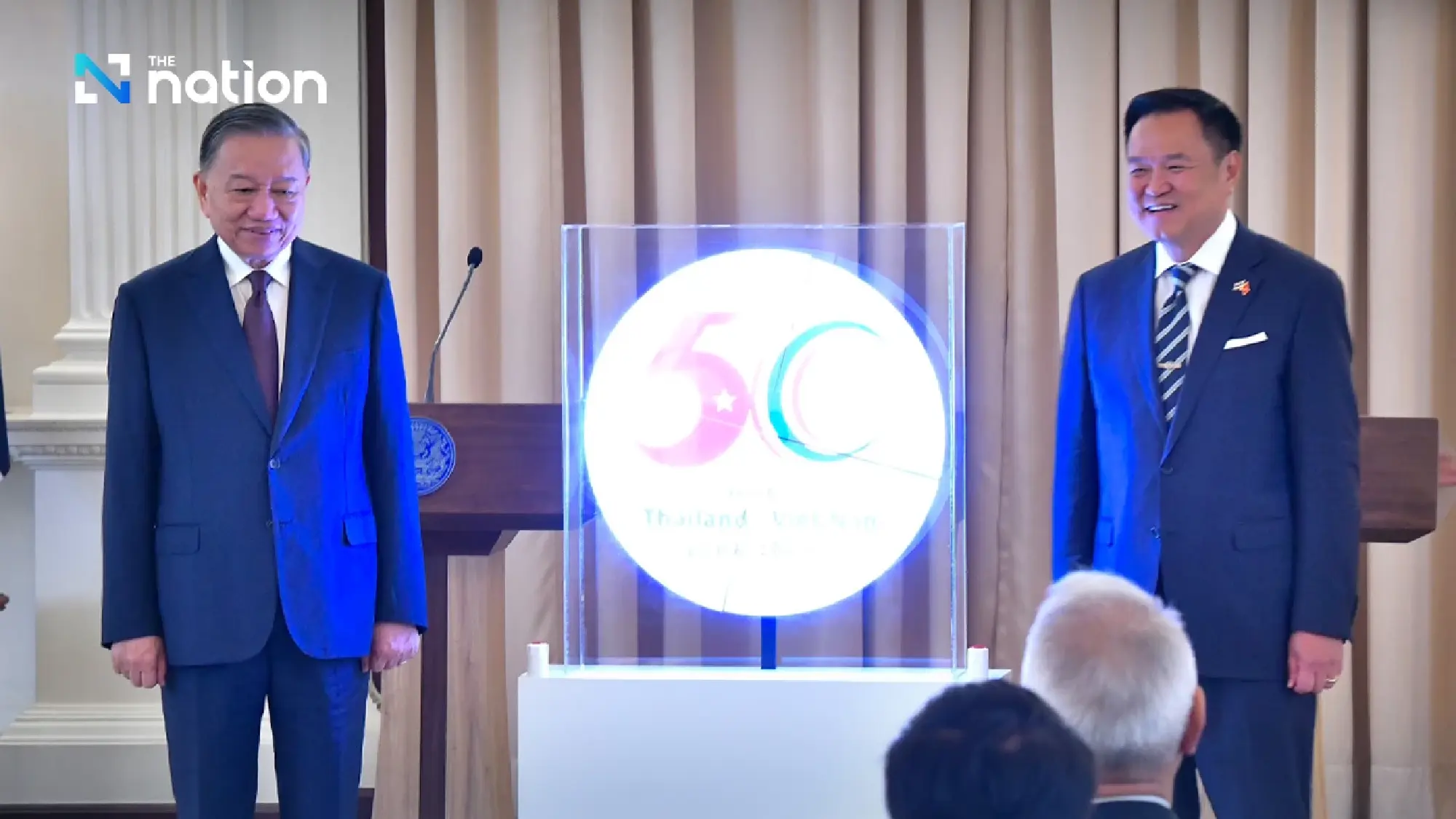
After the document exchange, Anutin and To Lam co-chaired the launch of the logo marking the 50th anniversary of Thailand-Vietnam diplomatic relations under the theme “Growing Together”.
The logo was designed to reflect long-standing friendship, shared growth and close cooperation between the two countries. The number “5” represents progress and continuous development, while the number “0” symbolises stability and unity as the two countries move towards a sustainable shared future.
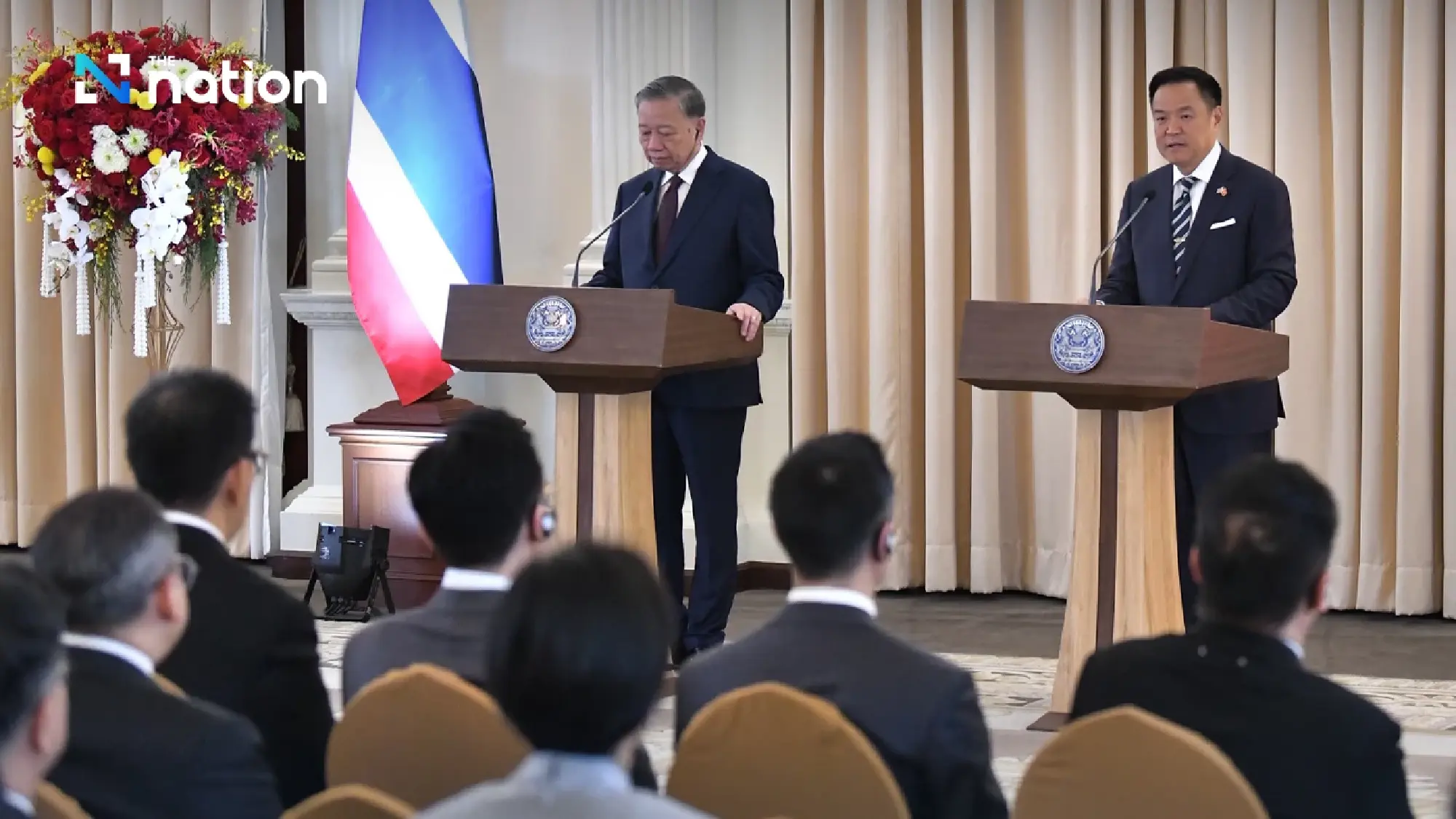
At a joint press conference, Anutin said he was pleased that To Lam had chosen Thailand as his first Asean country to visit after assuming office, saying this reflected the close friendship between the two countries.
To Lam thanked the Thai government and people for their warm welcome and praised Thailand’s role in promoting regional cooperation and strengthening the Asean Community. He said Vietnam attached great importance to developing relations with Thailand and was ready to work closely with Bangkok to promote peace, stability and shared prosperity in the region.
At the end of the meeting, To Lam invited Anutin to visit Vietnam at the earliest opportunity, while the Thai prime minister said the outcome of the talks would help build on 50 years of steadily growing relations between the two countries.
