
Cambodia uses UNCLOS and Timor-Leste model in Thai maritime row
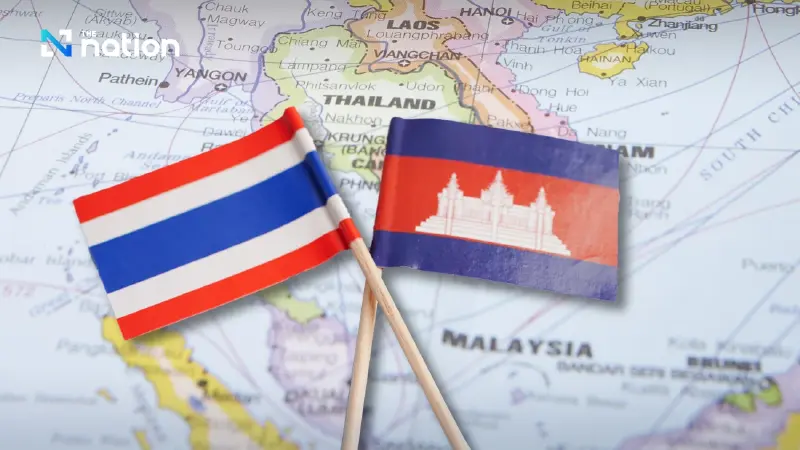


Hun Manet says Cambodia has notified Thailand and the UN Secretary-General to begin compulsory conciliation under UNCLOS.
- Cambodia has formally initiated compulsory conciliation proceedings against Thailand under the UN Convention on the Law of the Sea (UNCLOS) to resolve their maritime dispute.
- The strategy is explicitly based on the "Timor-Leste model," referencing the successful 2018 case where Timor-Leste used the same process to achieve a favorable maritime boundary settlement against the larger state of Australia.
- As part of this model, Cambodia is portraying Thailand as the larger, insincere state failing to comply with international law, a tactic that previously helped Timor-Leste secure a 70:30 resource split in its favor over Australia.
- The process involves forming a five-member conciliation commission, with two members appointed by each country and a fifth jointly selected chairperson, to propose a solution.
In a statement on efforts to resolve the maritime dispute between Thailand and Cambodia under compulsory conciliation pursuant to the 1982 United Nations Convention on the Law of the Sea (UNCLOS), Cambodian Prime Minister Hun Manet said:
“Cambodia has sent formal written notice to Thailand and the UN Secretary-General to initiate compulsory conciliation proceedings to protect Cambodia’s sovereignty and maritime rights in accordance with the principles of international law.”
In the statement, Hun Manet also cited the dispute over the maritime boundary between Timor-Leste and Australia, which was resolved through compulsory conciliation.
“By initiating the second compulsory conciliation process in the history of the United Nations Convention on the Law of the Sea, Cambodia hopes once again to demonstrate the value of international law and the peaceful settlement of disputes,” the Cambodian prime minister said.
At present, Cambodia has appointed two conciliators: Ambassador Peter Taksøe-Jensen of Denmark, who previously chaired the Conciliation Commission between Timor-Leste and Australia; and Prof Jean-Marc Thouvenin, an international lawyer and academic who is Secretary-General of The Hague Academy of International Law.
Under the process, a five-member commission will be formed, with two members from Thailand and two from Cambodia. The four will jointly select one chairperson, bringing the total to five, to hear both sides’ arguments and consider evidence before proposing a way to end the dispute.
This shows Cambodia’s plan to apply to Thailand the same model used by Timor-Leste, which previously prevailed over Australia, the larger state, in a maritime boundary settlement reached in 2018.
Initially, Australia used voluntary conciliation with Timor-Leste, not unlike Thailand’s position of choosing this approach to resolve the maritime dispute with Cambodia.
At the time, however, Australia did not co-operate at all, leading to compulsory conciliation.
In the end, what had been expected to be divided 50:50 became 70:30, with Timor-Leste winning, making it a case study now on record.
Beyond the “Timor-Leste-Australia model”, Cambodia is also trying to isolate Thailand by taking its case to the world and arguing that Thailand, as the larger state, is not sincere in ending the maritime dispute under compulsory conciliation.
Thailand is clearly disadvantaged by the label of being “the larger state”, meaning it is expected to accept every condition in every case.
It has also ratified UNCLOS and pledged to comply with it, but when the time comes, it is accused of failing to follow through by not entering compulsory conciliation.
This not only suggests a lack of sincerity but also indicates that Thailand’s ratification pledge was merely words, with no compliance when the time came.
All this is what Cambodia is preparing to project about Thailand in the eyes of the world to gain an advantage, while also asking what roadmap Thailand would offer if it wants to resolve the maritime dispute voluntarily, and when results would be achieved.
At the Foreign Ministry, Sihasak Phuangketkeow, Minister of Foreign Affairs, must counter Cambodia’s move to show that Thailand is sincere and ready to enter the voluntary process.
He must then invite Cambodian representative Prak Sokhonn to help draw up a roadmap showing that the two countries voluntarily want to talk, starting with which issues should be discussed, what timeline should be set and what outcomes would follow.
Thailand must also draw lessons from the case in which a voluntary process failed and led to compulsory conciliation, examining what Timor-Leste did so that Thailand can close the loopholes.
Thailand must also show that Cambodia itself is not sincere by creating impossible conditions, with maritime law, or UNCLOS, serving as the indicator.
Cambodia’s drawing of a line through Thailand’s Koh Kut reflects that Cambodia seeks only gains and continually takes advantage, while Thailand must publicise this to the world.
A Navy source said what Sihasak is doing now is seeking allies.
The principle is to isolate the opposing party and seek allies, a principle that must be pursued continuously.
Those allies should be neutral, straightforward countries with influence to pressure the other party.
In the end, there are gains and losses, and trade-offs are necessary.
“For example, if Cambodia wants this, we must get that. We must accept the reality that no one gains everything and no one loses everything. It is the same as the case study. In the Timor-Leste case, the original split was 50:50 under the criteria previously set. Once it entered the compulsory process, it became 70:30, and Timor-Leste beat Australia.”
“This shows Timor-Leste must have had something, and must have used some method to win, so how should we respond? As the larger state, as Australia was when it contested Timor-Leste, this is what is called knowing the other side and knowing ourselves. We must take this as a lesson in how to contest the case, what method Timor-Leste used, while Thailand now knows Cambodia is trying to copy it by using the Timor-Leste model.”
From now on, it remains to be seen what move Sihasak, who is attending the Organisation for Economic Co-operation and Development (OECD) Ministerial Council Meeting in Paris, France, from June 3 to 4, will take in response to Cambodia.
