
Thailand advances Bt12bn Koh Samui cruise terminal project
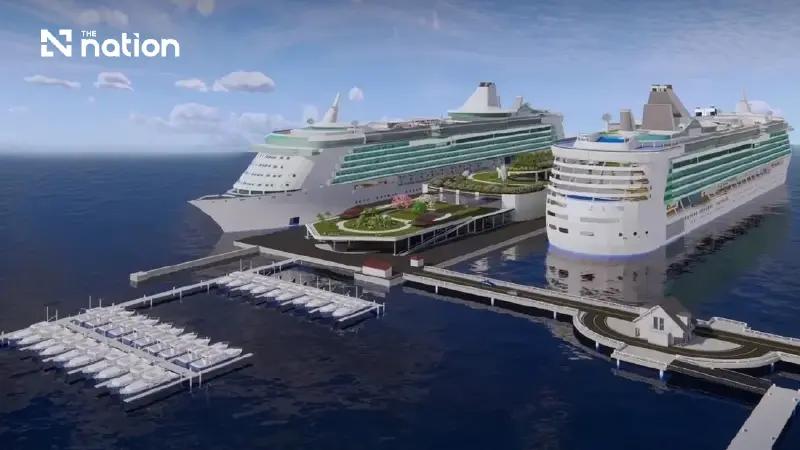


Thailand is advancing a Bt12.17bn cruise terminal on Koh Samui in Surat Thani, designed to accommodate up to 400,000 visitors and 240 cruise calls a year.
- The project is a 12.17-billion-baht cruise terminal on Koh Samui, which will be developed under a public-private partnership (PPP) model.
- Designed to handle large cruise ships, the terminal is expected to accommodate up to 400,000 tourists and 240 cruise calls annually.
- The project's timeline targets Cabinet approval in 2027, with the tendering process in 2028 and an operational launch scheduled for 2032.
- Under the PPP agreement, a private partner will invest 12.02 billion baht to construct and operate the terminal for a 30-year period.
The Transport Ministry is advancing a 12.17-billion-baht cruise terminal project on Koh Samui that is expected to accommodate up to 400,000 tourists and 240 cruise calls annually.
The proposed terminal, capable of serving large cruise ships, is among the ministry’s 262 major transport projects planned for 2027, with a combined investment of 229.76 billion baht.
Overseen by the Marine Department, the project is intended to improve maritime transport, accommodate large cruise ships, and support the growth of Thailand’s cruise tourism industry.

Terminal to cover 47 rai
The terminal will be developed across 47 rai, comprising 15 rai of onshore land and 32 rai of offshore space. Total investment is estimated at 12.17 billion baht.
The government plans to deliver the project under a public-private partnership (PPP) Net Cost model, with the private partner responsible for constructing and operating the terminal.
The state would reimburse the cost of infrastructure investment over a 10-year period.
The estimated investment is divided into:
- State investment: 148.58 million baht
- Private investment: 12.02 billion baht
The private investment comprises approximately 6.27 billion baht for construction and equipment and 5.75 billion baht for system installation, operations, and maintenance throughout the 30-year contract.

Cabinet approval targeted for 2027
The project is currently under consideration by the Transport Ministry and will be submitted to the transport minister for approval in principle before being forwarded to the Cabinet.
Applications for permission to use land overseen by relevant agencies, including the Royal Forest Department, will be processed in parallel with project approval. Preparations for the submissions are under way.
Under the ministry’s preliminary timetable, Cabinet approval is expected in 2027, followed by the tendering process in 2028. Construction would begin soon afterwards, with the terminal scheduled to enter service in 2032. The planned operating period is 30 years.
Once operational, the terminal is expected to handle between 200,000 and 400,000 tourists annually, as well as about 240 cruise calls a year.
The project study estimates that the terminal could generate approximately 46 billion baht in economic value over 30 years, with an economic rate of return exceeding 15%.
