
Thailand and Indonesia Target $23 Billion Trade in Strategic Economic Shift
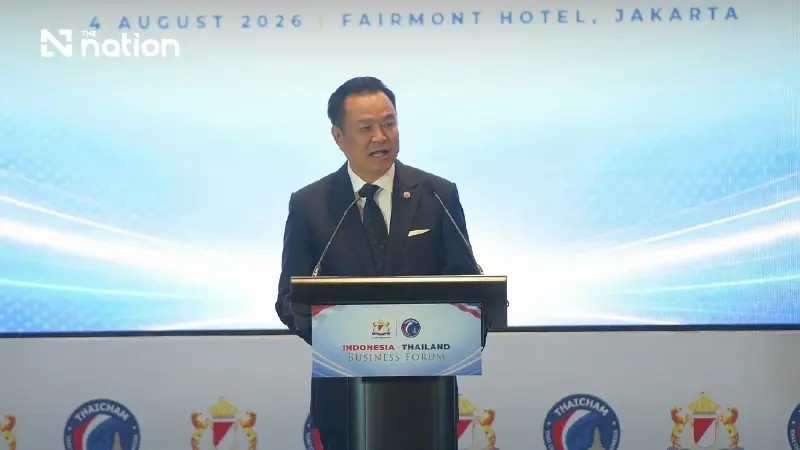


Prime Minister Anutin Charnvirakul proposes a four-pillar framework linking mainland manufacturing with Indonesia’s maritime economy
- Thailand and Indonesia have set a new bilateral trade target of $23 billion, aiming to elevate their economic relationship to a strategic partnership.
- The plan involves a four-pillar framework to integrate Thailand's mainland manufacturing capabilities with Indonesia's large maritime economy and domestic market.
- Key areas of cooperation will include food security and the Halal economy, logistics and infrastructure, digital and financial connectivity, and green energy technologies like electric vehicles (EVs).
Prime Minister Anutin Charnvirakul proposes a four-pillar framework linking mainland manufacturing with Indonesia’s maritime economy.
Thailand and Indonesia have agreed to deepen regional economic ties and elevate their relationship from traditional trading partners to strategic ‘co-creators’, setting a target to boost bilateral trade to $23 billion.
Speaking at the Indonesia–Thailand Business Forum in Jakarta on Tuesday, Thai Prime Minister and Interior Minister Anutin Charnvirakul outlined a vision to integrate manufacturing, investment, and green technology across the two largest economies in Southeast Asia.
The forum, co-hosted by the Thai Chamber of Commerce in Indonesia and the Indonesian Chamber of Commerce and Industry (Kadin Indonesia), brought together over 300 government officials, investors, and business leaders. Notable attendees included Indonesian Minister of Trade Budi Santoso, Special Presidential Envoy Hashim Djojohadikusumo, Chairman of the Thai Chamber of Commerce Poj Aramwattananont, and Bangkok Bank President Chartsiri Sophonpanich.
Anutin urged the business community to bridge ‘mainland and archipelago’ by leveraging Thailand’s manufacturing capabilities alongside Indonesia’s vast domestic market and maritime gateway.
Following bilateral discussions with Indonesian President Prabowo Subianto, Anutin noted that amidst ongoing global economic volatility, closer integration within the Association of Southeast Asian Nations (ASEAN) is ‘not an option but a necessity'.

"Governments must reduce barriers, build trust, and establish clear rules to enable the private sector to invest and innovate to its full potential," Anutin said.
Two-way trade between the two nations currently stands at nearly $20 billion. With a combined population exceeding 350 million, both leaders agreed that current figures capture only a fraction of the market’s long-term potential.
To expand value chains beyond commodity trade, the Thai Prime Minister outlined four core pillars of cooperation:
Food Security and Halal Economy: Developing an end-to-end Halal value chain, streamlining certification standards, and scaling up high-value agricultural exports globally.
Logistics and Infrastructure: Cutting cross-border trade costs and enhancing regional transport links, supported by new flight routes connecting Bangkok and Phuket directly to Jakarta and Bali.
Financial and Digital Connectivity: Expanding cross-border financial operations and integrating digital payment infrastructure via PromptPay–QRIS.
Green Energy and Future Tech: Jointly developing clean energy projects to power emerging high-tech sectors, including electric vehicles (EVs), artificial intelligence, and data centres.

The visit marks the first official trip to Indonesia by a Thai prime minister in 15 years. Private sector delegates welcomed the renewed diplomatic momentum, emphasising that stronger tripartite ties—spanning government, business, and civil society—will bolster ASEAN’s global bargaining power and strengthen regional supply chain resilience.
