
NARIT confirms bright meteor over Thailand was a bolide, not a threat
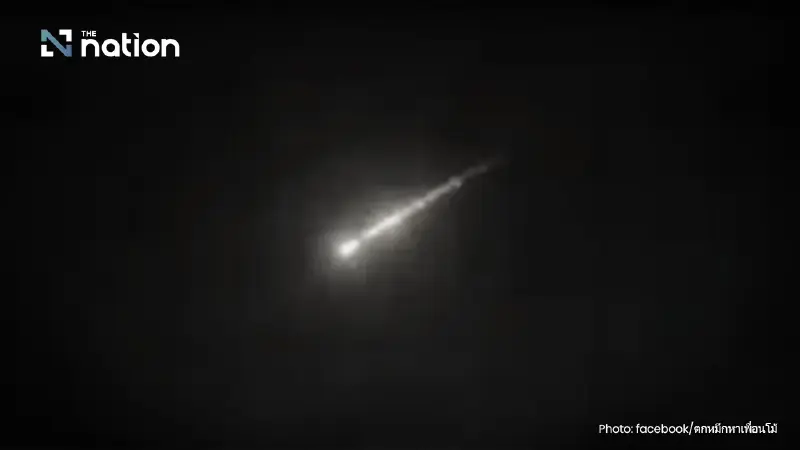


A bright meteor or “bolide” with a sonic boom was seen over central and eastern Thailand early Sunday, confirmed by NARIT as a natural celestial event.
The National Astronomical Research Institute of Thailand (NARIT) clarified that an exceptionally bright fireball accompanied by a sonic boom seen over the skies of many central and eastern provinces early Sunday was a normal celestial phenomenon known as a bolide.
Many social media users reported sightings of a very bright fireball followed by a sonic boom at around 12:28 a.m. on Sunday, with no reports of damage.
NARIT said it believed the phenomenon was a bolide, possibly associated with the Orionids, which occur annually from October 2 to November 7.
A bolide is a term used to describe an exceptionally bright meteor, often one that explodes in the atmosphere. These fireballs undergo a catastrophic breakup or detonate before reaching the ground. This explosion, or “airburst,” can produce a brilliant flash and sometimes a loud sonic boom.
NARIT explained that a bolide can be as bright as the full moon, with an apparent magnitude of -14. It usually occurs about 80 to 120 kilometres above the Earth, making it visible across vast areas such as Thailand’s central and eastern regions.
The Orionids are caused by cosmic debris left behind by Halley’s Comet (formally known as 1P/Halley). The Earth passes through this stream of debris every year between October 2 and November 7, so the bolide seen early Sunday could have been one of the meteors from the Orionid shower.
NARIT noted that Thailand had also experienced a bolide from the Perseids on August 3 this year.
The institute added that the bolide detected on Sunday was not among the near-Earth objects (NEOs) observed and recorded in the database of the United States National Aeronautics and Space Administration (NASA).
According to NARIT, NASA reported that as of Saturday, October 25, a total of 39,771 NEOs had been identified and recorded, including:
- 11,466 with diameters of over 140 metres
- 877 with diameters exceeding 1 kilometre
- 123 near-Earth comets
NASA has confirmed that none of these NEOs pose a risk of impacting Earth.
