
Thai Army disputes Cambodian claim linking explosion to Thai artillery shell, urges responsible reporting to support peace efforts


The Royal Thai Army has rejected Cambodia’s claim that a Thai shell caused a deadly explosion, urging factual reporting to aid bilateral conflict de-escalation.
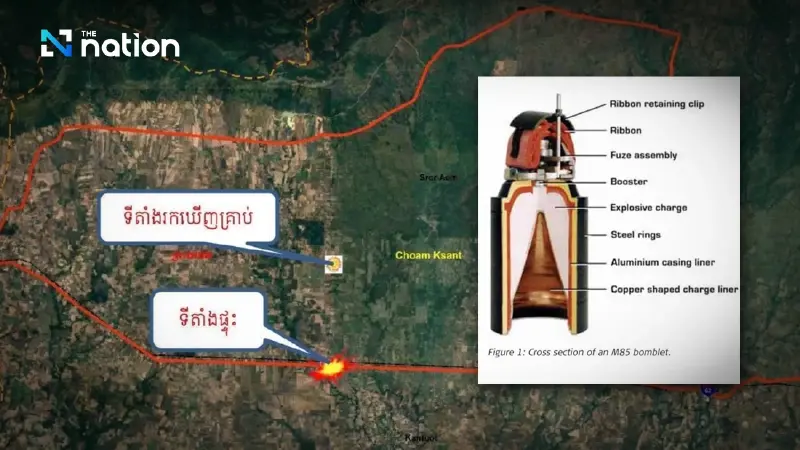
The Royal Thai Army (RTA) has raised concerns over Cambodian media reports claiming that an explosion in Choam Khsant District, Preah Vihear Province, which killed a 10-year-old boy and seriously injured his father, was caused by a cluster submunition from a Thai artillery shell.

According to Cambodian reports citing a statement by the Cambodian Mine Action Centre (CMAC) on October 25, 2025, forensic analysis and photographs from the site allegedly identified the explosive as an M85 cluster submunition from an M396 155mm artillery shell “fired by the Royal Thai Army.” The statement further claimed the munition was an unexploded remnant from clashes along the border between July 24 and 28, 2025.

Maj Gen Winthai Suvaree, spokesperson for the Royal Thai Army, clarified that after reviewing the Cambodian statement and comparing the evidence with technical data on the specified type of artillery shell, several key inconsistencies were found:
1. Thailand does possess 155mm Dual Purpose Improved Conventional Munitions (DPICM), which release M85 submunitions upon detonation. However, these submunitions are designed to self-destruct automatically and do not remain unexploded in the field.
2. Each M85 submunition contains a shaped-charge high explosive, intended to penetrate armour or fortified targets, and does not contain steel ball bearings or other shrapnel-generating components.
3. Photographs released by Cambodia show numerous puncture marks on a house roof and water jars, along with general blast fragments. This pattern is inconsistent with the effects of an M85 shaped-charge, which typically causes melting or burn marks due to its focused high-temperature blast, not widespread fragmentation. The M85 is not designed to create the kind of shrapnel damage visible in the images.

Winthai further stated that it is highly unlikely for an M85 submunition to fail to detonate, and even if such a malfunction occurred, the damage pattern observed contradicts the forensic conclusion presented by Cambodian authorities.
“The Royal Thai Army hopes that Cambodian media will report this matter based on verified facts and with responsibility, to prevent misinformation that could create misunderstanding among the public,” Winthai said.
He added that inaccurate or misleading information could harm the ongoing efforts by both countries to reduce border tensions and foster cooperation, stressing that careful and factual communication is essential to maintaining stability between Thailand and Cambodia.

