
Chao Phraya water discharge slows, flood victims surge by over 15,000 in two days
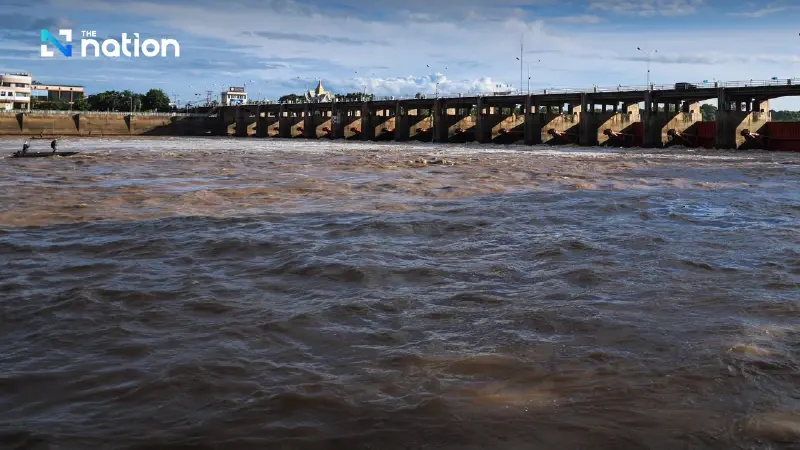


Slow drainage from the Chao Phraya Dam and nearby lowlands has prolonged flooding, raising the number of flood victims by more than 15,000 in just 48 hours, despite an overall drop in water levels.
The Chao Phraya River is showing signs of easing as rainfall in northern catchments declines, temperatures drop, and water flow in major tributaries weakens.
The Royal Irrigation Department has begun reducing discharge from the Chao Phraya Dam to lessen downstream impacts and prepare for the 2025–26 dry-season irrigation phase.
- Nakhon Sawan (C.2): Discharge 2,931 m³/sec (down from 2,965); water level 24.73 m, nearly a metre below the embankment — a clear downward trend.
- Chao Phraya Dam, Chai Nat (C.13): Discharge reduced to 2,755 m³/sec (from 2,800); upstream water 17.52 m, downstream 16.41 m; storage capped at +17.70 m MSL to maximise irrigation capacity.
- Sam Khok, Pathum Thani (C.29B): Flow averages 2,284 m³/sec, slightly lower, keeping low-lying areas around the Chao Phraya stable.
Cooler weather signals onset of dry season
A cold air mass from China is bringing cooler mornings to the upper regions, with temperatures expected to drop sharply between November 18–20. Northern areas will see strong winds and isolated rain early in the period, while the South will experience more rain — heavy to very heavy in some provinces.
Reservoirs near full capacity
Large reservoirs are nearly saturated, holding 90% of capacity and 83% usable water. All four main dams in the Chao Phraya Basin remain critically high:
- Bhumibol 99%
- Sirikit 98%
- Kwae Noi 102%
- Pasak 96%
Authorities are releasing water gradually to ensure safety while avoiding downstream surges.
Flood impact update (as of November 17)
Even though water levels along the Chao Phraya Basin have begun to fall, flooding remains widespread across 13 provinces, largely because low-lying areas and zones downstream of the Chao Phraya Dam continue to drain slowly.
The situation has changed only slightly since mid-November. On November 15, authorities reported flooding in 52 districts, 419 subdistricts, and 2,708 villages, affecting 137,106 households or 444,543 people.
By November 17, the number of affected provinces remained the same, but flooding extended to 53 districts and 420 subdistricts, while impacted villages dipped slightly to 2,698. The number of affected households rose to 137,569, with the total number of people impacted climbing sharply to 460,426 — an increase of around 15,883 people within just 48 hours.
Fatalities stood at 16 as of November 17.
