
Thailand Flood Crisis: Northern Runoff Slows, But 13 Provinces Remain Submerged
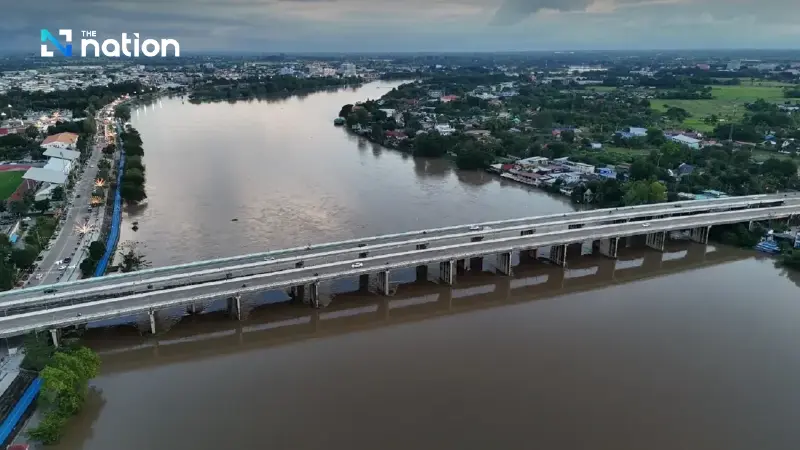


Government rushes to drain vast amounts of 'field water' into the sea as river levels ease across the Chao Phraya basin; South braced for heavy monsoon rains
- Although northern runoff in the Chao Phraya River Basin is slowing, allowing authorities to actively drain floodwater, 13 provinces remain submerged.
- The number of affected households has slightly increased due to large amounts of stagnant "field water" trapped in low-lying areas, even as main river levels recede.
- Water storage in major reservoirs is at a critically high 90% capacity, and a new weather threat is emerging as southern Thailand braces for heavy monsoon rains.
Government rushes to drain vast amounts of 'field water' into the sea as river levels ease across the Chao Phraya basin; South braced for heavy monsoon rains.
Flow rates along the Chao Phraya River Basin have continued their steady decline from the upper reaches to the lower central plains, offering a significant sign of relief across the nation's main waterway.
Crucial measuring stations—from C.2 in Nakhon Sawan down to C.29B in Pathum Thani—all recorded reduced volumes of water over the past 24 hours.
In response, government agencies have modified their water management strategy, increasing releases from key reservoirs and fully deploying the Khlong Lat Pho Canal to actively drive water out to the sea during low tide.
This concerted effort is aimed at quickly resolving the persistent flooding in the lower central provinces.
However, the national flood crisis is far from over. Despite the number of affected provinces holding steady at 13, data from the Department of Disaster Prevention and Mitigation (DDPM) for 17–18 November 2025 shows a marginal rise in the number of affected villages and households.
This increase confirms that while the main river levels are receding, vast quantities of water remain trapped and stagnant in low-lying natural retention areas (known locally as 'field water').
Dam Storage Remains Critically High
The overall water accumulation across Thailand's reservoirs remains at a dangerously high level, posing risks for continued water management, particularly concerning the upcoming dry season.
Total stored water stands at 72,154 million cubic metres (cu.m.), representing 90% of total storage capacity. Usable Water is 48,031 million cu.m., or 83%.
Authorities stressed that this level is considered to be "exceeding risk" for operational management, necessitating precise control over dam releases to avoid re-flooding downstream areas.
The four main dams in the Chao Phraya basin are all near or over capacity, though discharge rates are being carefully managed.
Weather Focus Shifts to the South
While volatile weather continues in the North, the focus is now heavily on the South, which is entering a period of heavy rainfall due to an intensification of the NEMO Monsoon.
Forecasters predict that a powerful cold air mass from China will reach upper Thailand between 19 and 23 November, bringing lower temperatures and stronger winds.
This is expected to naturally aid the drainage of northern runoff.
Simultaneously, the southern region must remain highly vigilant for continuous episodes of heavy to very heavy downpours.

Flood Impact Remains Widespread
The 13 provinces currently facing the flood crisis span a wide geographical area, stretching from Phitsanulok and Sukhothai in the upper central region down through Nakhon Sawan, Chainat, Singburi, Ang Thong, and Ayutthaya to the Bangkok perimeter.
The eastern province of Ubon Ratchathani is also still impacted.
The slight increase in affected residents confirms the challenge facing the authorities: draining the substantial residual water from the low-lying plains.
