
‘Don’t just take my life away now’


Twenty-one years since the deadly tsunami, calls for better preparedness are still heard
It was a normal day for the locals strolling on the seaside in Phuket, happily picking up fish left stranded on the beach. Little did they know their lives were to be tossed upside down in the coming minutes. A westerner suddenly shouted at them: “Big waves are coming.”
Srinual Khaolek, then 47 and working as a vendor, threw away the bottles of drinks she carried and ran for her life. She was not fast enough to outpace the surging waves that caught up with her tiring legs and knocked her down, surging over her fallen body.
“I was underwater and was dragged away by the powerful waves,” Srinual says, remembering that day 21 years ago when a deadly tsunami wreaked havoc in many parts of Asia.
Srinual, however, was more fortunate than tens of thousands of others who lost their lives in the tsunami. As the waves dragged her, she managed to grab a tropical almond beach tree, clung tightly to it and climbed up to free herself from the clutches of the surging waters, Srinual tells The Nation, the nightmare as fresh in her memory today.
Patong Beach, in Thailand's biggest resort destination, was among the places hit hardest by the Indian Ocean tsunami on December 26, 2004. Big waves two to 10 metres high hit Patong Beach within minutes, according to the Thai Mineral Resources Department.
According to the United Nations (UN), the devastating disaster stemmed from a 9.1-magnitude earthquake off the west coast of Indonesia's Sumatra island.
It claimed the lives of more than 230,000 people and displaced more than 1.7 million, as it swept across Sri Lanka, the Maldives, India, Indonesia and Thailand, with its impacts extending to countries like Somalia and Mexico on the other side of the world, the UN reported.

Thailand’s six provinces along the Andaman coast were severely affected, resulting in roughly 5,395 deaths, both Thais and foreigners, and 8,000 injured, the department said.
A 66-year-old street massage parlour worker, Thaworn Thongren, says her sister-in-law was among the fatalities.
Phuket saw 279 deaths – 151 Thais, 111 foreigners, and 17 unidentified, according to the Disaster Prevention and Mitigation Department (DDPM).
“My sister-in-law was swept away by the waves and [was found] dead at a restaurant nearby,” she says. Thaworn says she fled the water and tried to get to the seventh floor of a high-rise building around there, where she met both foreigners and locals.
Thaworn says she waited until she heard someone shouting from below that “the waters had receded”.
Patong was plunged into an eerie silence after the tragedy, with only ambulance sirens piercing the air. Temples reeked of the stench of corpses, she says, adding that she was taken elsewhere by her children. But despite being away from the scene of the tragedy, she could not get over the nightmare.
“I’m terrified. I still hear the sirens right in my ears. I didn’t even dare to shower for a long time. Even two bowls of water were too much. I’m not lying. I was just too scared. All I could hear in the bathroom was the sirens,” she says.
Her parlor friend, Jiraporn Thueanthin, 63, also recalled a similar experience, trying to get to a higher place when waves attacked.
“We could have easily died, but we’re alive,” Jiraporn says, showing her amulet from a local temple, which she believed helped save her life. At the time the catastrophe struck, she says she begged the sacred amulet: “I haven’t done anything wrong, please don’t take my life away now.”

How ready is Patong for a tsunami?
All three survivors say they are “ready and prepared” if a tsunami were to happen again, but also add: “It might depend on luck. It is somehow a matter of fate.”
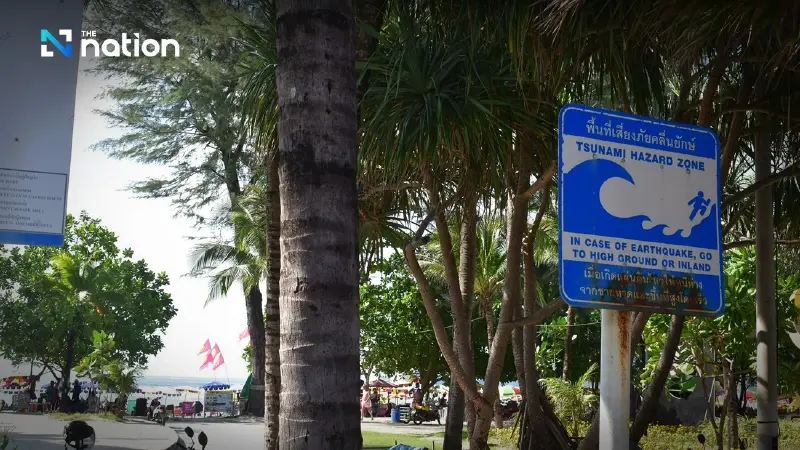
Since the deadly disaster, Patong has been equipped with warning signs, buoys, designated escape routes, broadcasting towers, as well as actions in place, including evacuation drills, to prepare the destination for a tsunami in the future. Response plans were initiated specifically for Phuket, together with frequent commemoration ceremonies, according to local authorities.
However, Sompak Somsiri says he is not convinced that Patong is equipped to handle such a tragedy should it happen again.
“We might be safe initially, to a certain extent, but we do not know what is going to happen in the real situation,” says Sompak, a witness of the 2004 tsunami, who is the director of Bansainamyen School that serves as the main tsunami evacuation centre in Patong.

Veteran local politician Chalermlak Kebsap, a former mayor, councillor and MP for Patong, says awareness has increased significantly among locals, as all stakeholders prioritise this matter. All local sectors, such as schools, businesses and hospitals, always participate in tsunami-related events like evacuation drills, she says.

Red tape problems
Now the owner of two hotels in the district, Chalermlak says the early-warning system is still a concern for her. “Can the warning system detect things more quickly? Like, how much longer until it reaches which place — the Andaman Sea, Patong? But I don’t know if that’s possible.”
In her understanding, having been in a managerial position, she says that when a tsunami threat is detected, it will first be received by the National Disaster Warning Centre, and then communicated to the DDPM, before informing local DDPM units to announce it via local means, such as speakerphones.
“If such a threat is detected, notification should be delivered right away,” she says, pointing to the time lag.
According to the department, the disaster warning process includes information reception, analysis and dissemination.
Both Sompak and Chalermlak also call for “decentralisation of power”. They believe that giving local entities more power could allow Patong to manage more effectively, pointing to budget allocation which relies on a “registered population”, while Phuket has a number of latent people, tourists and expats to manage.
“How much of our tax is given to the government, but how are we given back? That’s it,” Sompak says.
They say decentralisation could allow effective law enforcement and stability despite an administration change.

Call for better preparation
Their ideas are shared by an independent researcher in disaster-preparedness and risk assessment, Sirinon Suwanmolee, who urges that the government should delegate its authority when it comes to informing the public about disasters.
“The duty for disaster warnings currently rests with the DDPM, under the Ministry of Interior, which is not located in high-risk areas and lacks knowledge of the specific geographical conditions or circumstances at the local level,” she tells The Nation.
Though Thailand saw the creation of the Cell-Broadcast system in the aftermath of an earlier earthquake in Myanmar, which could deliver messages directly to people’s phones, Sirinon says it would not be effective if local authorities do not spearhead it.
“Villagers at the sub-district or village level need specific and understandable warning messages, indicating which zones will experience what events. This centralisation might stem from the government’s concern over a lack of single command, potential distortion of information and inaccuracies. The current situation is simply like sharing official documents and reading them aloud.”
The academic also urges an amendment to the 2007 Disaster Prevention and Mitigation Act to clearly pin duties and accountability, allow more flexible criteria for budget use, and appoint a person knowledgeable in natural disaster management.
The 2007 Disaster Prevention and Mitigation Act stipulates four levels of disaster management, namely small, medium, large and extra-large, with municipalities, provinces, the Interior Ministry and the Prime Minister responsible respectively.
Meanwhile, the issue of community reluctance to participate in the DDPM’s Community-Based Disaster Risk Management (CBDRM) programme has often been raised by officials within the department.
Studies find that community preparedness and capacity vary widely, with many areas constrained by limited budgets, equipment and trained personnel.
Scholars also note that CBDRM remains uneven due to inconsistent community participation, unclear local roles and weak coordination with state agencies and funding mechanisms.
Asked whether the issue of disaster preparedness is overlooked, especially when an election looms, Sirinon says the focus shifts to recovery rather than protection.
“It’s no different from populism, where people adopt it as a policy, as an agenda item, to make people see who’s helping, rather than focusing on prevention.
“In the next election, we need to move beyond the idea that disaster is a matter of fate. It’s predictable and can be mitigated,” she reiterates.
The next poll also marks the first general election after Thailand weathered many major natural disasters during the past few years including the March 28 earthquake in Myanmar and severe flood in Hat Yai, which significantly damaged the Kingdom’s economy and raised questions about preparedness, spotlighting political parties’ policies in the matter.
This coverage is part of the UNDP Media Fellowship on Sustainable Development in the area of disaster resilience, supported by the UNDP Regional Tsunami Project. The messages, views and opinions expressed in this coverage do not necessarily represent the views of UNDP.
This article is the first of the fellowship series. There will be more stories as part of the fellowship.

