
From flash mobs to nationwide recount: lessons the Election Commission never learns
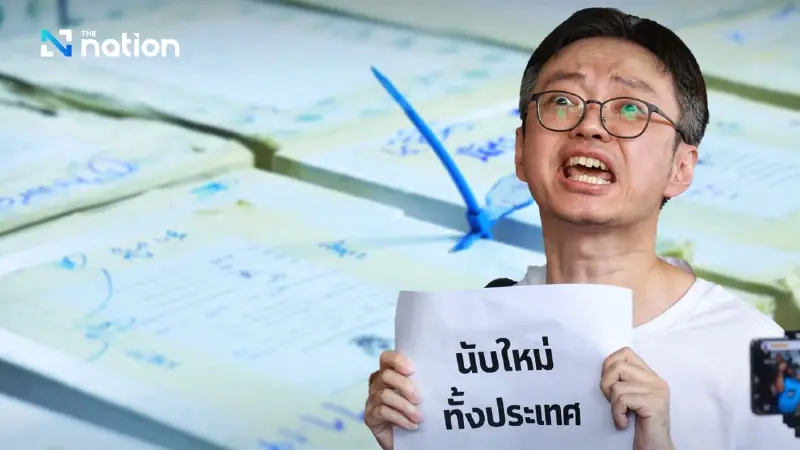


Calls for a “nationwide recount” have gained traction after disputed counts in Pathum Thani and Chon Buri, with protest groups urging the Election Commission to publish polling-station results and rerun votes where irregularities are found.
The “nationwide recount” has become a social current that is now turning into action, aimed at pressuring the Election Commission (EC) to instruct provincial EC offices to recount votes from the February 8, 2026 election—so as to reaffirm the will of the people expressed at the ballot box.

The spark came from a gathering of members of the public protesting the count in Constituency 7, Pathum Thani, after they said they could not trust that polling officials had counted transparently. They cited surrounding circumstances, including reports that a CCTV camera was covered with a black plastic bag and that officials blocked observers from watching the count.
The situation was then compounded by developments in Chon Buri, in Constituency 1 and Constituency 3, where suspected irregularities in vote tallies led to calls for a recount. Tensions escalated further amid concerns about how ballot boxes were stored, prompting protesters to surround the storage site. The Chon Buri standoff has continued into the present.

The movement intensified alongside activity by the People’s Party, after party leader Natthaphong Ruengpanyawut publicly accepted that the party had not finished first, but insisted: “We can accept defeat, but we cannot accept being cheated.” He also argued that ordering a recount across an entire province—or even nationwide—was within the realm of what could be done. Those remarks helped amplify the “nationwide recount” campaign.
The People’s Party was also the first party to have its MP candidates submit formal requests to the EC for recounts in constituencies where irregularities were suspected—at least 18 constituencies, according to the account.
The recount demand has moved beyond individual problem areas and become a broader social agenda driven by a crowd movement operating under the name United Front of Thammasat and Demonstration. Formed on February 10, 2026, it called a rally at the Bangkok Art and Culture Centre at Pathum Wan intersection, before mobilising supporters to gather at the Election Commission office at the Chaeng Watthana Government Complex on the morning of February 11, 2026.
Their demands included:
- A nationwide recount of House election votes
- Immediate disclosure of polling-station-level results, citing suspected irregularities in multiple areas
- In some cases, calling for elections to be declared void and rerun in constituencies where ballots were missing or where “floating ballots” exceeded the number of voters
- A demand that the EC fix problems quickly—and take responsibility for errors through resignations

Theerapop Tengpraphat, a representative of the group, was quoted as saying: “Defeat is something we can accept, but what has happened is all about a lack of transparency. If the EC does nothing in response to our demands, we will escalate the protests.”
That, in turn, increases pressure on the EC to explain itself and rebuild confidence in election management—before the protest movement grows into a wider rejection of election results, similar to the unrest seen after the March 24, 2019 election.

In 2019, flash mobs gathered on the skywalk at Pathum Wan intersection to protest the election outcome. The movement was led by the Future Forward Party, then headed by Thanathorn Juangroongruangkit. That election drew criticism of the EC over “floating ballots” and changes to the party-list calculation formula, which were seen as favouring the continuation of the National Council for Peace and Order (NCPO)-linked government.
Although the flash mobs later shifted from protesting election irregularities to defending Thanathorn and Future Forward amid a party dissolution case, the article argues that the current “nationwide recount” movement may not dissipate so easily—because it began with what it describes as “pure civic force” in local areas unwilling to tolerate perceived “grey” conduct by election officials that could distort the public’s will.
If the EC does not act swiftly to address public anger among voters who “won’t back down and won’t tolerate it”, political tensions could intensify and spill into wider consequences.

Abhisit Vejjajiva, leader of the Democrat Party, is cited as warning that if the EC fails to provide clarity and demonstrate transparency, history suggests the repercussions could be severe—potentially damaging Thailand’s political standing and leading to undesirable situations that affect post-election stability and perceptions of Thai politics.
There is also an earlier example involving the selection of senators, referencing a senate collusion case, arguing that the EC, as the organiser, failed to dispel clear doubts, leaving lasting negative public perceptions and affecting the image of the legislature.
If House elections are managed in an ambiguous way—prompting questions such as “transparent in what way?”—the consequences may go beyond the election itself, potentially extending to public refusal to accept not only the vote but also the government and Parliament, which would be damaging to Thailand’s political system.
