
Public Safety Warning: Don’t Let Your Power Bank Become a ‘Firebomb’ in Your Bag
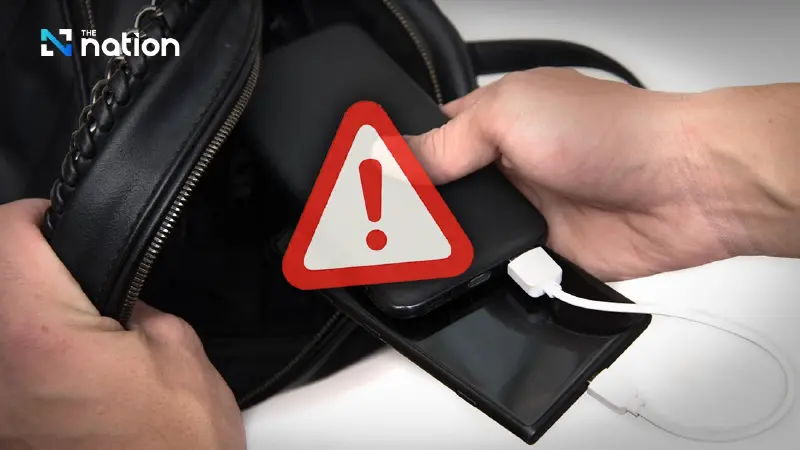


The Department of Disaster Prevention and Mitigation issues a high-level alert over faulty charging habits that lead to life-threatening battery explosions
- Officials warn that improper charging habits are a leading cause of power bank fires, specifically citing charging in hot spaces, using "pass-through" charging (charging a phone while the bank is also charging), and letting the battery regularly drop below 30%.
- To prevent overheating and potential explosions, users should keep power banks away from direct sunlight, unplug them once fully charged, and regularly inspect them for physical damage like swelling or bloating.
- Authorities recommend only purchasing power banks that have official safety certifications (such as the TISI mark mentioned in the article), as these have undergone rigorous safety testing that cheaper, unbranded devices often skip.
The Department of Disaster Prevention and Mitigation issues a high-level alert over faulty charging habits that lead to life-threatening battery explosions.
The Department of Disaster Prevention and Mitigation (DDPM) has issued an urgent public safety warning regarding the misuse of portable power banks.
Officials cautioned that improper charging habits are leading to a rise in battery failures, with some devices "exploding" inside users' bags or pockets.
Teerapat Katchamat, director-general of the DDPM, stated that while power banks have become indispensable, they carry significant fire risks if handled incorrectly.
"A power bank is essentially a chemical energy store; if it is compromised by heat or poor usage, it can become a serious incendiary hazard," he warned.

The Three Fatal Mistakes
The DDPM highlighted three specific behaviours that significantly increase the risk of a thermal runaway event:
The Heat Trap: Charging a device in a confined, hot space—such as inside a car parked in the sun or near a running computer—is the leading cause of battery swelling.
The 'Pass-through' Risk: Users are urged never to charge their phone via a power bank while the bank itself is plugged into the mains. This "pass-through" charging causes extreme internal heat.
Deep Depletion: Letting a battery drop below 30% regularly can degrade the internal cells, making them unstable during the next charge cycle.

Official Safety Code: Five Steps to Protect Yourself
To mitigate these risks, the DDPM has released a five-point safety manifesto for all smartphone users:
Monitor the 30% Threshold: Never let your power bank run flat. If the charge drops below 30%, stop using it and find a power source to prevent cell damage.
Disconnect Promptly: Unplug the device as soon as it reaches 100%. "Trickle charging" or leaving a device plugged in overnight leads to heat accumulation and potential short circuits.
Strictly Avoid Heat: Keep devices away from direct sunlight and high-temperature environments. Heat is the "silent killer" of lithium-ion batteries.
Physical Inspection: Regularly check your power bank for "bloating" or swelling. If the casing appears distorted, or if there are cracks or leaking fluids, the device must be disposed of at a designated e-waste point immediately.
Look for the ‘Kite Mark’ Equivalent: Only purchase devices that carry the Thai Industrial Standards Institute (TISI) certification. These products have undergone rigorous safety testing that cheaper, unbranded alternatives bypass.
"We are seeing too many incidents where a simple lack of awareness turns a daily convenience into a life-threatening accident," Teerapat concluded. "Safety must come before convenience."
