
Decoding "Fat Dust" – Why Dust Appears Thick Even with Improved Ventilation
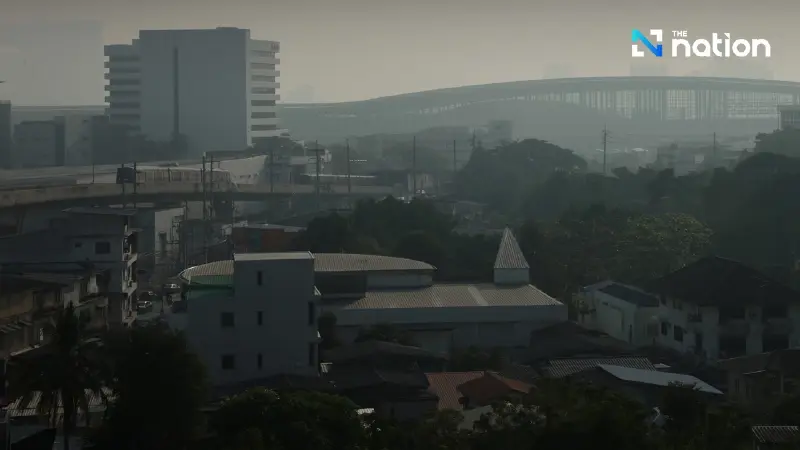


Bangkok reveals why dust appears thick despite improved ventilation, citing humidity and illegal biomass burning. Authorities continue to fight the pollution challenge.
On January 16, 2026, at 08:00 AM, Governor of Bangkok, Chatchart Sitthipan, along with Pornphrom Vikitsreth, an advisor to the Governor of Bangkok, and the sustainability executive of Bangkok, revealed the current situation regarding PM2.5 dust in Bangkok.

Area-specific Dust Situation Update:
Governor Chatchart stated that the situation has slightly improved. This morning, there were no red areas, although some orange areas still remain. Yesterday (January 15, 2026), districts on the eastern side, like Lat Krabang, saw red dust levels, but now the levels have decreased to orange.
However, the situation improved more slowly than expected, even though air ventilation has improved (better than on January 12-13, 2026). This is due to the burning of biomass in agricultural areas in nearby provinces such as Nakhon Nayok and Prachinburi. Winds have carried this dust into Bangkok, causing the dust levels to rise, and the air ventilation system could not clear it quickly enough.
Pornphrom mentioned that he had coordinated with the district chief in Nakhon Nayok to stop biomass burning, which received good cooperation. However, there were still cases of illegal burning in agricultural areas. On January 15, Pornphrom visited the area himself, managing to halt burning on approximately 1,000 rai of land. However, burning activities continued in Prachinburi, Chachoengsao, and Chonburi. For areas in Bangkok where illegal burning of grass or waste was found, the Bangkok authorities immediately dispatched fire trucks to extinguish the flames.
The "Fat Dust" Phenomenon:
Governor Chatchart raised the question of why the dust seemed thicker this morning, despite the overall improvement.
Pornphrom explained that the high humidity (around 95%) caused by southerly winds had contributed to the phenomenon. When tiny PM2.5 particles, which are invisible, come into contact with the moisture and water vapour, they cluster together and become larger, which is referred to as "fat dust." This makes the dust appear foggy. When the sun comes out, the heat helps dissipate the fog, and with improved ventilation, the situation will gradually improve.
Effectiveness of Green Spaces:
Governor Chatchart pointed out that comparing dust levels between parks and streets clearly shows a difference. In parks, where trees help filter dust, the situation is less severe than on the streets. This illustrates the importance of trees in helping reduce dust levels. Bangkok has already planted over 2 million trees as part of its efforts.
Legal Authority to Detect Black Smoke:
Pornphrom clarified the legal limitations regarding Bangkok's authority.
According to the National Environmental Quality Promotion and Conservation Act B.E. 2535, Bangkok and the Pollution Control Department (PCD) can only monitor black smoke from private 4-wheel vehicles. If black smoke exceeds 20%, a yellow sticker is placed on the vehicle, prohibiting its use for 30 days until improvements are made. However, Bangkok has no authority to inspect vehicles over 6 wheels, such as public transport buses or large trucks, or 4-wheel vehicles with yellow plates.
For vehicles over 6 wheels (trucks, public buses), the Department of Land Transport (DLT) has the authority under the Land Transport Act B.E. 2522 to immediately suspend their use with a red sticker. Therefore, for black smoke inspections, an integrated unit is formed, with Bangkok coordinating with the DLT and traffic police to carry out checks, primarily at bus depots and construction sites to minimize traffic disruption.
Governor Chatchart emphasized that the situation has improved this year overall, and asked for cooperation from neighbouring areas to control burning. He also urged the public and all sectors to maintain their vehicles and wear face masks in areas with high dust levels.
