
Phiphat and Ekniti lead Middle East war-room meeting, eye bigger oil reserves
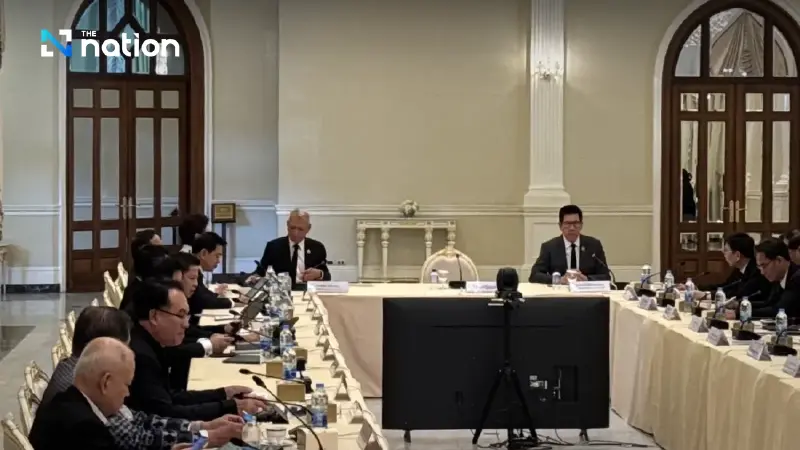


Prime Minister Anutin Charnvirakul has assigned Transport Minister Phiphat Ratchakitprakarn and Finance Minister Ekniti Nitithanprapas to chair an emergency meeting to respond to the Middle East conflict.
On Wednesday (March 4), at 4.30pm, Prime Minister Anutin Charnvirakul assigned Transport Minister Phiphat Ratchakitprakarn and Finance Minister Ekniti Nitithanprapas to co-chair the second 2026 meeting to assess the situation arising from the fighting in the Middle East (Meeting 2/2569), held at Government House in Bangkok.
At the start of the meeting, Phiphat said the situation in the Middle East directly affected Thailand through oil prices. Once oil prices are involved, he said, the government must consult and question relevant agencies on a range of issues, including the prices of goods, transport costs, and retail fuel prices at service stations, as well as how the country should cope.
He said the Energy Ministry had indicated Thailand currently has oil reserves sufficient for 60 days. The ministry has estimated this could potentially be extended by cutting out certain non-essential operations, such as reviewing the export of surplus oil by sea via floating storage vessels that have no advance contracts.
If that oil is instead retained for domestic use, he said, it would be necessary to consider where additional storage tanks could be secured. The Energy Ministry would need to discuss with operators across all companies how much extra tank capacity is available, and whether they could jointly manage any overflow, as well as how each operator would manage the situation.
As for petrol and diesel, Phiphat said that if a further shock occurs, Thailand may need to adjust its retail fuel-blending formulas. At present, Thailand uses B5 diesel, which contains 5% biodiesel (B100). He said discussions would be needed on whether it could shift to B7 or B10.
For gasohol, he said it may be possible to increase the proportion of alcohol blended into fuel. He added that discussions would be required in several formats to identify measures to support the situation.
Ekniti said that earlier in the day he had discussed the situation with the prime minister. Private-sector representatives, including the Joint Standing Committee on Commerce, Industry and Banking, were invited to receive the same information so all parties could share a common understanding.
The key was to keep information updated and to understand the latest situation.
He said the prime minister had assigned the Ministry of Foreign Affairs as the central agency to coordinate information collection, so it can liaise with spokespersons from various ministries. The ministry would provide updates that are closest to developments on the ground.
These steps would help verify which reports are true and which are not, to prevent panic. Regular updates would also allow the war room to assess impacts on the economy, trade, investment and other areas.
Ekniti said there were three key issues to monitor:
- Oil, to be handled by the Energy Ministry
- Transport, to be handled by the Ministry of Transport
- Prices of goods, to be handled by the Ministry of Commerce
He said officials from the Stock Exchange of Thailand and the Securities and Exchange Commission were invited to assess capital-market conditions, while the Bank of Thailand governor assigned a deputy governor to attend and monitor the baht.
The aim was to ensure all potential impacts were fully considered and that necessary measures could be put in place. He said the prime minister would later summarise the measures to be introduced to manage the situation.
