
PM calls on agencies to clarify SSO criticism; board launches reform drive
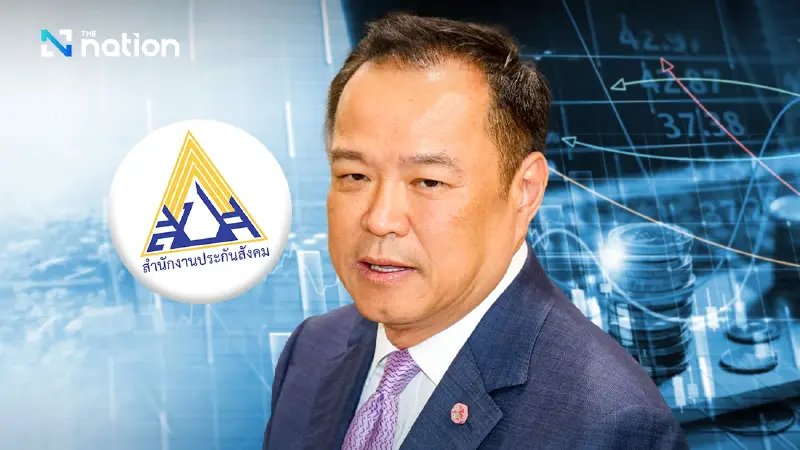


PM Anutin has convened relevant agencies to address public criticism of the Social Security Office, while the Social Security Board has set up a reform task force and approved changes to the investment allocation.
Anutin Charnvirakul, Prime Minister and Minister of Interior, said on Tuesday (January 27) that he had summoned Labour Minister Treenuch Thienthong, the permanent secretary for labour and the secretary-general of the Social Security Office (SSO) to seek clarification over issues currently under public scrutiny.
He said he had not previously received any report indicating serious problems, and all officials insisted that the facts did not align with media reports. However, he told them that internal explanations were insufficient and that the agencies concerned must publicly clarify the matter and allow the media to question them in full.
Asked whether he had offered guidance on how to resolve the issue, Anutin said the main weakness was the public perception that the SSO was directly under government control, as its secretary-general is a career civil servant.
In reality, he said, the SSO operates under the Social Security Board—a tripartite body representing employers, employees and the government—and is not subject to political direction.
He added that if his team had the opportunity to continue overseeing the agency in the future, they would consider how to enhance its clarity, transparency and independence—possibly by adopting a model similar to the Government Pension Fund (GPF), rather than relying on the rotation of senior civil servants.
He suggested that the secretary-general could instead be recruited through an open selection process.
When asked whether the SSO could be taken out of the bureaucratic system like the GPF, Anutin said it was premature to take any action, as decisions now could bind a future government and budget. Since parliament had been dissolved, he said, no such moves could be made.
On questions over the selection of the Social Security Board, Anutin said he had not examined the issue in detail and advised directing the question to the labour minister.
Social Security Board approves reform roadmap, investment shift
Pol Lt Col Wannapong Kotcharak, permanent secretary for labour and chairman of the Social Security Board, said after the board’s second meeting of 2026 that structural reform of the Social Security Office was deemed an urgent agenda item.
A task force to study reform options will be set up within this week, with its first meeting expected next week.
The task force, chaired by the permanent secretary for labour with the labour minister as adviser, will include four representatives each from insured persons and employers, along with government officials and representatives from key agencies such as the Ministry of Finance, the Council of State and the Office of the Public Sector Development Commission (OPDC).
Its mandate is to draft a roadmap and propose models to modernise the SSO, and it may invite external experts—including those from the Bank of Thailand and the GPF—to provide technical input and share international best practices.
The task force must produce agreed conceptual models within 60 days of its appointment, after which the proposals will be forwarded for academic and technical assessment, given their broad impact on the public.
Wannapong noted that similar studies were conducted in 2002 and 2016, but changing circumstances necessitated a fresh review. He said no decision had yet been made on whether the SSO should exit the civil service system.
Meanwhile, Assoc Prof Sustarum Thammaboosadee, a worker representative on the Social Security Board, said the new Strategic Asset Allocation (SAA Phase 2), to be fully implemented by 2028, would rebalance investments in line with international pension fund standards.
The plan raises the ceiling for higher-risk assets to achieve a 50:50 split between higher-risk and lower-risk assets, domestically and overseas, to enhance long-term returns.
He stressed that this ratio represents a maximum ceiling and that prudent risk management would remain in place. Following past controversies—such as the SKYY 9 building case—the SSO and the board set up a subcommittee to update risk-management regulations to prevent a recurrence.
Sustarum said regulatory adjustments would take around 15 months, with implementation expected in 2028.
The targeted investment return is 5–6%. While returns in 2025 appeared higher, he said this was largely due to exceptional bond-market conditions and should not be extrapolated. A sustainable long-term strategy could extend the fund’s lifespan by about two years.
He added that the reform would strengthen governance, transparency and accountability, aligning the SSO’s investment practices with global pension standards.
Under regulations issued in 2016, at least 60% of assets must be invested in low-risk instruments, with no more than 40% in higher-risk assets.
The Social Security Fund’s total value stood at 2.82 trillion baht, comprising 68.59% in low-risk assets and 31.41% in higher-risk assets. Since 1991, total investments of 2.82 trillion baht have come from cumulative contributions (59.82%) and accumulated investment income (40.18%).
