
Thailand eyes US LNG to cut Hormuz energy risk
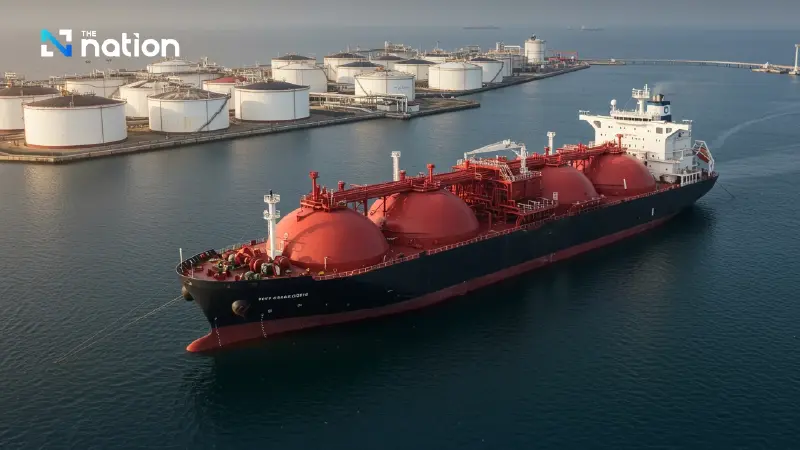


Thailand plans to secure new oil and LNG sources, including US LNG, to reduce Middle East reliance amid risks of a Hormuz Strait shutdown
Thailand is stepping up efforts to secure alternative energy sources, including potential purchases of liquefied natural gas (LNG) from the United States, to reduce risks associated with a possible closure of the Strait of Hormuz amid escalating tensions in the Middle East.
Prime Minister Anutin Charnvirakul has instructed the Energy Ministry and PTT Public Company Limited to urgently identify additional sources of oil and gas in order to reduce Thailand’s reliance on the Middle East. Officials have been asked to report progress within one week.
The move comes as the government seeks to ensure sufficient energy supplies during the ongoing crisis, which has raised concerns about disruptions to oil and gas flows through the region.
Government monitors energy supply risks
A source at Government House said a recent meeting monitoring the conflict in the Middle East acknowledged that global prices for oil and natural gas, particularly LNG, have risen in line with tightening supply conditions.
Energy infrastructure in the region, including refineries, pipelines and ports, has been damaged during the fighting, making production and transport more difficult. Iran has also announced the closure of the Strait of Hormuz to shipping, although it remains unclear how long the situation may last or whether it will escalate further.
Given these uncertainties, Thailand is preparing contingency measures to ensure energy security.
Proposal to import more LNG from the US
According to the source, Commerce Minister Suphajee Suthumpun has proposed that Thailand consider increasing LNG imports from the United States.
Thailand already imports LNG from several countries, but expanding purchases from the US could help reduce Thailand’s trade surplus with Washington, potentially supporting ongoing negotiations over tariff measures.
The proposal is also consistent with past trade discussions between Thailand and the United States. In 2025, the two countries issued a joint statement under the Framework for a United States–Thailand Agreement on Reciprocal Trade.
Under the framework, Thailand agreed to purchase energy products from the US, including LNG, crude oil and ethane, worth approximately US$5.4 billion (about 170 billion baht) per year.
The agreement highlighted the growing role of the United States as an important energy supplier for Thailand and underscored Thailand’s increasing reliance on LNG in the future.
Looking to diversify supply from the US and Africa
Sources said Thailand is considering increasing imports from existing partners such as the United States and West Africa, while also accelerating negotiations with neighbouring producers including Malaysia and Brunei to ensure stable supply flows.
However, changing crude oil sources is not straightforward, as oil from different regions has varying qualities and compositions. Refineries may need to adjust their processing systems, which could increase costs.
Transporting oil from more distant sources would also raise shipping costs.
At the same time, expanding national oil reserves beyond the current policy level of 60 days would require significant investment, and oil traders are reluctant to bear the risks of holding expensive inventory.
In 2025, senior officials from the Energy Ministry, along with representatives from PTT, the Electricity Generating Authority of Thailand (EGAT), and Electricity Generating Public Company Limited (EGCO), travelled to Alaska to discuss development of the Alaska LNG project and potential long-term gas supply.
On June 23, 2025, PTT signed a Joint Study Agreement with Glenfarne Group, the owner and developer of the Alaska LNG project, to study the feasibility of securing long-term LNG supplies from the project.
The proposed arrangement involves up to 2 million tonnes of LNG per year over a 20-year period.
Additional spot LNG imports planned
Poonpat Leesombatpiboon, secretary-general of the Energy Regulatory Commission (ERC), said the commission had assessed the impact of the Iran-related conflict on regional energy markets.
To ensure electricity system stability, the ERC has adjusted its procurement plan by adding three additional spot LNG cargoes scheduled for delivery between March and April 2026.
He said discussions with LNG shippers indicated that some gas supply sources are located in high-risk areas, while transport routes have also been affected by tensions in the Middle East.
Oil fund spending 400 million baht per day to support diesel
A source from the Energy Ministry said global diesel prices have surged sharply, rising by more than US$10 per barrel to around US$140–150 per barrel.
As a result, Thailand’s Oil Fuel Fund Office is currently subsidising diesel prices by around 400–450 million baht per day.
The fund currently holds about 27 billion baht in cash and has roughly 30 billion baht in outstanding borrowing. At the current rate of subsidy, the fund would be able to support prices for only about 15 days.
If global oil prices continue to rise, the government may eventually need to allow domestic fuel prices to reflect market conditions more fully.
Thailand relies heavily on imported energy
Thailand currently imports nearly one million barrels of crude oil per day, with more than 90% of total energy consumption coming from imports.
Around 40% of Thailand’s energy imports are transported through the Strait of Hormuz, a level that remains strategically significant even though it is less than half of total imports.
The United Arab Emirates is Thailand’s largest crude oil supplier, followed by the United States, which accounts for more than 10% of imports.
Other sources that do not rely on the Strait of Hormuz include Malaysia, Indonesia and West African producers such as Nigeria.
Thailand’s total oil reserves currently stand at around 60 days. This includes 25 days of legally mandated reserves, 13 days of working stock, and another 22 days of Thai-owned oil currently being transported through the Strait of Hormuz.
Calls for energy conservation measures
Officials have urged the public not to panic or hoard fuel, noting that the country continues to import oil while maintaining adequate reserves.
Beyond price measures, sources said the government should also push energy-saving policies more seriously, such as encouraging greater use of public transport and potentially reviving work-from-home arrangements similar to those used during the Covid-19 pandemic in order to reduce overall fuel consumption.
Shipping costs surge as tensions escalate
Bloomberg reported that the cost of transporting oil from the United States to Asia has surged to record levels amid prolonged tensions in the Middle East.
Data from the Baltic Exchange in London showed that the cost of shipping two million barrels of oil from the US to China rose to more than US$29 million as of March 4, roughly double the level seen two weeks earlier.
This translates to about US$14.50 per barrel in transport costs alone. Compared with the benchmark WTI crude price of about US$75 per barrel, shipping now accounts for nearly 20% of the oil price.
Global oil prices have risen sharply over the past week following US and Israeli strikes on Iran on February 28 and the subsequent closure of the Strait of Hormuz, a key route for oil shipments to Asia.
As a result, Asian buyers are increasingly considering purchases of US crude, pushing up prices of US grades such as Mars Blend.
However, analysts remain uncertain how long the price surge will last.
Over the past 24 hours, there have already been signs that several tanker charter deals along the US Gulf Coast have been cancelled or failed due to excessively high freight rates.
PTT tanker deal reportedly collapses
Shipping brokers reported that PTT had attempted to charter a tanker at a cost of around US$29 million, or roughly 1 billion baht.
However, data from Tankers International later indicated that the deal ultimately collapsed.
Such cancellations are common when freight rates rise too rapidly and charterers are unable to absorb the increased costs.
Meanwhile, tanker freight rates on major routes from the Middle East to China have surged to around US$475,000 per day, or roughly 17 million baht per day.
Despite the high rates, actual bookings remain limited because the Strait of Hormuz is currently closed.
Available oil tankers have become extremely scarce, forcing charterers to pay daily rates comparable to the cost of leasing offshore oil drilling rigs.
