
EU audits Thai produce residue controls, boosting confidence in Europe exports
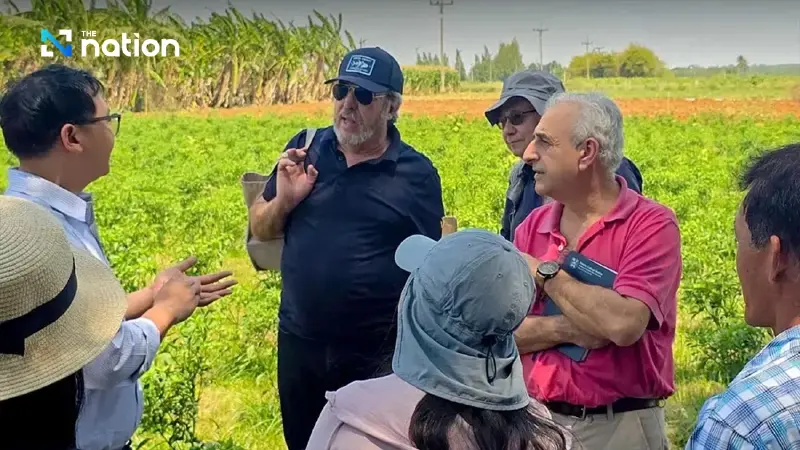


EU food safety auditors inspect Thailand’s fruit and vegetable residue control system, reinforcing confidence in exports to Europe worth about 1 billion baht a year
Rapeepat Chantarasriwong, director-general of the Department of Agriculture, said the European Union’s Directorate-General for Health and Food Safety (DG-SANTE), led by Pedro Moreno Valenzuela, head of the audit team, together with expert team members Amadeo Rodriguez Fernandez Alba and Demetrios Fragoyiannis, has travelled to Thailand to conduct an assessment and hold policy discussions on the country’s control system for pesticide residues in food of plant origin.

The DG-SANTE expert team is carrying out an assessment of Thailand’s residue control system from March 9–20, 2026. This is an important mechanism used by the European Union to evaluate the food safety regulatory systems of trading partner countries, in order to confirm that exporting countries have effective control systems in place and can guarantee the safety of agricultural products before they enter the European market.
The assessment is highly significant for Thailand’s agricultural export sector. The European Union is one of Thailand’s key export markets for plant products such as vegetables, fruit and related goods, with export value of around 1 billion baht a year. It is also a market with some of the world’s strictest food safety standards, requiring Thai exporters to maintain product quality continuously in order to sustain confidence among trading partners.

This assessment covers the control system throughout the production chain, from oversight of pesticide use at farm level, quality control at packing houses, supervision of agricultural hazardous substance retailers, and the laboratory system for analysing residue levels. These are all essential components of the food safety framework to which the European Union attaches great importance.

The Department of Agriculture has arranged site visits for the expert team to inspect operations in several locations, including chilli plots in Kanchanaburi and Nakhon Pathom, passion fruit plots in Lampang, and certified packing houses in Pathum Thani, Nakhon Pathom and Ratchaburi, in order to assess the effectiveness of Thailand’s control system and the management of agricultural goods before export.
In addition, the audit team followed the work of agricultural inspectors responsible for supervising pesticide retailers, in order to reflect the effectiveness of Thailand’s legal oversight system for agricultural hazardous substances. The team also visited agricultural research and development centres and residue analysis laboratories to assess scientific readiness and the accuracy of Thailand’s system for testing residue levels in agricultural products.

The Department of Agriculture is also continuing to transfer knowledge to farmers on the proper use of pesticides, while at the same time developing a traceability system that can track the origin of products throughout the production chain. This is intended to create transparency and ensure compliance with European food safety requirements.
“The European Union is one of the markets with the strictest food safety standards in the world. Thailand’s ability to demonstrate the strength of its residue control system will help build confidence among importers and consumers in the European market. This DG-SANTE assessment is not only a confirmation of the safety standards of Thai plant products, but also an important mechanism for strengthening confidence among trading partners and creating opportunities to expand Thai plant exports in the future,” he said.
