
Agriculture Department and Thai Ambassador push for Thai fruit exports to South Korea
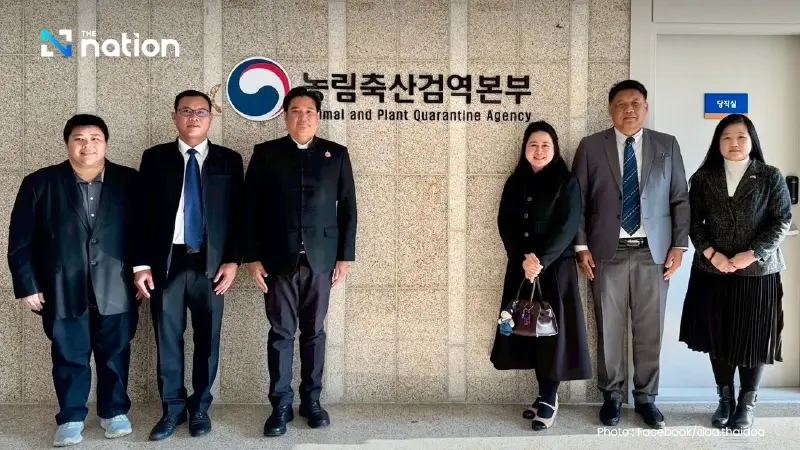


The Department of Agriculture and Thai Ambassador to Seoul meet with South Korean plant quarantine authorities to boost exports of high-value Thai agricultural products.
Rapibhat Chandarasrivongs, Director-General of the Department of Agriculture, and Tanee Sangrat, Thai Ambassador to Seoul, led a delegation to meet with Park Kyung-hee, Acting Director-General of the Animal and Plant Quarantine Agency (APQA) of South Korea.
The meeting aimed to drive forward the expansion of the Thai agricultural market, including high-value products such as fresh mangoes, pomelos, longans, and green papayas.
Discussions focused on addressing trade barriers, particularly sanitary and phytosanitary (SPS) measures, alongside increasing the export volume of Thai agricultural products to South Korea.

The Director-General highlighted the continued cooperation between the two countries in opening new agricultural markets. In 2026, Thailand submitted a request to open the pomelo market in South Korea, while South Korea requested market access for fresh paprika to Thailand.
In 2025, Thailand exported over 31,832 tons of fresh pomelos worth 1.42 billion baht. With South Korea’s approval to import Thai pomelos, exports are expected to increase to about 32,000 tons, valued at approximately 1.5 billion baht.
Additionally, Thailand requested South Korea to consider opening its market to longans and green papayas, both of which are high-potential agricultural products.
This aligns with the Ministry of Agriculture and Cooperatives' "market-driven production" policy. It is expected that by 2026, Thailand will be able to successfully open these markets, with anticipated annual exports of approximately 32,000 tons of pomelos worth 1.5 billion baht, 514,000 tons of longans worth 18.3 billion baht, and 372 tons of fresh papayas worth 30 million baht.

Regarding mangoes, Thailand currently exports four varieties—Nang Klang Wan, Nam Dok Mai, Rad, and Mahachanok—to South Korea. These mangoes undergo Vapour Heat Treatment (VHT) to control fruit flies of the Bactrocera genus.
However, during this meeting, the Director-General proposed an alternative method—Hot Water Immersion Treatment (HWIT)—which has been approved by the Commission on Phytosanitary Measures (CPM) since 2025.
The Director-General further explained that Thailand has used hot water immersion for exporting fresh mangoes to the European Union for over five years, without reports of pest contamination in Thai products.
This method also significantly reduces costs for operators compared to steam treatment, which requires a 3-ton steam oven costing approximately 11 million baht. In contrast, a 600-kilogram hot water immersion tank costs only around 350,000 baht, increasing Thailand's potential for fruit exports.
This meeting with the APQA marks another significant step towards enhancing cooperation between the National Plant Protection Organisations (NPPOs) of both countries.
It is expected to increase trade opportunities, add value to Thailand's high-quality agricultural products, bolster confidence in food safety and plant health, and improve the long-term competitiveness of Thai agricultural products in the South Korean market.
