
Candidates promise cleaner air and stronger support for northern agriculture
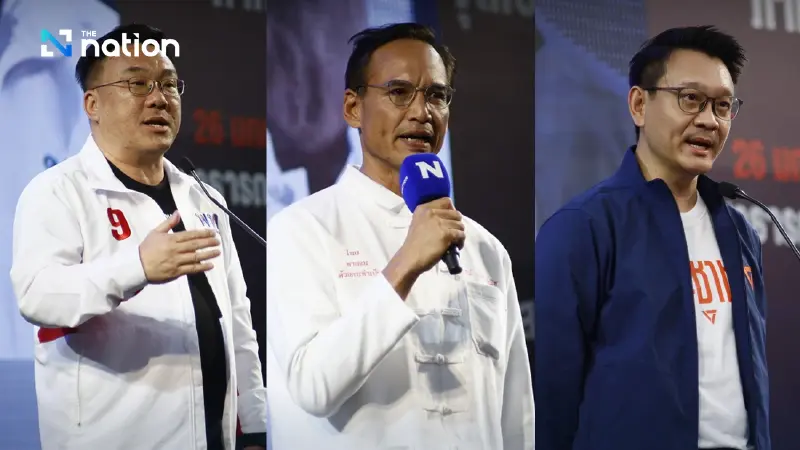


Representatives from the Pheu Thai, Democrat and People’s parties at Nation Election Debate 2026: The Crossroads (Northern Region) proposed measures to tackle air pollution and support the agricultural sector in northern Thailand.
Speaking at the Chiang Mai Provincial Administrative Organisation Public Park on Monday (26 January), Julapun Amarnvivat, Pheu Thai party leader and prime ministerial candidate, said the right to breathe clean air was not a secondary issue but a constitutional right for all citizens.
He said successive administrations led by former prime ministers Srettha Thavisin and Paetongtarn Shinawatra had taken concrete action, and claimed dust levels in Chiang Mai had been reduced by 40%. However, he added that the problem was complex and would take time to tackle sustainably at its source.
Julapun said the causes could be grouped into three main areas, and proposed structural solutions.
- First, he called for ending conflict in forest areas, arguing that some wildfires stemmed from tensions between the state and local communities. A lasting approach, he said, would be to build cooperation and improve knowledge so that people and forests could coexist, with communities taking part in forest protection rather than being treated as adversaries.
- Second, he urged agricultural reform grounded in “economics”, saying farmers burn crop residue because it is fast and easy, and because many lack sufficient profit to choose alternatives. He proposed a policy to guarantee a 30% profit margin for agricultural products, aiming to raise incomes. With stable earnings, he said, farmers would be better able to shift from burning to modern, more environmentally friendly technologies for managing agricultural waste.
- Third, he said industrial pollution in central and urban areas was driven mainly by factories and vehicles, and argued that enforcement should rely less on “human judgment”, which he said could create opportunities for corruption. Instead, he proposed accurate sensor-based monitoring and a centralised data dashboard to improve transparency, oversight and accountability.
Julapun said that if the government could mobilise all sectors in line with the plan, PM2.5 levels would fall significantly and people would permanently regain their right to clean air.
Democrat Party proposes “forest bonds” and salaried support for farmers
Korn Chatikavanij, deputy leader of the Democrat Party and a prime ministerial candidate, outlined what he called a proactive approach to tackling haze and improving quality of life.
He said the right to breathe clean air was a fundamental right and proposed a Clean Air Act to underpin that right in law, alongside strict enforcement of the polluter pays principle—covering both pollution clean-up and legal penalties.
Korn said economic tools were needed to support farmers and change behaviour fairly at the root cause. He highlighted two main mechanisms: income guarantees to ensure farmers have enough financial security to stop burning, and an innovation he described as “forest bonds”, designed to encourage farmers to become tree planters and forest stewards.
He explained that forest bonds would raise funding so the government could pay farmers a regular income or “salary” for seven to eight years while economic hardwood trees mature. Once the trees are ready for harvesting and sale, part of the proceeds would be used to repay the bonds, while the remaining profit would be paid to farmers as an additional dividend.
He said this would expand forest area, provide stable long-term income, increase carbon storage, and create a natural mechanism to help trap PM2.5.
People’s Party pushes data-driven wildfire management and “no-burn” incentives
Veerayooth Kanchoochat, deputy leader and prime ministerial candidate of the People’s Party, said his party had consistently pushed for a Clean Air Act since the Move Forward era, and insisted it could manage the problem better in government through three main strategies: more accurate data, sustainable domestic management, and proactive diplomacy.
On wildfire management, he said authorities must look beyond hotspot data to include burn-scar analysis so action targets the true scale and locations of burning. He also argued that wildfire budgets had not been allocated adequately to subdistrict administrative organisations or municipalities responsible for forest reserve areas.
The People’s Party, he said, would shift firefighting from a volunteer model to a professional system by allocating budgets to hire staff on salaries each year until the crisis eased.
For agriculture, he proposed 250 baht per rai in support for farmers who do not burn, alongside promoting crops suited to local soil conditions to create long-term sustainability rather than short-term fixes.
Veerayooth also criticised past government talks for lacking concrete outcomes on transboundary haze and toxic pollution in major rivers. He said the People’s Party would pursue proactive diplomacy through multilateral mechanisms under a “Pro-Thailand” approach, emphasising national interests in negotiations with major powers.
“Thailand is not a small country. We must have the courage to step forward and negotiate—whether with China or the United States. We are not anyone’s enemy, but we must negotiate issue by issue. If something causes problems for Thailand, we need to seriously use multilateral mechanisms to help address it,” Veerayooth said.
