
Thailand’s Songkran 2026 alcohol rules: hours, fines and penalties explained
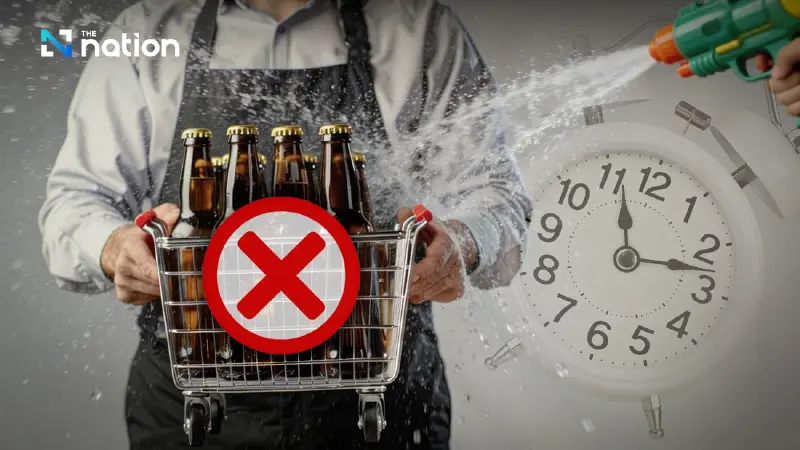


A look at Thailand’s latest alcohol control rules for Songkran 2026, from sales hours and fines to penalties for selling to under-20s or intoxicated customers.
Thailand’s Songkran festival in 2026 falls during the long public holiday from April 13 to 15. Many people use the break to relax, celebrate with friends, or travel home to spend time with family and loved ones.
But to ensure safety on the roads and during the festivities, alcohol remains one of the key areas requiring caution. For business operators in particular, the Alcoholic Beverage Control Act (No 2) BE 2568 (2025) should be properly understood, as several provisions carry serious penalties.
The key points are as follows:
Selling alcoholic beverages without a licence
- This carries a fine of 5,000 baht.
Selling to people under 20 and to intoxicated persons
- This is punishable by up to one year in prison, a fine of up to 100,000 baht, or both.
If a drinker goes on to cause damage to another person’s body or property
- The seller may also be held jointly liable in civil proceedings.
Under the law, sellers may ask to see a national ID card and may check whether a buyer appears intoxicated. Doing so can help reduce the seller’s civil liability under the law.
Alcohol sales are prohibited between midnight and 11.00am. Promotional activities such as discounts, giveaways, exchanges and free offers are also banned. Violators face up to six months in prison, a fine of up to 10,000 baht, or both.
This Songkran, several agencies are preparing to step up enforcement. The Excise Department is expected to inspect sales licences and other violations in Songkran water-play areas, while the Metropolitan Police Bureau has publicised the rules and says it is ready to enforce the law strictly in all major celebration zones.
For business operators, the Department of Disease Control’s criteria and methods for assessing intoxication can also be used to determine whether a person should be regarded as intoxicated.
A person is considered intoxicated if they display any of the following:
A person who has consumed alcohol in an amount that causes clear impairment of balance and bodily movement, such as:
- staggering or difficulty standing; or
- behaviour or speech that may pose a danger to themselves or others, or disturb public order.
A person who smells of alcohol and also shows at least one of the following symptoms:
Clearly observable physical signs, such as:
- bloodshot eyes or twitching eyes;
- clear loss of motor control, such as staggering, walking off line, difficulty standing, stumbling, or obvious hand tremors.
Speech and behavioural signs, such as:
- slurred speech, mumbling, clipped words, or repetitive, rambling speech;
- mood swings, irritability, aggressive behaviour, or violence;
- sexually suggestive behaviour or molesting others;
- threatening or provocative remarks likely to cause unrest;
- reduced awareness, such as confusion or drowsiness.
Methods for checking intoxication
Any one of the following methods may be used:
Touching one’s own nose
Ask the person suspected of being intoxicated to close their eyes, stretch one arm forward and point a finger, then bend the elbow and try to touch the tip of their nose without opening their eyes. If they miss the tip of the nose by more than one centimetre, or if their hand shakes visibly while attempting the test, they are considered intoxicated.
Heel-to-toe walking
Ask the person suspected of being intoxicated to walk ten steps in a straight line, placing the heel directly against the toe each time, then turn using one foot and walk back another ten heel-to-toe steps. If two or more of the following signs appear during the test, the person is considered intoxicated:
- inability to continue walking heel to toe;
- stepping off the line or obvious staggering;
- using the arms to maintain balance;
- stopping before completing ten steps;
- inability to turn properly.
Standing on one leg while counting
Ask the person suspected of being intoxicated to stand upright, raise one foot about 15 centimetres off the ground, and begin counting from 1,000 onwards (1001, 1002, and so on) for 30 seconds. If two or more of the following signs appear during the test, the person is considered intoxicated:
- putting the raised foot down before 30 seconds have passed;
- using the arms to keep balance;
- obvious swaying while standing;
- rising onto the toes of the supporting foot.
