
CAAT issues tighter power bank rules for airline passengers
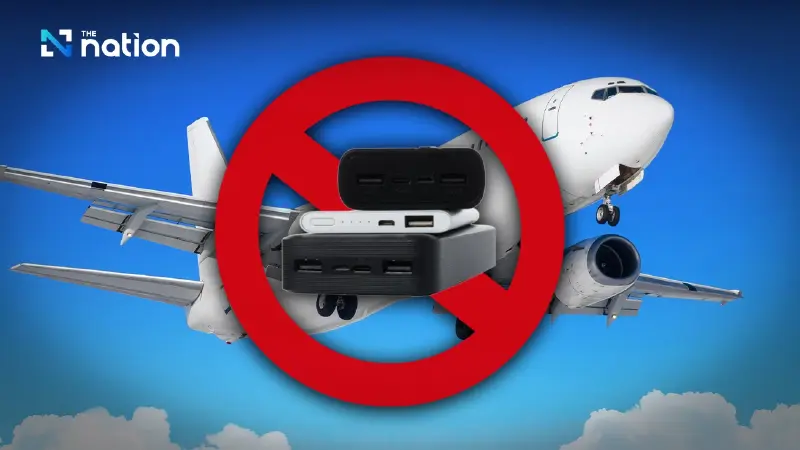


Passengers may carry power banks only in carry-on baggage under the new rules, which set capacity limits and ban use during flights.
- Power banks are restricted to carry-on baggage only and must be kept in an accessible place, such as a seat pocket, not in overhead compartments or checked luggage.
- The standard capacity limit is 100 Wh (20,000 mAh). Passengers need prior airline approval for power banks between 100-160 Wh, with a limit of two per person.
- During the flight, it is prohibited to use a power bank to charge any device or to charge the power bank itself from an aircraft power source.
- Power banks without a clearly stated energy rating or with uncheckable information are banned from being taken onto aircraft.
The Civil Aviation Authority of Thailand (CAAT) issued “Regulation of the Civil Aviation Authority of Thailand No. 122 on criteria, procedures and conditions for carrying lithium batteries on aircraft” on Thursday (June 4, 2026), to raise air transport safety measures and align with the Technical Instructions for the Safe Transport of Dangerous Goods by Air of the International Civil Aviation Organisation (ICAO).
CAAT issues new rules tightening controls on power banks on aircraft
The regulation’s main points set out guidelines for safely carrying spare lithium batteries, or power banks, on aircraft.
Power banks are commonly carried by passengers as backup power sources for portable electronic devices such as mobile phones, tablets and other electronic devices.
However, lithium batteries are currently classified as items that may pose safety risks in air transport.
If damaged, improperly stored or misused, they may overheat, emit smoke or catch fire.
CAAT has therefore raised safety measures for carrying power banks onto aircraft by setting clear criteria and conditions to allow passengers to travel safely and reduce risks that could affect passengers, crew and aircraft.
Past cases involving Thai and foreign airlines and onboard power bank fires
The global aviation industry has previously seen several incidents involving power banks and lithium batteries on aircraft, including an incident early in 2025 involving South Korea’s Air Busan, in which an aircraft preparing to fly to Hong Kong caught fire inside the cabin.
Preliminary investigation findings indicated that a power bank stored in an overhead baggage compartment may have been the cause of the incident.
The incident caused injuries, required all passengers and crew to be evacuated from the aircraft and left the aircraft severely damaged.
There was also a case involving India’s IndiGo, in which a power bank caught fire inside the cabin after the aircraft landed in Chandigarh.
This led to an emergency passenger evacuation and the suspension of the flight operation for safety checks.
Thailand has also experienced several similar cases.
One significant incident involved a Bangkok Airways flight on the Samui–Hong Kong route, when a passenger’s power bank overheated, producing smoke and catching fire during the flight, partially damaging the cabin floor.
As a result, the pilot had to divert and make an emergency landing in Bangkok for the safety of passengers and crew, while the cabin crew were able to bring the situation under control quickly.
Another case occurred on a Don Mueang–Nakhon Si Thammarat flight operated by Thai AirAsia, where the cabin crew were able to control the situation and deal with the incident in time.
Similar incidents have also occurred more frequently in several countries, causing some affected flights to divert, make emergency landings or suspend operations temporarily.
This reflects that risks from lithium batteries pose a significant threat to the safety of passengers, crew and the operation of the aviation system as a whole.
New rules for tighter control of power banks on aircraft
As a result, ICAO and aviation regulators in several countries have continued to tighten oversight of lithium batteries carried on aircraft.
Under the new CAAT regulation, passengers may take power banks on aircraft only as carry-on baggage.
They are strictly prohibited in checked baggage.
Power banks must also have an energy rating of no more than 100 Wh, or 20,000 mAh.
If they exceed 100 Wh but do not exceed 160 Wh, passengers must obtain airline approval before travel.
Each passenger may carry no more than two power banks.
The regulation also clearly states that power banks must not be charged from any power source on an aircraft, and must not be used to charge mobile phones or other electronic devices during a flight.
They must also not be stored in the overhead compartment.
They must be kept in a place where they can be easily reached or accessed, such as a seat pocket, the area under the seat in front, or carried on the person, so that action can be taken promptly if anything abnormal occurs, such as unusual overheating, smoke or a fire.
ACM Manat Chavanaprayoon, Director General of CAAT, said: “Lithium batteries and power banks are now devices widely carried by passengers during air travel. But if they are damaged, suffer an impact or are used improperly, they may overheat, emit smoke or catch fire, directly affecting flight safety. Clear measures and guidelines are therefore extremely important to proactively prevent risks and ensure maximum safety for passengers, crew and overall flight operations.”
The CAAT Director General added: “The regulation is not intended to impose restrictions on passengers, but to establish a safety standard in line with ICAO’s international guidelines and practices adopted by many countries around the world, so that air travel in Thailand is as safe as possible.”
The regulation also bans power banks that do not state their energy rating or whose information cannot be checked from being taken onto aircraft.
It also requires passengers to take measures to prevent short circuits, such as keeping them in their original packaging or separately in a protective pouch to prevent contact with metal materials or other batteries during travel.
CAAT asked passengers to check the rules on lithium batteries and power banks before every trip and strictly follow airlines’ safety measures for the safety of passengers, crew and the aviation system as a whole.
