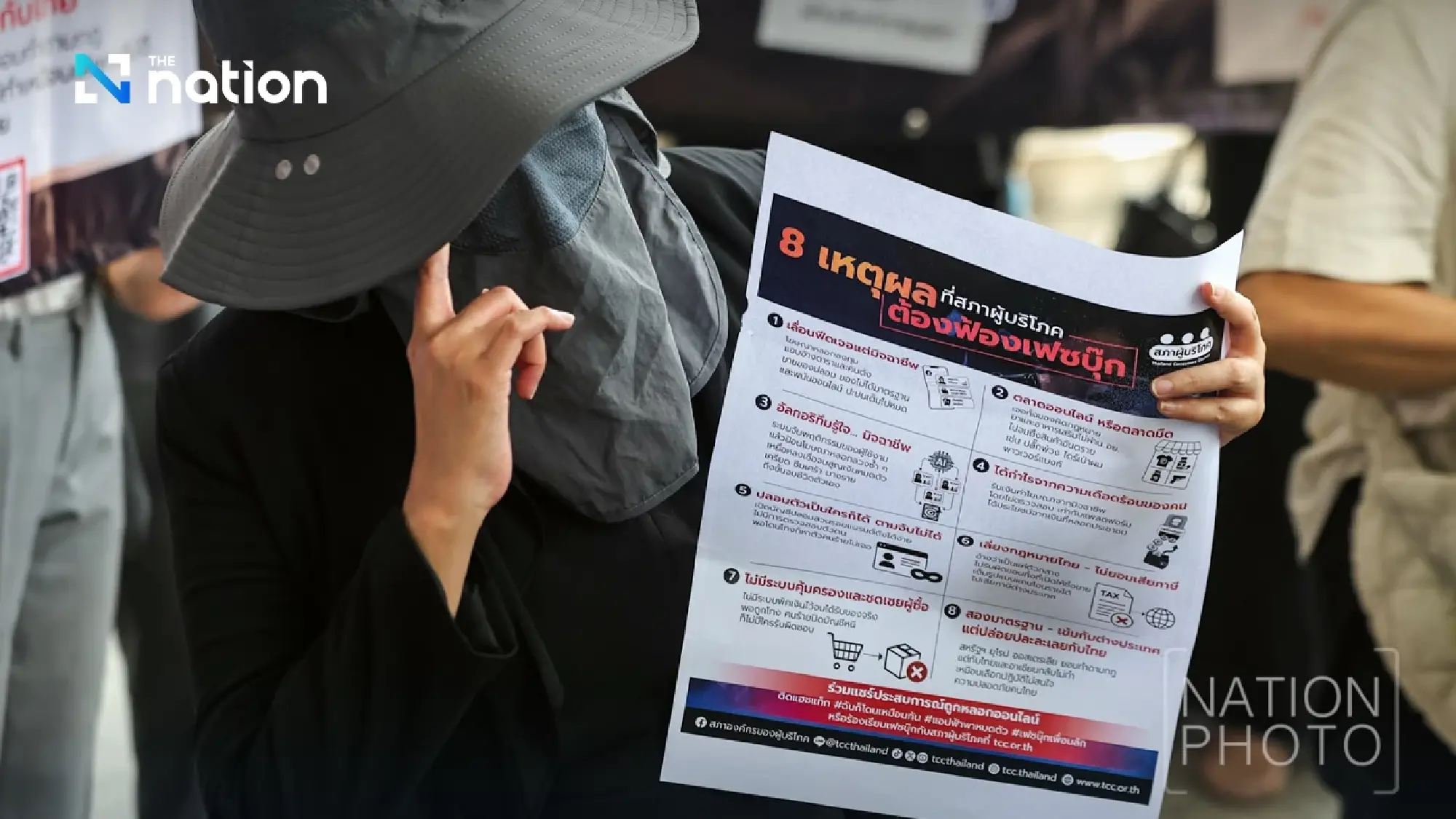
Thailand’s consumer council is suing Meta, LINE, Apple, Google and nine banks over online investment scams causing 230 million baht in losses
Thailand’s consumer watchdog has filed a landmark civil lawsuit against the parent companies of four major global technology platforms and nine financial institutions, seeking more than 230 million baht in compensation for victims of online investment scams.
The Thailand Consumers Council, together with lawyers and representatives of affected consumers, filed the case with the Civil Court on Ratchadaphisek Road on June 8, 2026.
The first group of claimants comprises 10 consumers who allegedly lost more than 230 million baht after being targeted by online investment fraud networks.
The Civil Court has scheduled the first case management hearing for August 3, 2026.
The lawsuit is being described as the first of its kind in Thailand to pursue liability against overseas parent companies that own and control major global digital platforms. The council said the case aims to establish a new benchmark for consumer protection and force major platforms to improve safety standards for Thai users.
Global platforms and banks named
The defendants are divided into two main groups.
The first group covers online platforms accused of violating consumer rights. The lawsuit targets the parent companies and related entities behind Meta’s Facebook, LINE, Apple’s App Store and Google’s Play Store.
The council said the case seeks to hold the foreign parent companies responsible because they control key systems, advertising policies and platform safety measures.
The second group comprises nine commercial banks and financial institutions linked to the flow of money from victims.
These include banks from which victims transferred funds and banks that allegedly received money through mule accounts, often involving juristic persons or companies used as fronts.
The lawsuit accuses the banks of failing to detect unusual transaction patterns or suspend suspicious transfers despite having legal duties to monitor financial risks.
Lawyers handling the case said fraudsters had used several digital systems together in what the council described as a full-cycle scam operation.
The alleged process began with scam advertisements on Facebook, often using the names or images of well-known people to build credibility and draw victims into LINE groups.
Victims were then persuaded to download fake investment applications through the App Store or Google Play, platforms many users believed were safe and properly screened.
The final stage involved transferring money through the banking system into mule accounts registered under front companies.
The council argues that the platforms had a duty to verify advertisers and users, as well as a duty of care to ensure digital safety, but failed to prevent repeated abuse of their systems by scammers.
Call for parent companies to take responsibility
Saree Ongsomwang, secretary-general of the Office of the Thailand Consumers Council, said global platforms should be held to both a duty to verify and a duty of care.
She said the council had chosen to sue the parent companies because they set policies and receive advertising revenue from the systems used by scammers.
Saree compared the situation to a large shopping mall allowing fraudsters to set up tables inside its premises to deceive visitors without accepting responsibility for the damage caused.
The council said the case was aimed not only at securing compensation for victims, but also at pushing major platforms to raise safety standards and accept responsibility for harm caused to Thai consumers.
Victims report heavy losses
Among the first group of 10 victims, one person allegedly lost as much as 165 million baht in a stock investment scam.
Another victim from Nong Bua Lamphu reportedly lost more than 3 million baht.
The council said fraudsters used sophisticated psychological techniques to win victims’ trust, including real stock-trading lessons before persuading them to invest larger sums.
Many victims said they had lost faith in state agencies, saying official processes had failed to provide practical remedies or meaningful compensation.
The Civil Court will consider the case at its first scheduled hearing on August 3, 2026.
The Thailand Consumers Council said it hoped the lawsuit would become a turning point in forcing digital platform operators to strengthen safety standards and share responsibility for damage suffered by Thai consumers.