
Thailand rejects Cambodia’s unilateral claim over Prasat Khana
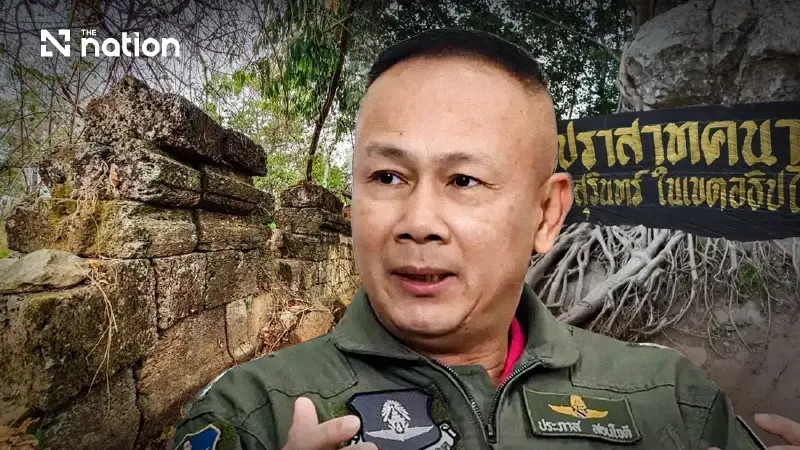


Thailand’s JIC rejects Cambodia’s Prasat Khana claim, insisting the Thai-Cambodian border row must be settled under international law and joint bilateral mechanisms.
- Thailand has officially rejected Cambodia's unilateral claim of sovereignty over the Prasat Khana temple area.
- Thai officials insist the disputed border's status must be settled jointly through bilateral mechanisms and international law, not by one-sided declarations or map interpretations.
- Thailand denied Cambodian allegations that its authorities had occupied the area or damaged the ancient site's staircase, demanding verifiable evidence for such claims.
Thailand has rejected Cambodia’s claim of sovereignty over Prasat Khana and denied allegations that Thai authorities damaged the ancient site, insisting that the disputed area along the Thai-Cambodian border remains a bilateral matter that must be settled jointly under international law.
The Joint Information Centre (JIC) on the Thailand-Cambodia Situation issued the response on Tuesday (June 30), stressing that the border area in question has yet to be jointly verified through agreed legal and bilateral mechanisms. The centre added that such an approach was necessary to prevent tensions and preserve good relations between the two countries.

Air Chief Marshal Prapas Sornchaidee, director of the JIC, responded to remarks by Cambodian officials in media interviews claiming that “Prasat Khana belongs 100% to Cambodia”. Cambodian officials also accused Thailand of occupying the area, altering the condition of the ancient site and damaging the staircase leading to the temple.
He rejected the claims as a unilateral position that could not be treated as a final conclusion under international law. Thailand does not accept any one-sided assertion of sovereignty over a disputed area, he stated, adding that unresolved boundary issues must be considered through bilateral mechanisms agreed by both countries.
Such consideration must be based on legally significant evidence, including treaties, historical documents and previous boundary-demarcation records, rather than public statements or the interpretation of maps by either side alone.

Prapas noted that maps alone could not determine sovereignty. Although Cambodia had claimed that Prasat Khana lies within Cambodian territory under both 1:200,000-scale and 1:50,000-scale maps, the JIC regarded this as a unilateral assertion.
Under international law, Thailand and Cambodia must still conduct joint surveys and boundary demarcation through bilateral mechanisms, meaning the status of sovereignty cannot be concluded from one-sided map interpretation, he added.

On Cambodia’s allegation that Thailand had burned or damaged the staircase leading to the temple, the JIC director stated that the claim must be proven with verifiable evidence. Thailand, he added, was ready for a fact-finding process based on clear evidence and could not accept conclusions drawn solely from one-sided allegations.
Addressing Cambodia’s allegation that Thailand had occupied the site, Prapas explained that Thailand’s security measures, area control and care of the ancient site were being carried out within territory that Thailand considers to be under its control.
He added that Thailand’s actions were consistent with the joint statements of both countries and rejected the accusation that Thailand had occupied Cambodian territory.

Prapas reiterated that Thailand remains committed to resolving Thai-Cambodian border issues through bilateral mechanisms, in line with international law and the joint statements of both countries.
He emphasised Thailand’s position on reducing tensions, avoiding provocation and refraining from the use of force, as well as avoiding any action that could escalate the situation.

“The Thai JIC calls on all parties to exercise caution in public communication, to rely primarily on facts and to avoid spreading information that could create misunderstanding or increase tensions,” Prapas stated.
“Thailand remains ready to act constructively on the basis of international law, good faith and good neighbourly relations in order to maintain lasting peace and stability along the Thai-Cambodian border,” he added.

