
Thai army evidence places border blast 50 metres inside Cambodia
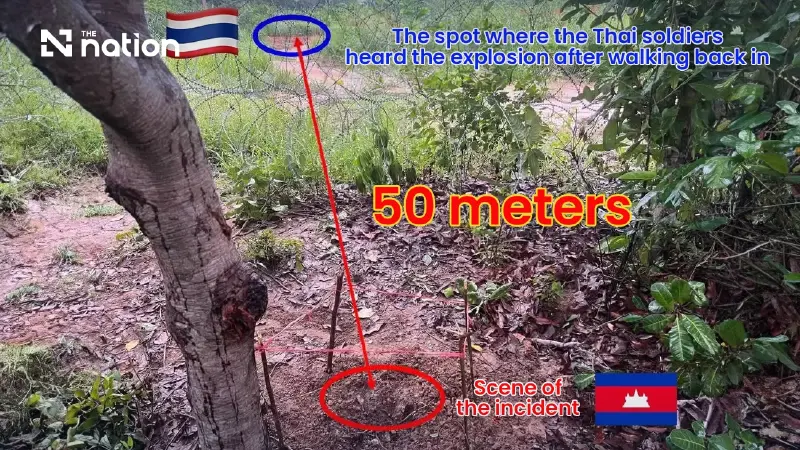


Thailand’s Second Army Region says evidence from a July 5 border blast points to an explosion on Cambodian-controlled territory
Thailand’s Second Army Region has said preliminary evidence indicates that an explosion which injured Cambodian soldiers near the Thai-Cambodian border on July 5 occurred inside Cambodian-controlled territory, not on the Thai side.
The clarification followed a public statement by Cambodia’s Defence Ministry spokesperson concerning the blast in Banteay Ampil district of Oddar Meanchey province, where four Cambodian soldiers were reported injured. Cambodia said it had launched an investigation into the incident, while Thai authorities have rejected Cambodian allegations that Thai soldiers were responsible.
According to the Second Army Region, Thai troops stationed in the area had earlier approached Cambodian personnel near a barbed-wire line to inform them that Thai units would be carrying out road work. The Thai side said the work was being conducted entirely within Thai territory and did not cross into Cambodian-controlled land.

The army said the exchange between troops from both sides was orderly, with no argument, threat or confrontation that could have led to the use of force. After the discussion, personnel from both sides returned to their respective areas.
Shortly after Thai soldiers began walking back towards their work site, an explosion was heard from an area under Cambodian control outside Thailand’s barbed-wire line, the Second Army Region said. It insisted that Thai forces had not used force or conducted any military action at the location of the blast.
Witness accounts gathered by Thai military units in the area were consistent with this sequence of events, according to the army. The head of the Thai security team said he was walking back towards the Thai deployment area, about 50 metres from the barbed-wire line, when he heard the explosion from the Cambodian side, followed by calls for help from Cambodian personnel.
The Second Army Region said it had also reviewed preliminary publicly available images of injured Cambodian soldiers. It said the visible injury pattern appeared more consistent with an explosion from the ground than with a thrown explosive device, although it stressed that this assessment was only preliminary and could not be treated as a forensic conclusion.
The Thai side said further verification by relevant authorities was still required before any final conclusion could be reached.
The army added that, because the blast site was located on the Cambodian side, several questions remained for investigators, including whether the incident involved an explosive device already present in the area or an accident related to the handling of explosives by Cambodian personnel.
Thailand’s Ministry of Foreign Affairs earlier rejected Cambodia’s allegation that Thai soldiers threw a hand grenade into a Cambodian position, saying the incident occurred on Cambodian territory and was not caused by Thai forces. The ministry said Thailand remained committed to restraint, transparency and accountability.
The Second Army Region said Thailand would continue to follow bilateral agreements and cooperation mechanisms with Cambodia, and stood ready to support fact-finding through official channels based on transparency, neutrality and verifiable evidence.
It also urged all parties to avoid speculation or accusations before the investigation is completed, saying public communication should be based on facts in order to preserve good relations, border stability and the confidence of the international community.
