
Power tariff held at 3.95 baht through year-end
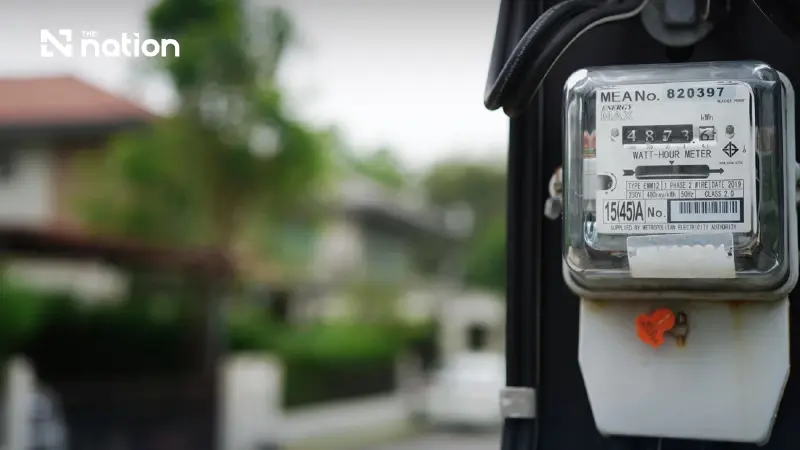


Thailand’s power tariff will stay at 3.95 baht per unit from September to December, backed by 16.1 billion baht in clawback funds
- Thailand's average electricity tariff will be held at 3.95 baht per unit for the final four-month billing period of the year, from September to December.
- The stable rate is achieved by using over 16.1 billion baht in "clawback funds" to subsidize the fuel tariff and prevent an increase due to rising energy costs.
- This decision was made by the Energy Regulatory Commission to ease the public's cost-of-living burden while balancing the financial stability of state energy enterprises.
Thailand’s average electricity tariff will remain at 3.95 baht per unit from September to December, after regulators approved the use of more than 16.1 billion baht in recovered excess benefits to limit the impact of rising energy costs on consumers.
The Energy Regulatory Commission approved a fuel tariff, or Ft, of 16.23 satang per unit for the final four-month billing period of 2026. When added to the base electricity rate of 3.78 baht per unit, the average tariff will remain at 3.95 baht per unit, excluding value-added tax.
Poonpat Leesombatpiboon, secretary-general of the Office of the Energy Regulatory Commission and spokesman for the commission, said the decision was reached after the regulator considered the outcome of its public consultation and reviewed the latest cost projections.
Clawback funds used to contain fuel tariff
The underlying estimate for fuel and purchased-power costs during the September-to-December period was calculated at 41.27 satang per unit after projected natural-gas prices were adjusted to reflect current conditions.
However, the Electricity Generating Authority of Thailand will continue carrying accumulated outstanding costs, known as the accumulated adjustment factor, totalling 31.268 billion baht on behalf of electricity users.
The regulator will also apply 16.12717 billion baht in clawback funds — equivalent to 25.04 satang per unit — to reduce the amount charged to consumers. This brings the collected Ft down to 16.23 satang per unit and keeps the overall tariff at 3.95 baht.
The commission said the measure was designed to balance the need for electricity prices to reflect actual energy costs with efforts to ease the public’s cost-of-living burden.
Using the clawback money would soften the impact of higher fuel costs and allow the average tariff to remain unchanged for another billing period, it explained. The regulator must nevertheless consider the long-term financial stability of state energy enterprises and the security of the electricity system.
Decision follows regulatory framework
The commission said its decision complied with Sections 65 and 67 of the Energy Industry Act of 2007, which require regulated service charges to reflect genuine costs and be determined transparently, fairly and in a manner that can be scrutinised.
Clause 34 of the commission’s 2021 electricity-tariff framework also allows clawback funds to be used, where appropriate, to reduce consumer charges, ease the effects of a crisis and support tariff stability in subsequent regulatory periods.
Public consultation draws seven comments
The regulator held an online consultation from July 13 to 20. Details of the proposed tariff options were viewed 445 times by 168 visitors, while seven comments were formally submitted.
Some respondents expressed concern over household expenses and urged the authorities to maintain the existing tariff. The commission considered the feedback alongside fuel-cost projections, outstanding financial obligations and the potential effects on electricity users.
LNG prices and geopolitical risks under watch
The commission will continue monitoring global energy prices, liquefied natural gas costs, foreign-exchange movements and geopolitical developments when calculating future electricity tariffs.
It said subsequent rates would need to reflect appropriate costs transparently and fairly while limiting the effect on consumers and preserving the security of Thailand’s energy system.
The regulator will formally notify the Metropolitan Electricity Authority and Provincial Electricity Authority so that the approved rate can be applied to bills covering September through December.
The Office of the Energy Regulatory Commission is also studying measures assigned to it following a National Energy Policy Council resolution on July 15. Details are being prepared with the relevant agencies before being submitted to the commission for further consideration and implementation.
