
Thai river groups protest, demanding Myanmar halt mines over pollution
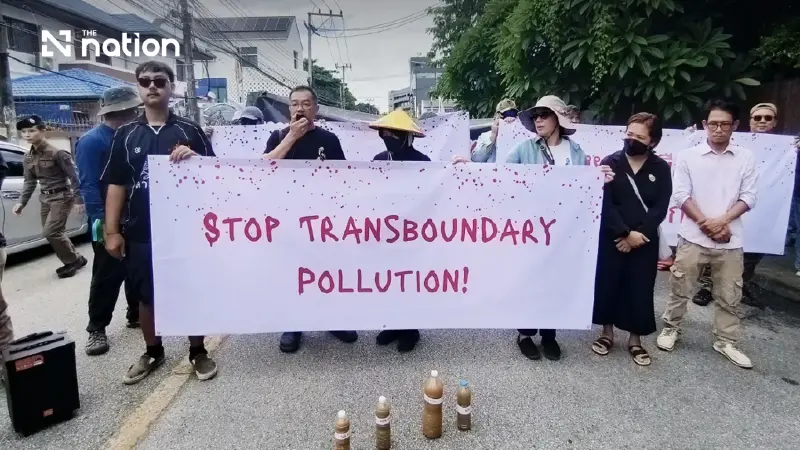


Protesters in Chiang Mai urged Myanmar to stop mining near shared waterways, alleging toxic contamination in the Kok, Sai, Ruak and Mekong rivers
- Thai environmental groups are demanding that Myanmar's military government halt mining operations alleged to be polluting the Kok, Sai, Ruak, and Mekong rivers.
- The campaigners claim the pollution involves toxic heavy metals, which are contaminating water used for farming and drinking, and harming local fishing and tourism industries in Thailand.
- Protesters submitted a petition to Myanmar's leader, noting that Myanmar has previously denied the mining allegations, a claim the groups say is contradicted by satellite imagery.
- The groups also urged the Thai government to suspend a joint water quality monitoring agreement with Myanmar and halt all mineral imports to increase pressure.
Environmental campaigners rallied outside the Myanmar Consulate in Chiang Mai on August 3, demanding that Myanmar’s military government halt mining operations they allege are contaminating the Kok, Sai, Ruak and Mekong rivers.

Members of the Network for the Protection of the Kok, Sai, Ruak and Mekong Rivers marched from Santitham Temple carrying bottles of water collected from the four waterways before gathering outside the consulate at about 10.30am.
Police officers in uniform and plain clothes were deployed around the building after authorities were informed of the planned demonstration.
Pol Col Sawek Choosiri, superintendent of Chang Phueak Police Station, later accepted the campaigners’ petition and water samples on behalf of the consulate for delivery through official channels.
Campaigners seek acknowledgement from Myanmar
Dr Suebsakul Kijnukul said the petition was addressed to Myanmar junta leader Min Aung Hlaing and called on the military government to acknowledge that mining operations were causing environmental problems affecting communities in Myanmar, Thailand and the wider Mekong basin.

He said recognition of the problem was necessary before the two countries could begin addressing its causes.
Suebsakul added that the campaign represented not only affected Thai communities but also people in Myanmar who were unable to express their views freely, including communities along the Salween River and in areas opposite Ranong and Kanchanaburi.
The network also referred to opposition in Kanchanaburi to a proposed fluoride-processing plant.
“We want Min Aung Hlaing to acknowledge that there is a problem and that mining is the cause,” Suebsakul said.
The campaigners also raised concerns about negotiations between the Thai and Myanmar governments over a proposed agreement to monitor water quality jointly.
Suebsakul alleged that Myanmar had rejected Thailand’s proposal to involve an ASEAN Mekong body in the monitoring process and that information gathered under the agreement could remain confidential.
He argued that such confidentiality would conflict with Thailand’s constitutional principles.

The network called on the Thai government to suspend the current terms of reference and focus on resolving the alleged pollution at its source.
It also urged Thailand to strengthen its bargaining position with Myanmar and China by suspending imports of all minerals.

Symbolic protest targets Thai and Myanmar leaders
During the rally, two male protesters wore masks depicting Prime Minister and Interior Minister Anutin Charnvirakul and Min Aung Hlaing.
Campaigners presented a petition and water samples to the person wearing Anutin’s mask, who then attempted to pass the bottles to the person portraying Min Aung Hlaing.
The two performers pushed the bottles back and forth, symbolising what the group described as both governments’ reluctance to accept responsibility for contaminated water.
Saengrawee Suweerakarn, vice-president of the Rom Pho Foundation, read a statement alleging that millions of Thai residents living near the Kok, Sai, Ruak and Mekong rivers were being affected by toxic substances flowing from mining sites in Myanmar.
The statement claimed that farmers in the Mekong basin had to use contaminated water for rice cultivation across at least 110,000 rai and that the crops were subsequently sold to consumers across Thailand.
It further alleged that fishers in 60 villages had lost income because consumers were unwilling to buy fish believed to contain lead, cadmium and mercury.
The group cited Health Ministry advice against eating prawns, shellfish and crabs from affected waterways, as well as warnings not to consume fish organs because of high concentrations of heavy metals.
Tourism operators along the Kok River were also losing income, the statement alleged.
Campaigners further claimed that at least 40,000 households, representing about 120,000 people in central Chiang Rai, had to consume tap water contaminated with heavy metals.

Myanmar denied mining allegations
The statement referred to a United Nations joint communication published on April 21 concerning alleged continuing environmental and human-rights violations resulting from mining and contamination in the Mekong subregion.
According to the campaigners, Myanmar responded on June 17 by denying allegations involving rare-earth and other mining and stating that no such operations were taking place along the Kok River in Myanmar.
The group argued that the response conflicted with satellite images.
The campaigners called on Myanmar’s military government to acknowledge the alleged impact of mining along the Kok, Sai and Ruak rivers, other Mekong tributaries and the section of the Mekong flowing through Myanmar.
They demanded an immediate suspension of all mining along the waterways until the contamination problem had been resolved.
