
Huai Kha Khaeng tiger poses extreme danger after hunting human, expert warns of copycat behaviour
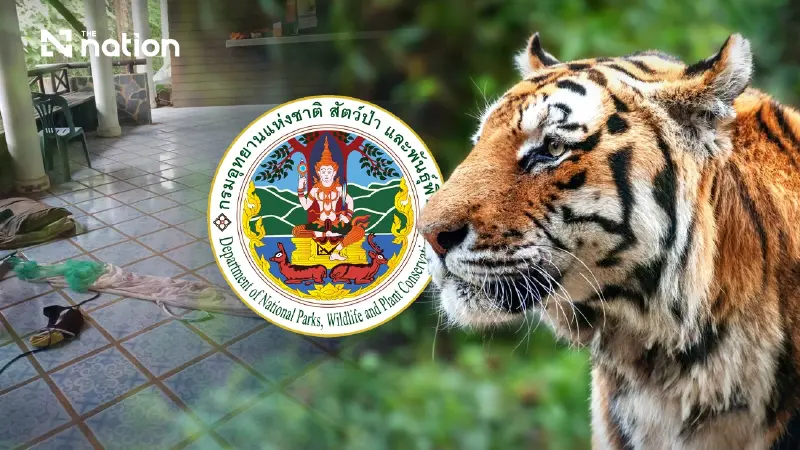


Thailand’s parks department says tiger DNA testing is not a hunt, as Chaiwat warns the Huai Kha Khaeng animal poses an extreme danger and urges action to prevent other tigers from copying the behaviour
- Thai wildlife authorities are capturing tigers to collect DNA samples following the death of a ranger at the Huai Kha Khaeng Wildlife Sanctuary.
- The operation's purpose is to identify the specific animal involved in the incident, not to hunt or kill the protected tigers.
- Experts state that a tiger hunting a human is highly abnormal behavior, making it crucial to identify the individual animal to prevent future attacks.
Thailand’s wildlife authorities are preparing to capture tigers near the site of a ranger’s death at Huai Kha Khaeng Wildlife Sanctuary for DNA testing, stressing that the operation is intended to identify the animal involved rather than hunt or kill tigers.
Sakarin Wichachan, a government employee at the wildlife sanctuary in Uthai Thani province, was killed while working near the Thap Salao stream on Wednesday (August 5).
Investigators found signs that a wild animal had moved the victim and fresh tiger tracks near the scene. The evidence prompted officials to investigate whether a tiger was responsible and, if so, identify the individual animal.
Atthapol Charoenchansa, director-general of the Department of National Parks, Wildlife and Plant Conservation, ordered teams to capture tigers around the sanctuary’s office area and compare their DNA with evidence from the scene.
Department says operation is not a hunt
The department said the capture-and-testing mission was not intended as a tiger hunt or a wider operation against the protected population.
Specialist researchers will carry out the work to determine what caused the fatal incident, identify the animal involved and reduce the risk of another attack.
Any tiger captured during the operation will be examined and have a DNA sample collected under the department’s wildlife-research procedures.
The department said the investigation must protect both people working or travelling inside the forest and the tigers living in the sanctuary.
Abnormal behaviour raises safety concerns
Chaiwat Limlikitaksorn, a former director of the Department of National Parks’ National Parks Office, said a tiger hunting and consuming a person would constitute highly abnormal behaviour.

He said identifying the individual tiger was necessary because the animal could present a serious danger to patrol officers, staff stationed at forest units, researchers, visitors and people living near protected areas.
Chaiwat supported the director-general’s order for urgent surveillance and DNA testing of tigers found near the scene.
He argued that officials should establish whether one tiger was responsible and monitor whether it attempted to approach or attack people again.
Chaiwat also expressed concern that repeated access to human prey could influence the behaviour of other tigers in the area. This was his assessment, and the department’s statement did not say that such behaviour had already spread.
Huai Kha Khaeng remains key tiger habitat
Huai Kha Khaeng is an important habitat for Thailand’s wild tiger population, where researchers use camera traps, identification codes and tracking equipment to monitor individual animals.
Earlier in 2026, officials temporarily closed part of the sanctuary after a female tiger gave birth near a visitor area, citing public safety and the need to avoid disturbing the animal.
The department has also previously captured, rehabilitated and released tigers in the Huai Kha Khaeng forest while using tracking collars to monitor their movements and protect nearby communities.
Officials have not yet announced how many tigers will be examined or when DNA comparison results are expected.
