
IF steel producers oppose proposed overhaul of rebar standards
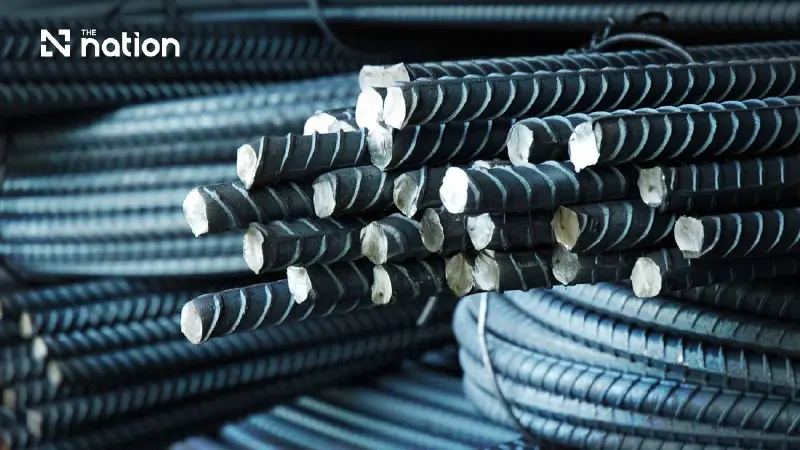


A proposed Thai standard would restrict structural deformed bars to BOF and EF production, prompting IF operators to warn of business losses and higher steel prices.
- Thailand's standards institute has proposed banning steel rebar made with induction furnaces (IF) from use in critical structural work, citing safety concerns.
- IF steel producers strongly oppose the new rule, arguing it is unfair to established businesses, that their products meet quality standards, and that the move is driven by commercial competition.
- Opponents warn that the ban would disrupt the supply chain, causing steel shortages and sharp price increases for the construction industry.
The Thai Industrial Standards Institute (TISI) has opened discussions on revised standards for steel reinforcing bars, proposing that deformed bars used in critical structural work be produced only through basic oxygen furnace or electric arc furnace processes.
The proposal, intended to improve construction safety, has drawn strong opposition from induction furnace operators, who argue that excluding their production method would be unfair, damage established businesses and potentially drive up steel prices.

TISI held a workshop on Monday to gather views from associations representing manufacturers of concrete reinforcing steel, deformed bars and round bars after the Industrial Product Standards Council approved a draft revision of the deformed-bar standard.
Under the proposed rules, deformed bars used in primary structural elements, including columns and beams in high-rise buildings, would have to be produced through a basic oxygen furnace (BOF) or electric arc furnace (EF).
Steel produced through an induction furnace (IF) would no longer be permitted for deformed bars used in critical load-bearing structures.
TISI said the restriction was intended to improve safety and strengthen quality control.

Proposed restriction remains under consultation
Atavit Suwanpakdee, a United Thai Nation Party list MP and former chairman of the advisory team to the industry minister, told the forum that the Industrial Product Standards Council had already approved the principle of limiting deformed-bar production to BOF and EF processes.
The decision would effectively exclude IF-produced steel from the deformed-bar category, he said.
However, the council’s resolution is only a step towards drafting a ministerial regulation. The proposal must first undergo a public consultation to determine whether the framework approved by the council is appropriate.
Atavit argued that standards should control the production process itself rather than rely solely on testing the finished steel.
He pointed to the limited number of officers responsible for steel inspections, saying that only five officials had handled such inspections nationwide during the 10 years from 2016 to 2026.
Under the routine inspection process, he claimed, samples were often cut and prepared in advance for examination, allowing products to continue passing inspections.

Following the collapse of the State Audit Office building, however, a larger special task force involving officers from several agencies conducted more intensive checks and found that numerous steel samples failed to meet the required standards, he said.
“I am therefore convinced that we cannot judge the quality of steel only from samples inspected by five officials,” Atavit said.
“The manufacturing process itself must be controlled, otherwise problems will continue.”
He supported the council’s decision to exclude IF production from the revised standard, but acknowledged that businesses still using induction furnaces would be affected and that the government would have to consider appropriate assistance.
Their views must be heard during the consultation process, he said, although public safety should remain the priority.
“Safety standards must come first because the public cannot afford to wait,” he added.
IF operators insist their steel meets Thai standards
Sakchai Thanabodijirapong, president of the Induction Furnace Metal Smelters Trade Association, rejected the proposal and insisted that steel manufactured through IF technology could comply with both existing and revised Thai Industrial Standards.
He said IF operators fully supported efforts to raise production standards and strengthen public confidence.
However, he argued that using the consultation forum to consider whether IF production should be abolished was unfair to businesses that had operated in the industry for almost two decades.
Sakchai said concerns raised over the past 10 years involved only two or three factories and should not be used to judge the entire sector.
“Our operators have been in business for almost 20 years. I have personally produced IF steel since 2004,” he said.
“Over that period, the industry has supplied tens of millions of tonnes of steel to the market. Had there been a widespread problem, it would have emerged long ago rather than only now.”
He described the controversy as being driven more by politics and commercial competition than by the production method itself, and called on the media and the public to recognise that IF manufacturers believed they were being treated unfairly.

Operators warn of shortages and higher prices
Amorn Uengsomboon, vice-president of the association, warned that eliminating IF production would require a major technological transition with consequences extending beyond manufacturers.
Contractors, property developers and other steel users could face immediate supply difficulties, he said.
“The most heavily affected group will be steel users. Where will they obtain the steel they need?” Amorn asked.
“Contractors and developers have already made plans based on the existing supply. If that supply disappears, prices are likely to rise sharply.”
He questioned whether the authorities would compensate both manufacturers forced to discontinue IF production and customers affected by higher costs or shortages.
Sakchai said businesses in the IF sector were worth tens of billions of baht, while the wider market value connected with their operations amounted to hundreds of billions of baht.
“If TISI intends to use taxpayers’ money to provide compensation, where will that funding come from?” he said.
The debate leaves regulators facing a difficult balance between strengthening structural safety and avoiding disproportionate disruption to manufacturers and steel users.
The proposed revision has not yet taken effect, and the final conditions will depend on the consultation process and the subsequent drafting of a Ministry of Industry regulation.
