
Queen Mother’s royal initiative lifts highland livelihoods


Her Majesty Queen Sirikit The Queen Mother’s Doi Monlan initiative has raised highland incomes, restored forests and expanded domestic and overseas market access.
- A royal initiative by Queen Sirikit The Queen Mother has helped highland communities in Chiang Mai transition from opium cultivation to sustainable, high-value agriculture.
- The project introduced crops like coffee, tea, and temperate fruits, which has significantly boosted average annual household incomes and improved food security.
- Alongside economic improvements, the initiative has led to the restoration of vital watershed forests, improving water supplies and conserving local wildlife.
- The creation of viable livelihoods has successfully reduced drug-related problems and provided opportunities that encourage younger generations to remain in their communities.
On the cool highlands of Doi Monlan in Chiang Mai’s Prao district, coffee now grows beneath shade trees, terraced rice fields provide food for local families and high-value crops offer farmers a source of income without putting further pressure on the surrounding forest.
The transformation reflects more than two decades of work at the Doi Monlan Highland Agricultural Development Station, established under the royal initiative of Her Majesty Queen Sirikit The Queen Mother.
Its progress is also part of a much longer effort that began in Chiang Mai in 1989, when Her Majesty’s royal initiatives sought to improve the quality of life of highland communities while protecting forests, watersheds and other natural resources on which they depended.
The first such royal initiative in Chiang Mai was established in Omkoi district in 1989. The approach subsequently expanded across watershed and forest areas of the province, eventually giving rise to different forms of development projects, including eight Highland Agricultural Development Stations.
At the time, narcotics posed a serious problem in parts of the highlands, while remote mountain areas also lay along drug-trafficking routes and were sometimes used as transit or resting points.
The Queen Mother recognised that lasting solutions would require communities to have viable alternatives.
The Highland Agricultural Development Stations were therefore conceived not only to distance villagers from narcotics but also to introduce new occupations, strengthen household incomes and improve living conditions while conserving the surrounding environment.

A royal initiative rooted in people and forests
The Doi Monlan Highland Agricultural Development Station in Prao district was established in 2004 after the Queen Mother observed the conditions faced by long-established Akha communities in the area.
Many families had depended on shifting cultivation and opium growing for their livelihoods. This contributed to the degradation of important watershed forests feeding the Mae Ngat River, part of the upper Ping River basin, leaving stretches of mountain denuded.
The loss of forest cover also affected water supplies to the Mae Ngat Somboon Chon Dam, with consequences extending beyond the highlands to communities elsewhere in Chiang Mai. Poverty, inadequate sanitation and the departure of working-age residents seeking jobs in urban areas compounded the challenges facing local villages.
Covering 97,500 rai, or about 15,600 hectares, the project area lies at an elevation of around 1,696 metres above sea level, where the climate is cool and access historically depended on unpaved roads.
Under the royal initiative, the station was given a broad mission. Forests were to be replanted to protect watersheds and revive streams, using local tree species where possible. Rare and endangered plants were to be propagated, while experimental work included sheep farming and the breeding of silver pheasants and mountain peacock-pheasants.
The area was also to be developed as a destination for nature- and culture-based tourism.
At the heart of the programme was the restoration of degraded watershed forests alongside the transfer of appropriate agricultural knowledge to ethnic communities. Farmers were encouraged to move away from shifting cultivation and towards commercial crops suited to high elevations.
Composting, reduced use of chemicals and soil and water conservation were promoted alongside measures intended to raise living standards.

Higher-value farming reshapes household incomes
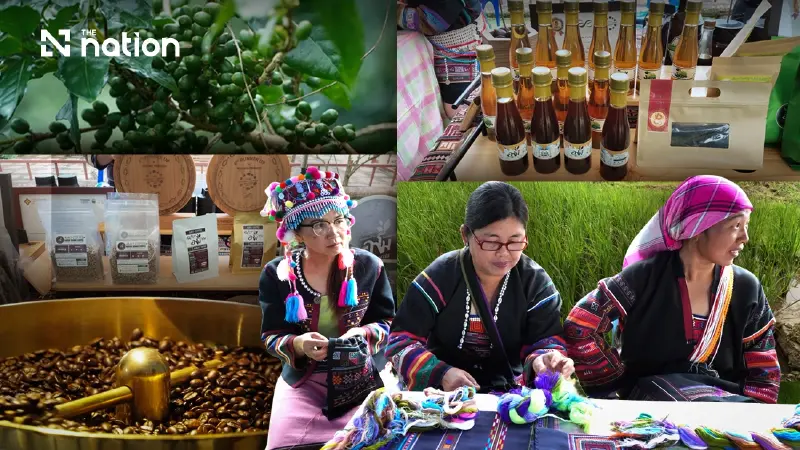
The results are now increasingly visible. Agriculture remains the principal source of income, but the crops have changed. Families now grow coffee, plums, persimmons, mulberries and temperate-climate vegetables, while supplementary income comes from arts and crafts and work commissioned by government agencies.
RDPB data for 2020 showed that average household income had risen from about THB5,000 per family per year before the project to THB120,000 per family per year.
Figures for 2023 covering three villages and 97 households recorded combined annual agricultural income of THB6.89 million. Coffee generated THB5.14 million, making it the leading source of farm income, while temperate fruits including plums and peaches brought in THB148,200 and tea generated THB84,000.

Food security has improved alongside cash income. By 2021, the 97 households were cultivating a combined 295 rai, or 47.2 hectares, of terraced rice fields, helping ensure that families had rice to eat throughout the year.
Land security has also improved. Forty-six households were able to purchase legally documented farmland in the Prao district area covering a combined 24 rai and two ngan, or about 3.92 hectares.
Education opportunities for local residents have also been developed as part of efforts to improve quality of life more broadly.

Income rises as the watershed recovers
Economic gains have been accompanied by efforts to restore the natural resources that sustain the highlands. Government agencies and other organisations working in the watershed have coordinated conservation, rehabilitation and measures to tackle forest fires and haze.
A total of 4,950 rai, or about 792 hectares, of watershed forest has recovered, with natural regeneration helping the forest recover further.
Surveys have recorded wildlife including barking deer, wild boar, Asian palm civets, junglefowl, peafowl and several groups of snakes. Large native trees found in the area include banyan, olive, Java plum, Burmese rosewood and several other forest species.
Water is another measure of the recovery. Even during the dry season from December to April, runoff continues to flow steadily. A catchment area of 60.77 square kilometres is capable of producing an estimated 22.08 million cubic metres of water a year.

The landscape itself has also become an economic asset. Doi Monlan’s mountain terrain and natural surroundings have made it suitable for ecotourism, educational visits focused on forest conservation and royal development initiatives, as well as cultural tourism centred on the traditions and way of life of highland communities.
Individual farmers show how the environmental and economic objectives can work together.
Supoj Muenlaeku, for example, grows coffee beneath shade trees under the “A Kha Abuza Coffee” brand. The farming model allows coffee production to generate income while helping maintain the surrounding forest ecosystem.
Another model farmer, Wanchai Muenlaeku, combines productive terraced rice farming with fruit trees in an integrated agroforestry system. Water from a mountain supply system is managed alongside the farm so that limited highland land can be used efficiently.

Creating reasons for a new generation to stay
Suporn Treenarin, secretary-general of the RDPB, noted that more than 20 years after the Doi Monlan station was established, one of the clearest changes was the improvement in local people’s quality of life.
Drug-related problems had fallen sharply and were now virtually absent in the community, she explained, linking the change to the creation of viable livelihoods based on higher-value agriculture.
Coffee, tea and other crops suited to the highlands have given families alternatives that can generate stable income without exposing them to the risks associated with narcotics.

The change is also visible in the way produce reaches the market. Farmers no longer necessarily have to leave their villages to find buyers. Traders can purchase produce directly from the community, while local products have gained wider access to domestic and overseas markets.
Coffee and tea have emerged as particularly visible products, alongside a range of highland crops. At the same time, Doi Monlan has developed another source of opportunity through nature-based and cultural tourism, with visitors able to experience the landscape and learn about Akha traditions.
The next phase will place greater emphasis on listening directly to communities.
The RDPB is working with the Ministry of Interior, the Ministry of Agriculture and Cooperatives, the Ministry of Natural Resources and Environment and other agencies to identify villagers’ needs and problems before drawing up integrated development plans.
Rather than deciding in advance what communities should receive, Suporn explained that agencies want future measures to respond more precisely to what residents themselves identify as their priorities.

Another objective is to encourage younger generations to return home.
Highland communities once frequently saw working-age adults leave for employment elsewhere, leaving older people and children behind. Better opportunities to earn a living locally are beginning to reverse that trend, with some younger people recognising that their home communities can also provide viable economic opportunities.
“The heart of highland development is enabling people to have occupations and incomes while conserving natural resources,” Suporn said.
“When people have suitable livelihood choices, forest encroachment declines and communities can live alongside the forest in a mutually supportive way. This leads to the protection of watershed forests and water sources, creating security for both people and the environment and supporting sustainable development.”

The achievement at Doi Monlan is therefore measured by more than agricultural output or farmers’ earnings. It reflects a model in which people, forests and water develop together.
As households gain suitable and sustainable livelihoods, their dependence on exploiting forests can decline. In turn, restoring watershed forests protects water supplies and ecosystems on which agriculture and communities depend.
More than two decades after the station was established, the royal initiative has created a cycle in which stronger local economies support conservation, while healthier natural resources sustain communities — reinforcing long-term economic security, quality of life and environmental resilience, while giving Doi Monlan a growing role as an ecotourism destination in Chiang Mai.
