
China Railway director gets 3 years in SAO building nominee case


Four men received prison terms over a State Audit Office contractor’s nominee arrangement, while the separate construction trial continues.
- Chuanling Zhang, the Chinese director of China Railway Number 10 (Thailand), was sentenced to three years in prison and fined THB1 million for offences under the Foreign Business Act.
- The conviction stemmed from the company's illegal use of Thai nominee shareholders to operate in the restricted construction sector without the required permission.
- The company was part of the joint venture constructing the State Audit Office (SAO) building that collapsed, prompting the investigation into its business practices.
- Three Thai nationals who acted as nominee shareholders and directors for the company also received prison sentences and fines for their roles.
Bangkok’s Criminal Court sentenced China Railway Number 10 (Thailand) Co Ltd’s Chinese director, Chuanling Zhang, to three years in prison and fined him THB1 million on November 18, 2026, for Foreign Business Act offences involving Thai nominee shareholders.
Zhang was convicted under Sections 41 and 47 of the Foreign Business Act 1999. The court also imposed prison terms and fines on three Thai shareholders, fined the company THB1 million and ordered it to cease business operations.
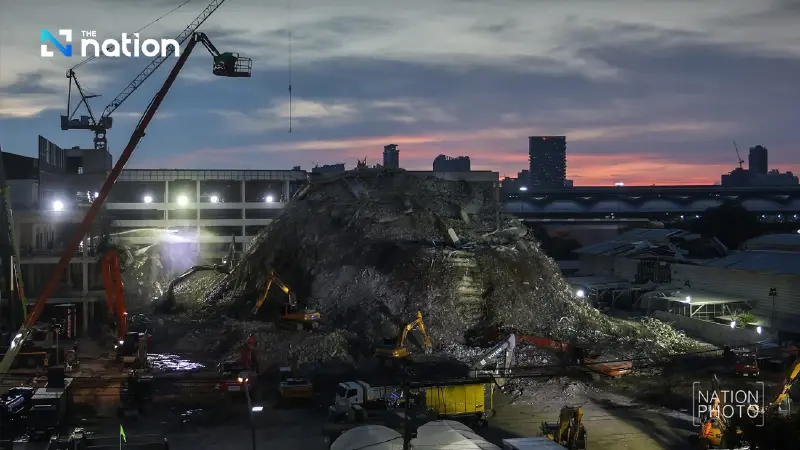
The company was a partner in the joint venture constructing the new 33-storey State Audit Office (SAO) building, which collapsed on the afternoon of March 28, 2025, killing and injuring many people.
Prosecutors from Special Cases Division 5 brought criminal case No. Or Ang.1558/2568, naming the company as the first defendant and Zhang as the second. The verdict was delivered at the Criminal Court on Ratchadaphisek Road.
Thai nominees receive prison terms and fines
Thai directors and shareholders Sophon Meechai and Manat Sri-Anan, the third and fifth defendants, were each sentenced to four years, nine months and 18 days in prison and fined THB1.6 million.
Sophon and Manat were convicted under Sections 36 and 41 for nominee shareholding and acting as company directors on behalf of foreign interests. The court initially imposed three years in prison and a THB1 million fine for each offence, giving each man a combined six-year term and THB2 million fine before a one-fifth reduction for his guilty plea.
Thai shareholder Prajuab Sirikhet, the fourth defendant, received two years, four months and 24 days in prison and a THB800,000 fine under Section 36 for nominee shareholding. His initial three-year term and THB1 million fine were also reduced by one-fifth following his guilty plea.
Prajuab’s sentence will run consecutively to a three-year term imposed by the Central Criminal Court for Corruption and Misconduct Cases in a separate case involving false registration of paternity.
The court also ordered Sophon, Prajuab and Manat to stop assisting China Railway Number 10 (Thailand) and end their shareholdings in the company.
Court rejects denial of construction work
The court rejected China Railway Number 10 (Thailand)’s claim, made after the SAO building collapsed, that it had not undertaken construction work.
The company’s registered objectives included constructing buildings, drainage systems, railways, bridges, tramways, electric rail systems and underground railways, as well as providing construction tender consultancy. The court found that construction had been a company objective from the outset and that the firm had consistently carried out such work.
Evidence from the Department of Special Investigation (DSI) showed that the Thai shareholders held shares on behalf of foreign interests. The court found that an overseas China Railway Number 10 company owned the Thai firm, making it a foreign business operating restricted construction activities without the required permission under List Three (10) of the Act.
The court accepted that China Railway Number 10 (Thailand) had registered capital of THB100 million and that Zhang had served as an executive director since October 2018.

Zhang alone was authorised to act for the company, signing construction contracts, certifying financial statements and executing the joint-venture agreement with Italian-Thai Development. Zhang exercised that authority throughout the construction period before the building collapsed and was arrested on April 19, 2025.
Years of law evasion weigh on sentencing
China Railway Number 10 (Thailand) had circumvented the law while bidding for government construction projects over several years, the court found. The three Thai defendants had used their nationality to facilitate the offences and prioritised personal interests.
The Criminal Court considered the arrangements dishonest and unfair to lawful Thai businesses, finding that tolerating such conduct would harm the country and its construction industry. The court considered substantial punishment necessary to demonstrate that such conduct was unacceptable.
In assessing mitigation, the court noted the individual defendants’ lack of previous offending but held that their prolonged conduct over several years could not support treating them as previously of good character.
Zhang had paid compensation to bereaved families and people injured in the building collapse, but the court found that the payments did not offset the losses suffered and were not grounds for reducing his sentence.
All defendants initially denied the charges, and the individual defendants had been granted bail. Sophon, Prajuab and Manat changed their pleas during evidence hearings, while the company and Zhang maintained their denials.
The Criminal Court considered the Thai defendants’ guilty pleas an attempt to obtain leniency after incriminating prosecution evidence had been presented. The court had also commissioned probation reports on the defendants’ backgrounds and conduct before sentencing, and all four individuals attended the verdict hearing.
Separate construction trial continues
The nominee verdict is separate from the main criminal case concerning construction of the SAO building.
In that case, prosecutors from Criminal Division 8 have charged Premchai Karnasuta, former president of Italian-Thai Development Plc, and other defendants. The Criminal Court is continuing to hear witness testimony.
