
6 countries agree to combat “scammers”; “Big Kong” introduces 3 urgent measures
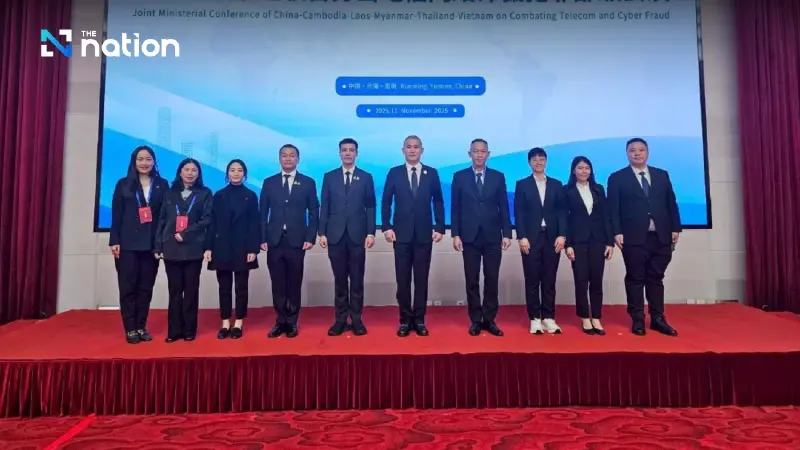


6 countries have reached a consensus to combat online scammers, with “Big Kong” introducing 3 urgent measures. Thailand has also positioned itself as a central coordinating body, demonstrating its sincerity in combating scams and taking a leadership role in the region.

November 14, 2025, in Kunming, Yunnan Province, China, a ministerial-level meeting was held to discuss cooperation in combatting telecommunications and online fraud. The meeting was attended by representatives from 6 countries: China, Cambodia, Laos, Myanmar, Thailand, and Vietnam. The session focused on transnational scams and online telecommunications fraud, which are causing significant harm to the economy, social security, and the rights of people in all affected countries. The meeting concluded with a consensus to strengthen operational cooperation moving forward.
The Thai delegation included Pol Lt Gen Jiraphop Bhuridej, Assistant Commissioner-General of the Royal Thai Police, and Pol Maj Gen Theerachai Chamnanmor, Deputy Commissioner of the Police Special Branch, alongside representatives from the Thai Consulate and the Police Technical and Scientific Division.
During the meeting, Pol Lt Gen Jiraphop presented Thailand’s position, emphasising that the “scam centres” in the Mekong River region are not just technological crimes but transnational crime networks harming citizens in all countries involved. He stressed that Thailand, which has been directly affected, does not deny its own responsibility and will act swiftly and decisively. He called for all countries involved to ensure that these operations are transparent and that information can be freely shared for the benefit of all.

Pol Lt Gen Jiraphop presented findings from the Anti-Cyber Scam Center (ACSC), which integrates data from banks, telecommunications providers, and technical intelligence agencies. The investigation revealed that money laundering through mule accounts mostly transfers funds to neighbouring countries. IP addresses and technical signals also point to areas outside Thailand.
Additionally, technical facts were presented, showing that many scam centres are located near borders or within certain economic zones of regional countries. Thailand has officially shared this information with the concerned nations. Pol Lt Gen Jiraphop called for genuine cooperation from all parties to combat these operations.
3 urgent regional measures proposed
Pol Lt Gen Jiraphop introduced 3 urgent measures:
- Real-time data exchange system: Creating a central database of mule accounts, phone numbers, and IPs linked to fraud crimes, and implementing an automated alert system to allow countries to block, freeze, and investigate simultaneously.
- Cyber Liaison Officers: Appointing Cyber Liaison Officers in each country, with law enforcement officials stationed in key operational hubs. These officers will serve as direct contacts, enabling quick information sharing and joint operations within 24 hours.
- Tighter telecommunications control measures: Implementing stricter SIM card registration processes with identity verification (including Face Recognition), limiting the number of SIM cards per person, and tracking suspicious SIM cards. In cases of widespread fraudulent use of signals, countries will work together to temporarily suspend signals until investigations are completed.
Example of successful collaboration
These measures align with previous operational agreements between Thailand and Cambodia to tackle cyber scams at the border. Thailand has been actively cutting off suspicious phone signals, freezing bank accounts, tracking financial trails, and supporting victims. Pol Lt Gen Jiraphop confirmed Thailand’s willingness to exchange in-depth data with cooperating countries, especially China, which has been a key partner in many cases.
“Thailand will not allow scam centres to operate within its borders. Every lead we receive will be acted upon decisively without exception. Crimes have no borders, and therefore, the fight against them must also have no borders.”
He emphasised Thailand’s commitment to transnational cooperation in eliminating scam operations, ensuring real partnerships with countries in the Mekong-Lancang Cooperation (MLC) region. Thailand remains ready to lead and strengthen the role of the ACSC as a regional coordinating body for data exchange and joint operations.
Pol Lt Gen Jiraphop also shared an example from the Thailand-Myanmar border, where 1,598 scammers from 28 nationalities were arrested. Thailand is working to quickly separate victims from criminals and send them back to their home countries.
ASEAN collaboration and next steps
The 6 countries’ ministers concluded with 21 key cooperation points, including:
1. Joint operations to dismantle "scam centres", gambling zones, and fraud networks with a comprehensive approach. Thailand has presented successful examples to be used as models.
2. Joint operations to crack down on gambling hubs and fraud centres
Thailand is ready to send law enforcement officers to participate in operations in every country, urging the exchange of evidence to ensure cross-border investigations proceed without limitations.
3. Joint arrests and coordinated investigations
Countries will work together to investigate, gather evidence, and exchange criminal evidence systematically (full transfer of criminal evidence).
4. Repatriation/extradition of suspects
Suspects should be repatriated to their home countries to prevent transnational criminals from evading justice by living freely in another country.
5. Seizing, freezing, and tracking assets
Track and seize assets related to criminal cases and return them to the victims or relevant countries.
6. Establishing official 6-nation meetings
Regular ministerial-level and department/agency-level meetings will be held to discuss progress and cooperation.
7. Establishing a "6-nation Ministerial Mechanism to Combat Telecommunications and Online Fraud"
8. Annual rotating meetings hosted by each country
Countries will take turns hosting meetings to report progress, identify obstacles, and jointly determine future action plans.
9. Working-level meetings under the Ministerial Framework
Regular working-level meetings will translate policy decisions into practical actions and ensure effective follow-up.
10. Developing cross-border case coordination and intelligence sharing systems
11. Creating and improving platforms for intelligence sharing
This includes platforms for call centres, websites/apps, money mule accounts, and cryptocurrency exchanges.
12. Setting joint standards for digital investigations
Standards for data logs and digital evidence that can be used in each country’s judicial process.
13. Supporting the tracking of financial and data flows
Ensuring that cross-border cases are treated as “one case” to expand the investigation.
14. Expanding cooperation with international organisations, civil society, and tech companies
15. Continuously supporting regional joint operations
Countries will continue to work together in operations focused on tackling scams.
16. Exchanging case studies and regulatory approaches for platforms, telecom providers, payment systems, and crypto exchanges
17. Inviting NGOs and tech companies to cooperate
In areas such as data sharing, alert systems, website/number/account blocking, legal research, technology development, and training (AI, Big Data, OSINT, Blockchain Analytics, etc.). Campaigns will be organised in multiple languages to prevent victims across borders.
18. Confirming the joint strategic framework under the Mekong-Lancang Cooperation (MLC) and rule of law
This framework will guide all cooperation efforts.
19. Each country will fully utilise its domestic laws to combat scam centres within its own borders and ensure there are no “Safe Havens” for scam operations in the region.
20. Following the Global Security Initiative, Global Governance Initiative, and MLC framework
Countries will operate within these global frameworks to ensure security and governance standards.
21. Emphasising transparency, rule of law, and mutual benefit
All cooperation projects will be based on transparency, rule of law, and mutual benefit.
At the same time, Liu Zhongyi, Assistant Minister of Public Security of the People's Republic of China, praised Thailand for its measures and sincere clarity in tackling scammers. The meeting also reviewed joint operations, such as the China-Myanmar-Thailand trilateral mechanism to combat gambling and scams in Myanmar’s border areas, the China-Laos joint operation in the Golden Triangle Special Economic Zone, and the China-Cambodia-Vietnam cooperation in arresting and extraditing scam suspects. This reflects that the newly announced cooperation framework builds on the real operational successes already achieved.
Pol Lt Gen Jiraphop concluded by stating that Thailand proposes to attack the root cause — ensuring that no country provides a safe haven for scam gangs. Countries with operational bases on their own territory must take responsibility for vigorous action against these groups. Allowing scam centres to exist is akin to “providing shelter to criminals,” which goes against the rule of law and true friendly relations between countries.
He also proposed the establishment of a Joint Task Force that uses real-time data from the ACSC. Thailand suggests setting up a special international task force to dismantle scam centres on the ground, using ACSC’s real-time information exchange system, aiming to respond to key leads within 24 hours.
Furthermore, transparency and accountability mechanisms should be established. Every case involving cross-border intelligence sharing should be followed up with regular updates to the affected countries. He also proposed setting up a joint working group to monitor and ensure that cooperation is being carried out effectively, ensuring all parties are confident in the commitment to tackling scams.

