
Thai FM Challenges Cambodia, Draws Line on Gaza War
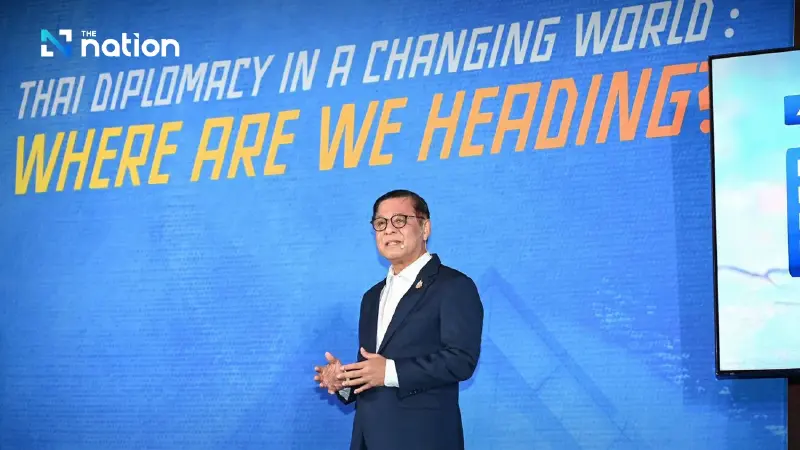


Thailand's new foreign minister raises concerns over Cambodia's negotiating conduct and reaffirms Bangkok's principled opposition to the Gaza war as he unveils a more assertive diplomatic doctrine
- Thailand's new Foreign Minister, Sihasak Phuangketkeow, has challenged Cambodia's negotiating conduct, accusing it of lacking "earnest effort" and using pressure tactics like unilaterally announcing a border meeting.
- The minister has drawn a clear line on the Gaza war, stating Thailand's principled opposition to the conflict and that it "should not have happened in the first place."
- Despite opposing the war, Thailand is refraining from publicly condemning either side in order to protect its nationals in the region and maintain its status as a non-belligerent party.
- These positions are part of a new, more assertive and "forward-looking" foreign policy doctrine being introduced by the minister.
Thailand's new foreign minister raises concerns over Cambodia's negotiating conduct and reaffirms Bangkok's principled opposition to the Gaza war as he unveils a more assertive diplomatic doctrine.
Thailand's new Deputy Prime Minister and Foreign Affairs Minister Sihasak Phuangketkeow has raised serious concerns over Cambodia's conduct in bilateral negotiations and reaffirmed Bangkok's principled opposition to the war in Gaza, using his first formal press conference to signal a sharper, more forward-looking foreign policy than his predecessors.
On Cambodia, Sihasak was candid, saying he had seen no "earnest effort" from Phnom Penh to genuinely improve relations despite Thailand's overtures.
He singled out Cambodia's recent unilateral announcement of dates for a Joint Boundary Commission meeting — without prior consultation with Bangkok — as a deliberate pressure tactic.
"All of a sudden, Cambodia proposes these dates and puts it out to the press. What is this? It is an attempt to pressure Thailand into appearing as though it does not want to negotiate," he said.
On the Middle East, he was equally direct, describing Thailand's position as unambiguous even as Bangkok refrains from publicly condemning either party.
"What I have stated all along is clear — we do not support this war. It should not have happened in the first place," he said, adding that Thailand's calculus was guided by a need to protect its nationals in the region and to remain a non-belligerent party.
The foreign ministry has maintained a round-the-clock war room since the crisis began.
The remarks came as Sihasak laid out a sweeping four-pillar vision for Thai foreign policy — built on strategy, speed, coherence and communication — at a time of mounting global uncertainty and domestic political flux.

Middle East: 'Not too much, not too little — just right'
On the conflict in the Middle East, Sihasak said Thailand was monitoring the situation around the clock and had established a war room from the very first day of the crisis to track developments and assist Thai nationals in danger zones.
But it was his description of Thailand's diplomatic posture that drew the sharpest attention. Characterising Bangkok's approach as calibrated and principled, he was measured about the country's refusal to be drawn into taking sides.
"We have to know where our interests lie. We must not be too much, and we must not be too little — we must be just right," he said.
Thailand opposes the war, he said, and never believed it should have started. Yet Bangkok has been careful not to publicly condemn any single party, citing the need to protect Thai nationals in the region and to uphold its position as a non-belligerent.
"What I have stated all along is clear — we do not support this war," he said. "It should not have happened in the first place."
Cambodia: A new page, but goodwill must flow both ways
Relations with Cambodia, another persistent headache for Bangkok, received candid treatment. Sihasak said Thailand had extended an offer to "turn a new page" in the bilateral relationship but expressed concern that the gesture had not been reciprocated in kind.
"I have not yet seen an earnest effort from their side," he said. "I see that they are still trying to seek unilateral advantage and trying to pressure Thailand in negotiations."
As a pointed example, he cited Cambodia's recent unilateral announcement of dates — 17 to 25 — for a meeting of the Joint Boundary Commission (JBC) without prior consultation with Bangkok.
"All of a sudden, Cambodia proposes these dates and puts it out to the press. What is this? It is an attempt to pressure Thailand into appearing as though it does not want to negotiate," he said.
On the contentious MOU 44 — the memorandum of understanding governing overlapping maritime claims — Sihasak suggested a review may be warranted to bring greater clarity and address public concerns, while stressing that Thailand could conclude maritime boundary agreements with neighbours even without such a framework, as demonstrated by the existing arrangement with Malaysia.
Myanmar: Engagement with Naypyidaw is unavoidable
Turning to Myanmar, Sihasak defended Thailand's continued engagement with the military government in Naypyidaw, framing it as a geographic and strategic necessity rather than a political endorsement.
"We have 2,400 kilometres of border," he said. "There is no way that we can solve this problem without engaging those in power in Naypyidaw as well as the ethnic groups."
Thailand has not departed from ASEAN's five-point consensus, he said, but believes the question of how that consensus is implemented matters more than the document itself.
Acknowledging the reality that a new election cannot simply be demanded of the junta, he said Bangkok's focus was on pushing for dialogue, reconciliation, a reduction of violence, and the opening of space for humanitarian assistance.
"Our effort is, first, to implement the consensus but in a practical way," he said. "Second, to recognise the reality of what has happened but at the same time try to ensure that this can be a turning point."

A four-pillar vision for Thai diplomacy
Beneath the immediate crises lay a broader architectural ambition. Sihasak outlined what he described as four pillars of a renewed and proactive Thai foreign policy, which he has branded collectively as the work of a "Team Thailand."
The first pillar is strategy — a rejection of the reactive, day-to-day crisis management that he said had come to define Thai diplomacy in less stable times.
"You cannot just allow events to run and be carried by events day to day," he said. "You have to have a strategy — what is that strategy and what is the outcome that you seek to deliver?"
The second is speed. In a world where situations shift with extraordinary swiftness, the foreign ministry must be capable not merely of keeping pace with events but of staying ahead of them.
The third pillar is coherence — what Sihasak called a "diplomacy of coherence," meaning that foreign-policy-related decisions, which frequently cut across multiple ministries, must be brought into alignment.
Specifically, he highlighted the need for the Ministry of Foreign Affairs and the Ministry of Defence to speak with one voice on border security matters.
The fourth and final pillar is communication. In a democratic society, Sihasak argued, foreign policy cannot be conducted behind closed doors.
The public must understand what the government is doing in their name and how it affects their daily lives. Transparency, he said, is also the most effective antidote to disinformation and information operations that seek to distort policy debate.
"Foreign affairs must be connected to the people," he said. "The people must feel what foreign policy means — how it makes their lives better."
Looking further afield
Beyond the immediate neighbourhood and the pressing crises of the day, Sihasak also sketched out an economic and multilateral dimension to his vision.
He spoke of expanding Thailand's trade footprint in frontier markets – citing Africa and the Gulf Cooperation Council countries as priorities – and of harnessing science and innovation as tools of diplomacy.
He also pointed to scam networks operating across Southeast Asia as a transnational challenge that Thailand could help lead on regionally and suggested that the country should not rely solely on the United Nations to deliver solutions, given the weight of internal politics within that body.
Instead, he said, Bangkok should focus on building coalitions of like-minded partners on specific issues.
Thailand is also preparing for its ASEAN chairmanship in 2028, which Sihasak framed as an opportunity to help shape the regional bloc's response to a shifting global order — including, he said, by working to ensure that multilateralism and international law remain the foundation of international relations.
Whether the ambition translates into durable policy will, as Sihasak himself acknowledged, depend on something that has eluded Thailand for years: a stable government with the political will to stay the course. With a parliamentary majority now in hand, he appeared cautiously optimistic that the conditions for genuine continuity may, at last, be in place.
