
Land bridge faces scrutiny over cost and commercial risks
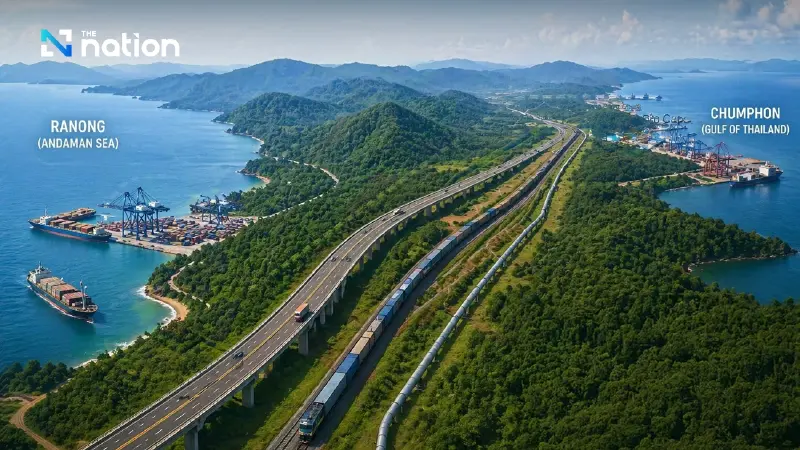


Business leaders and academics warn Thailand’s trillion-baht land bridge project must avoid repeating failures seen in Hopewell and airport rail schemes
- Critics question the project's financial viability, estimating that the dual-port system and cross-land transport could make it over $250 more expensive per container than shipping through the Strait of Malacca.
- The project's core commercial benefit is in doubt, as studies suggest the land bridge transfer process could take approximately 54 hours, potentially longer than the 48 hours required to navigate the Strait of Malacca.
- Commercial risks include a significant cargo imbalance between the two proposed ports, which could force vessels to operate below capacity, and a lack of incentive for the 74% of Thai trade already using efficient regional routes to switch.
- Industry leaders and academics are urging for more comprehensive studies and the direct involvement of global shipping operators in feasibility evaluations, warning of risks similar to past failed mega-projects.
Thailand’s ambitious Chumphon-Ranong land bridge project, valued at more than one trillion baht, is emerging as one of the country’s most closely watched mega-projects, as the government pushes ahead with plans to transform southern Thailand into a global marine logistics hub.
The project aims to connect the Gulf of Thailand and the Andaman Sea through a vast transport and deep-sea port network, reducing reliance on the Strait of Malacca while positioning Thailand as a major transcontinental shipping gateway capable of attracting substantial foreign investment.
However, industry leaders and academics have cautioned that the project requires far more comprehensive study before moving forward, warning of major commercial, environmental and structural risks.
Calls for careful study
Montri Mahapreukpong, vice chairman of the Federation of Thai Industries and head of its academic economics division, said the appointment of Deputy Prime Minister and Finance Minister Ekniti Nitithanprapas to chair the project’s feasibility committee was appropriate, given his economic expertise and ability to drive strategic national projects.
At the same time, he stressed that the land bridge must be studied carefully across multiple dimensions, including environmental impacts, logistics systems and transport connectivity covering rail, road and maritime networks, as well as effects on local communities and southern development overall.
Montri also highlighted Thailand’s sharply rising logistics costs, which he said had climbed from around 12% to roughly 26%, significantly hurting national competitiveness. He urged the government to accelerate infrastructure development while supporting grassroots economic activity and SMEs.
He added that Thailand must adapt quickly to rising geopolitical risks following warnings from the International Monetary Fund over tensions in the Middle East, particularly by strengthening bilateral trade cooperation and maintaining balanced international relations to safeguard long-term economic stability.
Mega-port vision to rival Singapore
Dr Tanit Sorat, vice chairman of the Employers’ Confederation of Thai Trade and Industry, said the land bridge has been promoted by several governments alongside the Southern Economic Corridor (SEC) strategy.
The plan includes massive deep-sea ports in Chumphon and Ranong, linked by motorways, railways and supporting infrastructure.
Government projections suggest that if the first phase opens by 2030 and the full project is completed within five years after that, Thailand’s economic growth could rise to 5% from the current average of around 2.5%, while the southern economy could expand by 9-10%, up from roughly 2% at present. The project is also expected to create more than 280,000 jobs and generate over 500 billion baht annually in economic value.
The ports are envisioned as facilities almost twice the size of Laem Chabang Port and capable of handling around half the cargo volume currently managed by Port of Singapore, one of the world’s busiest ports. They are also expected to accommodate Super Post Panamax vessels carrying more than 10,000 TEUs per ship.
The government argues the route could offer shipping lines an alternative to the Strait of Malacca and cut travel time by more than four days.
Doubts over demand and time savings
One major concern centres on cargo imbalance between the two ports.
Project data indicate that Chumphon Port would handle about 13.8 million TEUs annually, while Ranong Port could handle up to 19.4 million TEUs, a gap of 5.6 million TEUs. Critics warn this imbalance could leave some vessels operating below full capacity, pushing up shipping costs.
Analysts also noted that the land bridge would operate primarily as a transshipment system, meaning most cargo would not originate from or end in Thailand itself but would instead be transferred between oceans. If vessels are not fully loaded, unit costs would rise immediately.
Another issue involves Thailand’s existing trade patterns. Around 73.9% of Thai trade is conducted within Asia, including with China, Hong Kong, Japan, South Korea and ASEAN countries, most of which already rely on Gulf of Thailand and Pacific shipping routes. As a result, many major and feeder vessels may have little incentive to switch to the land bridge route if existing routes remain cheaper and more efficient.
Experts have also questioned government claims that the project could save more than four days in shipping time.
Some maritime studies indicate that passing through the Strait of Malacca typically takes around 48 hours, even when factoring in traffic congestion and weather conditions. By contrast, Thailand’s proposed “One Port Two Side” model would require containers to be unloaded, transferred across land by rail or truck, and then reloaded onto another vessel, a process estimated to take roughly 54 hours, potentially six hours longer than the Malacca route itself.
Costs and risks under scrutiny
Critics further warned that the dual-port system would create repeated handling costs from loading and unloading containers at both coasts.
Comparisons with operations at Laem Chabang Port suggest port handling charges alone could reach around US$502,307 per voyage, while cross-land transport over roughly 90 kilometres could add another US$730,769 per trip.
Combined estimates suggest using Thailand’s land bridge could cost about US$252.3 more per container than conventional shipping through the Strait of Malacca.
Academics are now urging the government to involve global shipping operators directly in evaluating whether there would be sufficient real-world demand once the project is completed, rather than relying mainly on state-led studies or theoretical projections.
Some also questioned why most committee members come from the public sector while key shipping industry players remain largely absent from the decision-making process.
Fears of repeating past mega-project failures
Observers warned the project could face risks similar to Thailand’s troubled high-speed rail link connecting three airports or the long-abandoned Hopewell transport project if contracts are not tightly managed.
The land bridge would require extensive land expropriation alongside the construction of ports, railways, motorways and related infrastructure. Critics said strict contractual safeguards are needed, particularly in cases where private partners fail to complete construction or abandon projects midway.
Environmental concerns have also intensified because the project spans both the Andaman coast and the Gulf of Thailand, areas rich in coral reefs, fisheries and marine tourism resources.
Experts called for in-depth environmental studies covering marine ecosystems, coastal impacts, local fishing communities and tourism industries, warning that environmental damage could become an irreversible long-term cost.
Ultimately, analysts said the land bridge represents far more than a transport project. It is a high-stakes gamble on Thailand’s future economic direction.
“If successful, Thailand could emerge as a new global logistics hub,” the report concluded. “But if it fails, the project could become another infrastructure scar the country carries for decades.”
