
Thai-EU FTA enters final stretch after Brussels breakthrough
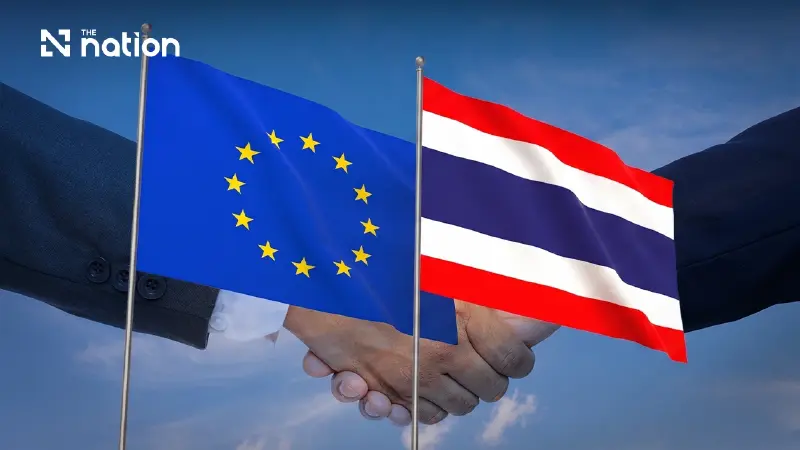


Thailand-EU FTA talks have closed 15 of 24 chapters after the Brussels round, with agriculture, digital trade and procurement still ahead
Thailand and the European Union have pushed their long-running free-trade negotiations into a crucial final phase, with the ninth round in Brussels concluding four more chapters and bringing the deal about two-thirds of the way towards completion.
Deputy Prime Minister and Commerce Minister Suphajee Suthumpun said the latest round of Thailand-EU Free Trade Agreement negotiations, held from June 22-30 in Brussels, Belgium, had made substantial progress across several key areas.
The talks wrapped up four additional chapters:
- Competition and subsidies — covering equal enforcement of competition law and transparent rules on subsidies.
- State-owned enterprises — ensuring that SOEs covered by the agreement operate commercially and without discrimination.
- Dispute settlement — setting out state-to-state mechanisms if either side breaches the FTA.
- Administration of the agreement — covering how the agreement will be managed once implemented.
Negotiators also concluded four related items, comprising three annexes and one protocol:
- An annex on duties and charges related to exports of goods.
- An annex on import and export monopolies.
- An automotive annex under the chapter on technical barriers to trade.
- A protocol on mutual administrative assistance in customs matters.
Together with issues completed in earlier rounds, Thailand and the EU have now concluded 15 of 24 chapters, along with related annexes. Suphajee said this meant about two-thirds of the overall agreement had been settled.
Talks move closer to final stretch
Suphajee said several remaining issues were close to being concluded, including anti-fraud provisions and the final provisions of the agreement.
Market-access talks are also advancing in three core areas:
- trade in goods;
- trade in services and investment;
- government procurement.
Both sides are now discussing detailed market-opening offers, signalling that the negotiations have entered a decisive phase close to the final stretch.
The next round will focus on the remaining one-third of the agreement, which includes several issues with major implications for the Thai economy:
- agricultural goods;
- industrial products;
- government procurement;
- energy and raw-material management;
- digital trade;
- services and investment;
- laws and regulations, including intellectual property.
High-level push helps move talks forward
Suphajee said she had been informed by Thailand’s chief negotiator that the latest round had made strong progress because of political support from high-level discussions between the two sides.
On June 24 in Brussels, Suphajee and Thai Trade Representative Werapong Prapha held talks with:
- Maros Sefcovic, European Commissioner for Trade and Economic Security;
- Christophe Hansen, European Commissioner for Agriculture and Food.
“I was informed by the head of the Thai negotiating team that this round made major progress because of political support from high-level discussions between the two sides on June 24 in Brussels,” Suphajee said.
“During the talks, I and Thai Trade Representative Werapong Prapha met the European Commissioner for Trade and Economic Security, Maros Sefcovic, and the European Commissioner for Agriculture and Food, Christophe Hansen.
“Ministers from both sides reaffirmed their shared intention to accelerate the Thailand-EU FTA negotiations so they can be concluded as soon as possible. They also instructed the chief negotiators to quickly prepare a joint work plan and to hold close discussions on outstanding issues,” she said.
Thailand prepares for round 10
The Commerce Ministry, through the Department of Trade Negotiations, will next convene a working group to drive the Thailand-EU FTA talks. The group is chaired by the deputy prime minister and commerce minister.
The meeting will bring together relevant agencies to discuss key unresolved issues in each negotiating area.
Both sides will also hold intersessional talks at several levels:
- between chief negotiators;
- within individual negotiating groups;
- at ministerial level.
Sefcovic is expected to visit Thailand before the tenth round of negotiations to follow up on progress and help push the talks forward.
The tenth round is scheduled to take place in Thailand in late September 2026. Both sides aim to make maximum progress and reach a conclusion as soon as possible, in line with the target set by ministers from Thailand and the EU.
For Thailand and the EU, the FTA is part of a wider strategy to:
- upgrade economic relations;
- expand trade and investment opportunities on the basis of mutual benefit;
- protect competitiveness;
- strengthen cooperation on sustainable development;
- respond to geopolitical tensions and global geo-economic volatility.
EU remains Thailand’s fourth-largest trading partner
In 2025, the EU was Thailand’s fourth-largest trading partner after China, the United States and Japan.
Two-way trade between Thailand and the EU was valued at US$45.03 billion, up 3.44% from the previous year.
Thai exports to the EU were worth US$26.45 billion, up 9.27%. Major export items included:
computers, equipment and components;
- gems and jewellery;
- air conditioners and parts;
- rubber products;
- electrical transformers and components.
Imports from the EU were valued at US$18.58 billion, down 3.86%. Key imports included:
- machinery and parts;
- medical and pharmaceutical products;
- chemicals;
- electrical machinery and components;
- scientific and medical instruments.
Thailand recorded a trade surplus with the EU of US$7.86 billion.
