
New government policies if Thailand’s 32nd prime minister is Anutin Charnvirakul
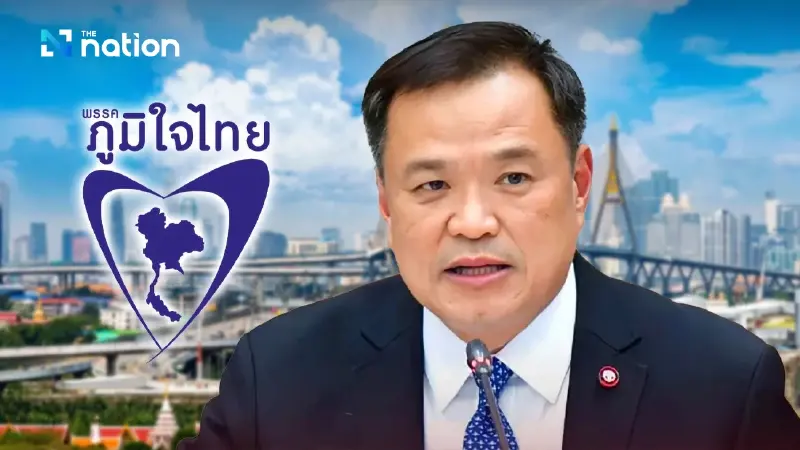


Thai politics has once again descended into uncertainty after the Constitutional Court ruled that Paetongtarn Shinawatra must vacate the office of prime minister, leading to the entire Cabinet stepping down.
This has forced the House of Representatives to prepare for a vote to select Thailand’s 32nd prime minister.
Attention has now shifted to the Bhumjaithai Party and its leader, Anutin Charnvirakul, who is expected to be nominated as the next prime minister. With 96 seats in hand, Bhumjaithai must secure additional support to command a majority in the House.
The fate of the next government hinges on coalition agreements and memorandums of understanding (MOUs), particularly with the People’s Party, which holds 143 seats.
The People’s Party has reiterated its demand that any new prime minister must dissolve the House within four months, hold a referendum, and establish a Constitution Drafting Assembly.
The party has also signalled it will assume the role of opposition, tasked with scrutinising the new government.
Meanwhile, the Klatham Party has issued a statement backing Anutin, but with strict conditions: no amendments to laws affecting the monarchy and a commitment to improving farmers’ livelihoods. Bhumjaithai has agreed in principle to these conditions.
Pheu Thai, by contrast, is facing internal divisions. A faction led by Sakda Wichiansin, MP for Kanchanaburi, is negotiating with Bhumjaithai to join the new government, claiming the support of more than 10 MPs.
In addition, Thai Sang Thai has also decided to back Anutin, further boosting his chances of forming a government.
Inside Bhumjaithai’s policy agenda
If Anutin becomes Thailand’s next prime minister, Bhumjaithai’s official website lays out 11 flagship policies spanning economic, social and infrastructure reforms.
At the heart of its grassroots economic agenda is the “50,000-baht emergency loan” programme, aimed at breaking the debt cycle outside the formal system. Thai citizens aged 20 and over would be eligible for unsecured loans, repayable at 150 baht per day over 365 days, totalling 54,750 baht including interest and principal.
On infrastructure, Bhumjaithai pledges the “Gulf of Thailand–Andaman landbridge” to link the two coasts, positioning Thailand as a regional logistics hub. It also promises extensive development in the South to establish a new national economic centre.
A key highlight is the party’s plan to revamp public transport, introducing electric buses to curb PM2.5 pollution and improve urban mobility, with fares starting at 10 baht. The ambition is to electrify the entire public transport fleet within three years.
In healthcare, Bhumjaithai intends to expand community-level access, raising allowances for village health volunteers to 2,000 baht per month with added health insurance, while opening free dialysis centres in every district.
Tourism targets are equally bold: attracting 80 million visitors and generating 6 trillion baht by 2027, ending the low season with over 300 annual events and promoting Thailand as the “wellness resort of the world.”
Debt relief also features prominently, with a “three-year debt moratorium” suspending both principal and interest payments.
In agriculture, the “prosperous farming through contract farming” initiative would secure guaranteed prices before planting and advance payments for major cash crops, with forward contracts encouraged.
On clean energy, Bhumjaithai proposes free rooftop solar panel installations, cutting household electricity bills by 450 baht per month, alongside incentives for affordable electric motorcycles and 25-year energy credit rights.
The budget challenge
The Thailand Development Research Institute (TDRI) estimates Bhumjaithai’s policies would cost as much as 1.9 trillion baht, the highest among the six main parties. Most of this would go towards infrastructure investment in special economic zones in the South.
The party also leans heavily on “off-budget financing,” with the emergency loan scheme alone requiring 700 billion baht annually from state-owned financial institutions.
Moreover, key pledges such as the debt moratorium, which could cost no less than 900 billion baht over three years, were not fully disclosed to the Election Commission.
Whether these ambitious policies can be implemented depends on Anutin’s success in securing parliamentary backing to become Thailand’s 32nd prime minister. Only then will Bhumjaithai’s package of promises move from manifesto to reality.
