
Half-half copayment scheme set for comeback from Prayut to Anutin
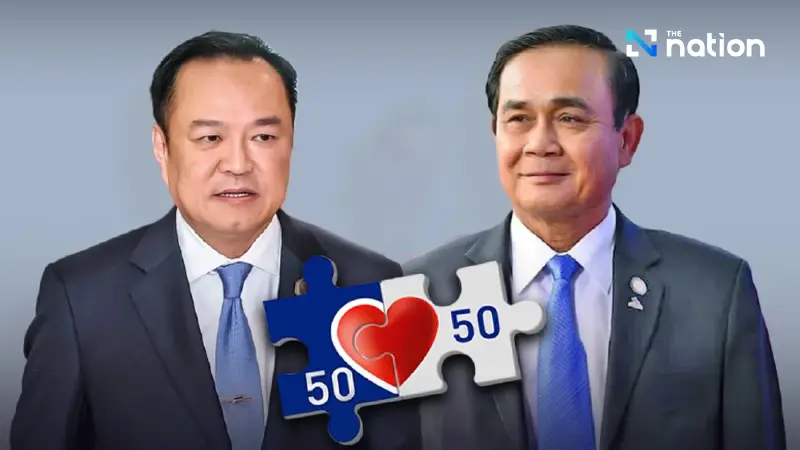


The Bhumjaithai Party has confirmed plans to revive the “half-half” co-payment scheme, first introduced during the Prayut Chan-o-cha administration, as part of its short-term economic stimulus measures.
Siripong Angkasakulkiat, deputy leader of Bhumjaithai, told reporters on Saturday that speculation about relaunching the scheme was accurate.
He said the party’s executive board and policy team had already discussed the initiative, which they believe can deliver stronger results than the digital wallet programme while enjoying broader public support.
Siripong stressed that the main purpose of the half-half scheme was to ease economic hardship, not to gain political advantage. He added that the scheme had proven effective in stimulating spending across the grassroots economy.
Unlike the digital wallet project, which required the creation of a new platform, the revived half-half scheme would operate through the existing “Paotang” app, which has already been used for several government programmes.
This, he said, would save time and ensure the scheme could be rolled out quickly during Anutin Charnvirakul’s caretaker government, which has a four-month mandate.
Budgetary details, however, remain undecided. The final allocation will depend on the prime minister and the core policies of the “Anutin 1” government.
Half-half vs digital wallet
Siripong argued that the half-half scheme offered better value for money compared with the 10,000-baht digital wallet handout pushed by the previous Pheu Thai-led government, which drew criticism over its massive budgetary burden.
He said the co-payment model required significantly less funding yet succeeded in distributing spending more directly to small shops and local businesses.
If the Anutin government proceeds, he expects the scheme could be relaunched within the first month after the new administration delivers its policy statement to Parliament. The prime minister would then issue immediate orders to ensure the programme is implemented within the government’s limited timeframe.
From Prayut to Anutin
The “half-half” scheme was first launched under former Prime Minister Prayut Chan-o-cha, spearheaded by the Finance Ministry and the Fiscal Policy Office in 2020. It was introduced at the height of the Covid-19 crisis, when lockdowns caused severe economic contraction and hardship among the public.
Objective: The programme aimed to ease the cost-of-living burden while injecting spending into the economy. Under the scheme, the state subsidised 50% of the cost of daily necessities such as food, drinks, and essential goods.
Target group: The scheme was open to Thai citizens aged 18 and over with a national ID card, excluding welfare cardholders who already received other forms of state support.
Mechanism: Participants registered through the “Paotang” app and made purchases via the G-Wallet system, with the government automatically covering half of the cost up to the set limit.
Budget and expansion of the scheme
Between 2020 and 2022, the half-half scheme ran through multiple phases, including supplementary measures from Phase 1 to Phase 5. The government spent more than 340 billion baht on the programme, which attracted between 30 and 35 million participants and over 1.5 million participating shops.
- Phase 1 (October 2020): Covered 10 million recipients, with the state subsidising up to 3,000 baht each. Budget: over 30 billion baht.
- Phase 2 (December 2020 – March 2021): Added 5 million more recipients and increased the subsidy per person from 3,000 to 3,500 baht.
- Phase 3 (July – December 2021): Expanded to 31 million participants, each receiving a further 3,000 baht. Budget: over 90 billion baht.
- Phase 4 (February – April 2022): Provided an additional 1,200 baht per person, covering 26.3 million people.
- Phase 5 (September – October 2022): A short-term extension, offering 800 baht per person. Budget: over 20 billion baht.
Impact of the half-half scheme
Immediate economic boost: The programme generated over 300 billion baht in spending, most of which circulated among SMEs and small local traders.
Eased household burden: Citizens were incentivised to spend more, particularly during the Covid-19 crisis.
Digital payment adoption: The “Paotang” app became a widely used digital platform, laying the foundation for subsequent government schemes such as “We Win” and “We Travel Together.”
The half-half scheme has already proven to be an effective measure in both stimulating the economy and directly supporting citizens.
Its potential revival under the Anutin government reflects an attempt to dust off a policy tool that previously worked, in order to inject purchasing power at a time when Thailand’s economy faces mounting pressures.
The key questions now are how much budget will actually be allocated and how the scheme will be redesigned to meet the dual goals of boosting the economy and satisfying the public—without falling into criticism of being merely another populist campaign tool.
