
Four elections next door could reshape Thailand’s border crises
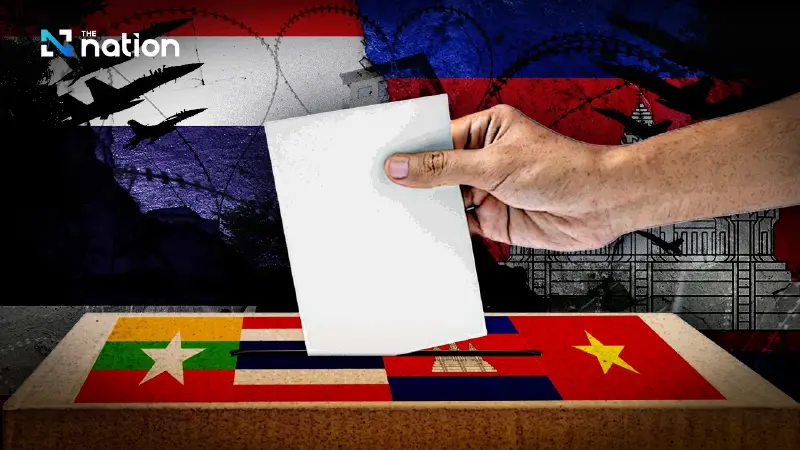


Elections in Myanmar, Cambodia, Malaysia and Thailand could shift pressure on Thailand’s borders—through conflict, migration, and diplomacy.
If Thailand’s border situation is increasingly tied to domestic politics, major elections in neighbouring countries—Myanmar, Cambodia, Malaysia and Thailand itself—will have unavoidable direct and indirect effects, Krungthep Turakij reported.
In Myanmar, the 2021 coup led by Senior General Min Aung Hlaing has been followed by civil conflict, fighting with ethnic armed groups along border areas, international isolation, and repeated shocks from natural disasters, including earthquakes—leaving the country struggling to stabilise.
Myanmar is now heading into its first election in four years, with Min Aung Hlaing insisting the vote will be “free and fair”. The process is set to run in three phases: December 28, 2025; January 11, 2026; and January 25, 2026.
Yet clashes continue in multiple areas, including around the Moei River opposite Thailand’s Tak province. The Naresuan Force under the Third Army Area has ordered closures of border checkpoints along the frontier and stepped up monitoring and pressure measures after stray rounds reportedly landed on the Thai side, damaging homes and affecting local residents.
The situation has also been compounded by blasts targeting buildings in the KK Park–Shwe Kokko area, widely linked to transnational crime and online scam operations. The stated aim is to dismantle criminal hubs and reduce Myanmar’s isolation ahead of the election.
Foreign nationals of various countries have fled the KK Park–Shwe Kokko area, crossing into Thailand. This has created a burden Thailand must manage—setting up screening points and coordinating with embassies and governments so each country can repatriate its citizens.
Army Commander-in-Chief Gen Pana Klaewplodtook has instructed the Third Army Area to keep the Thai–Myanmar border calm for now, noting the military is already under heavy strain from the Thai–Cambodian front—both in the Second Army Area’s southern Isan sector and the First Army Area’s Sa Kaeo sector.
Meanwhile, Maj Gen Maitree Choopreecha, commander of the Naresuan Force, has acted as a key liaison with Myanmar’s military leaders and ethnic armed groups, urging caution to prevent bullets from crossing into Thailand and asking that any demolition operations near the border be scaled back to avoid damage to civilian property. Cooperation has been forthcoming.
The Naresuan Force assesses that, in the long run, Myanmar’s election could be positive for border stability. In the near term, however, Thailand will continue to absorb the impact—from fighting and cross-border spillover to flows of foreign nationals and refugees—until Myanmar’s internal situation becomes more settled.
Thailand’s own election is scheduled for February 8, 2026, during a period of unresolved tensions with Cambodia. The direction taken by a new prime minister and government—its policies and posture—will matter for politics, security, and foreign affairs.
Political observers argue that a rising nationalist mood could boost Anutin Charnvirakul, leader of the Bhumjaithai Party, in a bid to return as prime minister. But momentum around the People’s Party, Pheu Thai, and the re-emergence of Abhisit Vejjajiva within the Democrat Party could reshape the political equation.
Beyond border policy with Cambodia, the campaign is also likely to be influenced by public anger over “grey capital” networks and scam operations seen as draining ordinary people and harming national interests.
Some parties have signalled they will not align with parties perceived as taking Thailand in an improper direction, or promoting policies that could deepen domestic division.
Turning to Cambodia, the key question is whether Cambodian Senate President Hun Sen continues to pursue a long-term strategy of confrontation with Thailand—stoking nationalist sentiment to strengthen Prime Minister Hun Manet and the Hun family network at home.
In Thai political debate, memories of the 2011 clashes are often invoked as a cautionary tale about how border conflict can shape legitimacy and domestic standing.
Cambodia has not succeeded in bringing Thailand before the International Court of Justice over disputes involving sites and areas such as Prasat Ta Muen, Prasat Ta Kwai, Prasat Ta Muen Tod, and the Chong Bok area.
The dispute could also expand into other sensitive flashpoints, including offshore energy resources and the Ko Kut area in Trat province.
This raises the prospect that the Thai–Cambodian border will remain volatile—especially if external pressure on Thailand becomes a tool to reinforce Hun Manet’s position ahead of Cambodia’s next election cycle, with 2028 frequently mentioned as a key political milestone.
To Thailand’s south, the three southern border provinces along Malaysia remain troubled, and some Thais question the neutrality of Malaysian Prime Minister Anwar Ibrahim—ASEAN chair—who has offered to mediate Thai–Cambodian disputes, with critics arguing the “scales” may tilt.
At the same time, violence in the Deep South persists, with continued attacks affecting lives and property. The robbery in Sungai Kolok, Narathiwat, on October 5, 2025—worth more than 35 million baht—remains a high-profile example.
Authorities have issued warrants and arrested some suspects, while others reportedly moved stolen gold across the border into Malaysia.
Thai officials say cross-border enforcement is complicated by dual nationality cases. They also point to earlier efforts to submit suspect lists to Malaysia and request handovers in relation to attacks in the southern border provinces—efforts they say have seen limited progress.
Anwar Ibrahim became Malaysia’s prime minister on November 24, 2022. If there is no major political disruption, Malaysia is expected to hold its next election in 2027. That means there is a real possibility the Deep South conflict could hit a turning point—improving, holding steady, or worsening.
Ultimately, Thailand must prepare for border pressures on all fronts—carefully managing risks so multiple flashpoints do not escalate at the same time.
