
‘Shinawatra’ stakes its hometown: ‘love Thaksin’ vs ‘love ideals’
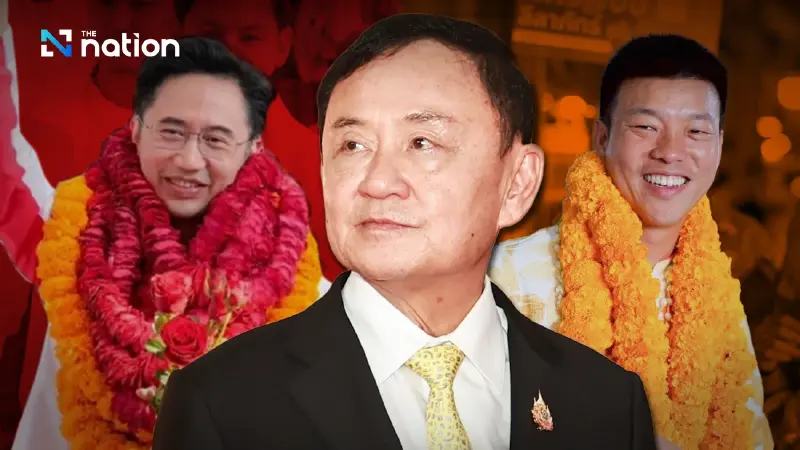


Shinawatra wager: Yodchanan Wongsawat fronts Pheu Thai in Chiang Mai, taking on Natthaphong Ruengpanyawut as 'Nakhon Ping' turns battleground
Election 2026 in Chiang Mai will test voters’ hearts: “love Thaksin” versus “love ideals”. Red holds long-standing local strongholds and powerful families; orange rides a newer political wave.
Chiang Mai is not only the birthplace of Thaksin Shinawatra; it is also the Shinawatra family’s political base, passed down from the era of his grandfather Lert to the next generation—“Ung Ing” Paetongtarn Shinawatra—and to the grandson Yodchanan “Chane” Wongsawat.
Yodchanan, the eldest son of “Jae Daeng” Yaowapa Wongsawat and Somchai Wongsawat, is presented as a new wave whom Thaksin hopes will become the next-generation leader of the Pheu Thai Party.
In this year’s Chiang Mai MP race, Pheu Thai wants to wipe away the humiliation of losing to the Move Forward Party (now the People’s Party), and has therefore pushed “Chane”, a young Shinawatra-bloodline figure, to lead the charge.
However, on January 18, 2026, NIDA Poll released its survey titled “Election 2026 of Chiang Mai People”, conducted on January 9–14, 2026. It found that Chiang Mai respondents preferred Natthaphong Ruengpanyawut as prime minister at 31.40%, compared with Yodchanan Wongsawat at 19.40%.
Even though Thaksin’s nephew trails Natthaphong in personal popularity, constituency-MP preferences were still close: the orange party at 37.39% and the red party at 31.68%.
If the NIDA Poll is analysed along those lines, Pheu Thai could be expected to increase its MP tally from two seats last time to around five or six—though not to the level of sweeping the entire province.
As is well known, in the 2023 Chiang Mai MP election, the Move Forward Party won seven seats, Pheu Thai won two, and Palang Pracharath won one—an orange victory that shook the whole of Lanna.
A new generation of the Shinawatra local “big house”
Behind-the-scenes strategists in Pheu Thai chose to “rebrand” the red camp by positioning Yodchanan as the selling point and as a prime-ministerial candidate—giving the move clear significance for Chiang Mai’s contest this year.
“Chane” Yodchanan Wongsawat, the eldest son of Yaowapa and Somchai, is being framed as the new wave that “Uncle Thaksin” hopes will become the third-generation leader of the red camp.
Chane–Yodchanan is an academic in biomedical engineering. At one point, he ran for MP in Chiang Mai, but that election was later annulled.
Before “Jae Daeng’s son” took the baton from “Thaksin’s child”, Pheu Thai assessed that it could break through the orange wall because it still holds local networks firmly. What it needed was a young brand, with an academic image, as the market’s new selling point.
In 2024–2025, Thaksin successfully reclaimed Chiang Mai in local politics. “Nayok Kong” Pichai Lertpongadisorn won as chief executive of the Chiang Mai Provincial Administrative Organisation (PAO), and Assanee Buranupakorn won as mayor of Chiang Mai Municipality.
‘Love Thaksin’ is not the same as before
Since the 2001 Chiang Mai MP election, when Thaksin ran the “prime minister—steamed rice” campaign, he swept up MPs across the upper North in large numbers.
For more than 20 years, Chiang Mai MPs were dominated by former MPs and their descendants from local “big houses” aligned with the Shinawatra network—across Thai Rak Thai, People Power and Pheu Thai.
But in the last Chiang Mai MP election, veteran red-camp former MPs were almost entirely defeated, leaving only Julapun Amornvivat (nicknamed “Nhim”)—son of Sompong Amornvivat—and Srisopha Kotkhamlue —daughter of Kamnan Sireht—to survive.
As a result, Pheu Thai’s MP candidates across Chiang Mai’s 10 constituencies were overhauled, with new blood pushed forward—driven by the local administration team of “Nayok Kong” Pichai Lertpongadisorn, the Chiang Mai PAO chief executive.
Constituency 1 (Mueang Chiang Mai): “Mor Jo” Thiraphat Tanphiriyakun, former deputy chief executive of the Chiang Mai PAO
Constituency 2 (Mueang Chiang Mai): “Mor Tong” Paethai Taecholarn, former deputy chief executive of the Chiang Mai PAO
Constituency 3 (San Kamphaeng): “Top” Jakkaphon Tangsutthitham, former Chiang Mai MP, previously moved to contest Constituency 1 and lost, now moved back to Constituency 3
Constituency 4 (San Sai): “Note” Phanu Charoensuk, former mayor of Chedi Mae Khrua Subdistrict Municipality, San Sai
Constituency 5 (Mae Rim): “Sprite” Atchara Nanthasen, daughter of Somthop Nanthasen, chief executive of Mae Sa Subdistrict Administrative Organisation, Mae Rim
— Julapun Amornvivat’s team is expected to work at full force here, as he narrowly survived last time.
Constituency 6 (Chiang Dao): “Nui” Bunchongsak Wongrattanawan, close to Sompong Amornvivat and assistant to Julapun Amornvivat, former Chiang Mai MP
Constituency 7 (Fang): Nithikorn Wuthinanchai, son of Prasit Wuthinanchai, former Chiang Mai MP
Constituency 8 (Hang Dong): Natthaphat Ratpathai, son of Noppakhun Ratphai, former Chiang Mai MP
Constituency 9 (Chom Thong): “SorJor Nu” Yongyut Yawichai, Chiang Mai PAO councillor, Chom Thong District, Constituency 2
—He will face the incumbent Naret Thamrongthipyakun, Deputy Agriculture and Cooperatives Minister, who is described as a key ally of Captain Thammanat.
Constituency 10 (Hot): “Om” Srisopa Kotkhamlue, former two-term Chiang Mai MP, daughter of Srires Kotikhamlue, former Chiang Mai MP
Chiang Mai’s countryside has changed
Before the May 14, 2023 election, many Chiang Mai academics did not expect the Pita wave to be so powerful that it would reshape Chiang Mai’s political landscape—from a “Shinawatra capital” into an orange capital.
Notably, seven Chiang Mai MPs were largely from ordinary backgrounds, with the exception of Nataphol Tovichakchaikul, son of the late former Chiang Mai MP Surapong Tovichakchaikul.
This time, former Chiang Mai MPs are again running across the board, including Phetcharat Maichompoo (Constituency 1), Kannika Kantha (Constituency 2), Nataphol Tovichakchaikul (Constituency 3), Phuthita Chaianan (Constituency 4), Orapan Chantaruang (Constituency 6), Somdun Uatcharoen (Constituency 7), and Phattarapong Leelaphat (Constituency 8).
The People’s Party is also fielding both new and returning candidates in constituencies it lost last time, believing it can beat candidates from both the red camp and the green camp (Kla Tham).
Nuttakorn Vititanon, a lecturer in the Faculty of Political Science and Public Administration at Chiang Mai University, said the physical reality of the countryside has changed: it has become more urban. This, he said, is “Nakhon Wiang Ping” today.
Above all, what connects the countryside with the city is social media—prompting “voters” in outer districts stretching to the Thai–Myanmar border to shift from “love Thaksin” to “love ideals”.
