
Northeast voters favour Pheu Thai-Bhumjaithai coalition: poll
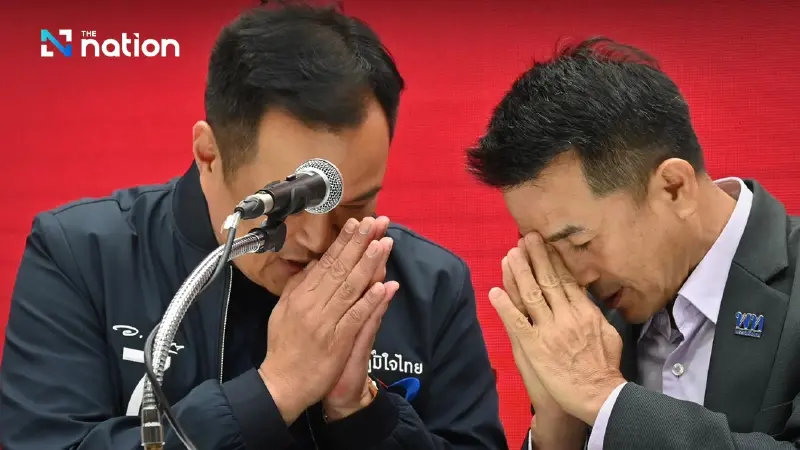


Bhumjaithai gains sharply in Northeast as People’s Party, Pheu Thai see declines
Most voters taking part in the latest E-san Poll said they want Pheu Thai and Bhumjaithai to form a coalition government after the next election, even though the People’s Party remains the most popular party in the region.
The poll, conducted by Khon Kaen University’s Faculty of Economics, surveyed 1,090 respondents aged 18 and over across 20 northeastern provinces between January 17-19. Participants were asked about voting preferences and factors influencing their decisions.
Asked which party they would support in the party-list race, 30.3% said the People’s Party, followed by Pheu Thai (30.1%), Bhumjaithai (27.2%), the Democrats (3.4%), Thai Sang Thai (2.8%) and Kla Tham (2.6%).
However, when asked which major parties they want to see forming a coalition government, the largest group of respondents, 35.3%, said Pheu Thai and Bhumjaithai.
Some 30.6% preferred a People’s Party-Pheu Thai government, while 20.8% supported a People’s Party-Bhumjaithai pairing. Only 13.3% said they favoured other coalition scenarios involving smaller parties.
So far, none of the three major parties has clearly ruled out potential partners, although the People’s Party has said it would not support Bhumjaithai leader Anutin Charnvirakul as prime minister.
Suthin Wianwiwat, head of the E-san Poll project, said support for both the People’s Party and Pheu Thai in the Northeast has declined, from 33.2% to 30.3% for the People’s Party and from 43.1% to 30.1% for Pheu Thai.
Bhumjaithai, meanwhile, has surged from 4.1% to 27.2%, he said.
The poll also found that 55.8% of respondents consider party policies, prime ministerial candidates and cabinet members the most important factors in choosing who to vote for. Other factors included individual constituency MPs (37.1%) and money offered after voting (6.9%).
On vote-buying, 45.5% said they would refuse money, while 44.7% said they might accept it but would still vote for their preferred candidate. About 7% said they would accept money and vote as requested.
Asked what they expect from constituency MPs, 21.4% said being helped when needed, 21.1% said securing local projects or budgets, 19.4% said pushing beneficial national laws, and 18.1% said helping people deal with government agencies.
Economic issues were the top priority for choosing a party-list MP, cited by 45.2% of respondents, followed by security and border issues (28.2%), corruption and scams (17.8%) and the constitution (7.5%).
On constitutional change, 46.7% said they want a new charter, while 31% opposed it and 22.3% were undecided.
