
Election pledges under the microscope as parties submit 527 budget-backed policies worth trillions
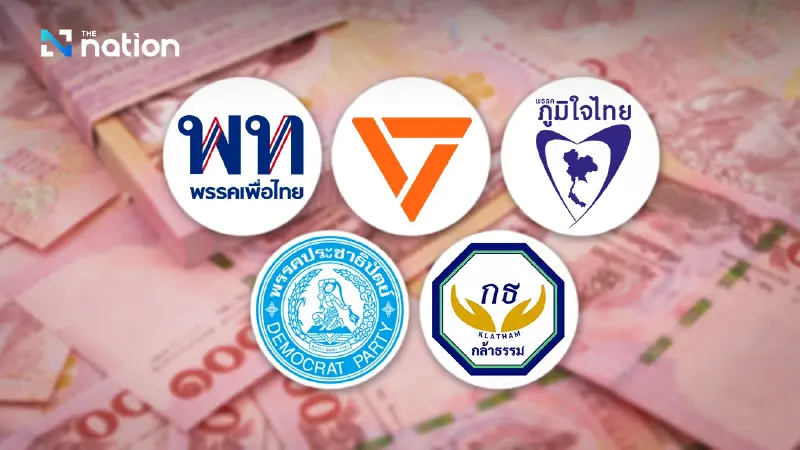


Thailand’s Election Commission says 51 parties have submitted 527 campaign policies requiring state budgets for the 2026 election, led by the Democrats with 91 policies and major spending lines across welfare, transport and infrastructure.
Thailand’s Election Commission (EC) has compiled a summary of political parties’ campaign policies that require state budget funding for the 2026 election. In total, 51 political parties submitted 527 policies.
The party submitting the most policies was the Democrat Party, with 91 policies—17.27% of the total.
The Democrat Party’s proposed budget totalled 2.12 trillion baht. Notable proposals include: farm income guarantees worth 360 billion baht; income guarantees for wage earners worth 120 billion baht; irrigation upgrades worth 25 billion baht; tourism opportunity routes through transport projects worth 25 billion baht; a new river channel: the Chainat-Pa Sak-Gulf of Thailand canal, budgeted at 10 billion baht; global connectivity transport worth 50 billion baht; and a 30-baht maximum fare per trip for electric trains and buses, using zonal fares and an integrated ticketing system, budgeted at 50 billion baht, among others.
Second was the Pheu Thai Party, with 43 policies (8.16%) requiring 243.3 billion baht. Notable proposals include: “No Thai Left Poor” at 60 billion baht per year; 30-baht healthcare anywhere with AI at 3 billion baht; “30 baht to heal every heart” at 2 billion baht per year; 20-baht flat fare on all electric train lines at 1 billion baht per year; a “gift for Thais” policy at 3.5 billion baht per year; “study with funding, graduate with a job” at 5 billion baht per year; a soft power policy at 5 billion baht; farmers’ debt relief at 15 billion baht per year; a “pay well: one year, one instalment free” policy at 30 billion baht; a 30% profit guarantee for agricultural products at 31 billion baht; and fertiliser and seed coupons at 10 billion baht per year.
Next was the Kla Tham Party, with 38 policies (7.21%) using 2.27 trillion baht. Notable proposals include: water management and irrigation systems worth around 400-550 billion baht; turning farmland into “life capital” worth around 35-48 billion baht; reducing production input costs worth around 35-40 billion baht; and support for farmer industrial estates nationwide towards agriculture, worth around 80-120 billion baht, among others.
The People’s Party submitted 36 policies (6.83%), with a total budget of 741.83 billion baht. Notable proposals include: drafting a people’s constitution at 3 billion baht per time; a mega-project to raise quality of life nationwide at 130 billion baht per year; and upskilling the workforce through a central system and skills-upgrade vouchers at 20 billion baht per year.
It also proposed reforming healthcare services in Bangkok and the provinces, managing the National Health Security Office (NHSO) fund, developing patient data linkage systems, hospital medicine systems, and reducing burdens on medical personnel, requiring 35.5 billion baht per year. It also proposed boosting capacity for elderly care and long-term patients at 45 billion baht per year; child subsidies and establishing quality childcare centres at 27 billion baht per year; and increasing disability allowances at 34 billion baht per year.
Notably, the Bhumjaithai Party submitted only 8 policies (1.52%), requiring 148.32 billion baht in total. Notable proposals include: Khon La Khrueng Plus at 44 billion baht (state portion only); electric motorcycles with instalments of 300 baht a month over 60 months, totalling 3.2 billion baht; electricity at 3 baht per unit at 63.36 billion baht per year; volunteer nurses to care for older people—one village, one volunteer nurse—at 13.5 billion baht per year; 100,000 volunteer soldiers earning 12,000 baht per month, totalling 22.7 billion baht per year; a border wall to prevent incursions at 866 million baht; and Education Equality Plus at 700 million baht, among others.
Other well-known parties include Thai Kao Mai Party and Rak Chart Party, each with 30 policies (5.69% of the total). The Ruam Thai Sang Chart Party submitted 21 policies (3.98%). The Thai Sang Thai Party submitted 7 policies (1.33%). The Thai Liberal Party submitted 6 policies (1.14%). The Economic Party submitted 4 policies (0.76%). The Palang Pracharath Party, Prachachat Party, Movement Party, and New Opportunity Party each submitted 3 policies (0.57%). The Thai Rumphalang Party submitted 2 policies (0.38%).
For these campaign policies, the EC requires political parties to provide details including funding sources and the budget required to implement the policies, value for money, expected benefits, impacts, and risks. Parties must submit this to the EC at least 20 days before election day February 8, 2026—that is, by January 19, 2026—so the EC can publish the information for the public.
In fiscal year 2026, the government has set total expenditure at 3.78 trillion baht. This comprises 2.65 trillion baht in recurrent spending, accounting for 70.2% of the total budget, while projected revenue is 2.92 trillion baht.
The government’s recurrent spending includes salaries, civil service remuneration, medical costs, utilities, subsidies, and so on. Compared with the annual expenditure budget, recurrent spending typically accounts for about 70-80%, while the share allocated to investment for national development is around 20%.
In addition, the government has earmarked 123.54 billion baht to repay treasury advances used in the previous year, representing 3.3%, and 151.2 billion baht for repayment of loan principal, representing 4%. This leaves an investment budget for national development of 861.73 billion baht within this year’s expenditure budget, which is 70.62 million baht less than last year.
As a result, the new government’s task will effectively begin from scratch once it takes office, as it will have to manage the budget and deliver on its campaign policies in the next fiscal year.
