
Nation Poll calls it: ‘Orange–blue–red’ are breathing down one another’s necks
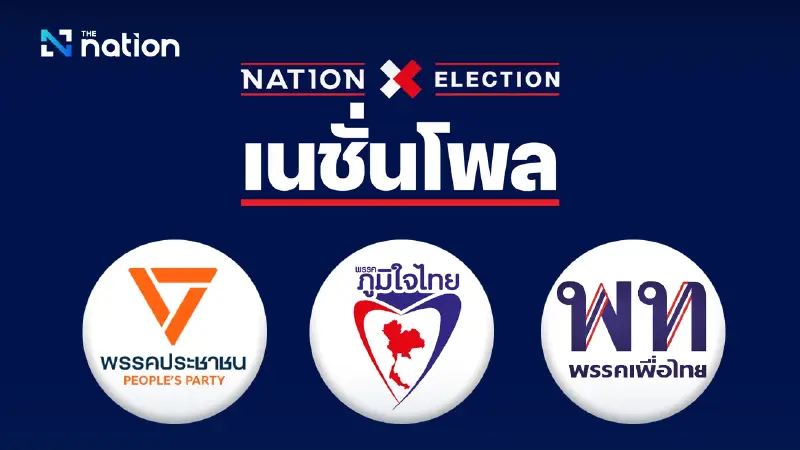


Nation Poll finds People’s Party and Bhumjaithai running neck and neck nationwide, with Pheu Thai third but leading in several areas
Nation Poll has released findings from a nationwide survey conducted in the final stretch before election day.
After a door-to-door survey of more than 10,000 people in all regions, the overall picture shows the People’s Party and Bhumjaithai running so close they are “breathing down one another’s necks”, while Pheu Thai is in third place — yet still delivering surprises by overtaking rivals and leading in several areas.
Nation Poll deployed field teams nationwide using a “walk-and-survey, knock-on-doors” approach, covering Thai voters in every region.
The country was divided into nine regional clusters of provinces, with interviews conducted down to community and village level, both inside and outside municipal areas. Each region had 1,200 respondents, for a nationwide total of 10,890 respondents.
The survey found that at the national level, voters show the strongest tendency to choose constituency MPs from Bhumjaithai and the People’s Party, at almost identical levels: 21.14% and 21.11% respectively (with Bhumjaithai slightly ahead). Next came Pheu Thai at 17.56%, followed by the Democrat Party at 7.58%. However, 23.85% said they were still undecided.

For party-list MPs, voters show the strongest tendency to choose the People’s Party and Bhumjaithai, again at very similar levels: 21.89% and 20.59% respectively (with the People’s Party slightly ahead). Next came Pheu Thai at 17.02% and the Democrat Party at 7.9%. Those still undecided accounted for 24.73%.

Compared with the 2023 election, the results are a stark contrast. In 2023, the top contenders for first place were Pheu Thai and the Move Forward Party (as it then was). Bhumjaithai’s popularity at that time stood at 11.08% in the constituency system and 9.62% in the party-list system.
64% likely to pick the same party on both ballots, but switching from 2023
Nationwide, a majority of respondents — 64.6% — are likely to choose the same party for both their constituency MP and party-list MP ballots in this election. Those likely to choose different parties stand at 35.4%.
In addition, more than half of respondents are likely to vote differently for constituency MPs compared with the last election, at 58.58%, while 41.42% are likely to choose the same constituency party as last time.
For party-list MPs, the pattern is similar: 58.97% are likely to vote differently from last time, while 41.03% are likely to choose the same party-list party as in the previous election.
‘Create jobs – cut the cost of living’ dominate urgent priorities
Nationwide, the issue most respondents want the new government to tackle urgently in its first 100 days is:
- Increasing jobs and income (wages, earning opportunities, support for SMEs) — 41.91%
- Reducing the cost of living by restructuring water and electricity costs, and providing accessible public transport and mass transit at reasonable prices — 33.2%
- Combating corruption and addressing “household debt” and “informal debt” were close behind at 23.27% and 22.05% respectively.

Majority support a referendum to amend the 2017 Constitution
On a referendum on amending the 2017 Constitution, most respondents are inclined to vote in favour of constitutional amendments, at 56.26%, while 30.12% are inclined to vote against.
Bangkok and Central region: orange still leads, blue close behind
For the regional results across nine regions — summarised here for the top three scorers in each area — the findings are as follows:
Bangkok
- Constituency MP voting tendency: People’s Party 28.84%, Bhumjaithai 19.24%, Pheu Thai 14.84%, undecided 24.99%
- Party-list MP voting tendency: People’s Party 29.34%, Bhumjaithai 18.92%, Pheu Thai 14.75%, undecided 25.16%
Central region
- Constituency MP voting tendency: People’s Party 20.82%, Bhumjaithai 16.68%, Pheu Thai 12.12%, undecided 34.92%
- Party-list MP voting tendency: People’s Party 20.65%, Bhumjaithai 18.79%, Pheu Thai 12.81%, undecided 33.3%
Eastern region surprise: Pheu Thai overtakes the two camps
Eastern region
- Constituency MP voting tendency: Pheu Thai 19.11%, People’s Party 15.51%, Bhumjaithai 13.18%, undecided 33.44%
- Party-list MP voting tendency: Pheu Thai 19.49%, People’s Party 16.03%, Bhumjaithai 15.03%, undecided 31.23%
Bhumjaithai dominates the Northeast
Upper Northeast
- Constituency MP voting tendency: Bhumjaithai 28.58%, Pheu Thai 25.81%, People’s Party 16.96%, undecided 17.2%
- Party-list MP voting tendency: Bhumjaithai 31.06%, Pheu Thai 23.33%, People’s Party 16.04%, undecided 19.44%
Lower Northeast
- Constituency MP voting tendency: Bhumjaithai 27.05%, People’s Party 23.12%, Pheu Thai 23.01%, undecided 23.01%
- Party-list MP voting tendency: People’s Party 26.88%, Bhumjaithai 23.17%, Pheu Thai 19.46%, undecided 24.82%
Upper North heats up: red vs orange too close to call
Upper North
- Constituency MP voting tendency: Pheu Thai 33.27%, People’s Party 30.83%, Bhumjaithai 9.34%, undecided 15.02%
- Party-list MP voting tendency: People’s Party 32.91%, Pheu Thai 31.74%, Bhumjaithai 9.26%, undecided 15.56%
Lower North: blue in full control
Lower North
- Constituency MP voting tendency: Bhumjaithai 28.87%, People’s Party 24.44%, Pheu Thai 17.47%, undecided 10.87%
- Party-list MP voting tendency: Bhumjaithai 28.67%, People’s Party 24.77%, Pheu Thai 17.35%, undecided 11.22%
Upper South: Democrats revive; Kla Tham enters Lower South
Upper South
- Constituency MP voting tendency: Democrat Party 33.54%, People’s Party 19.5%, Bhumjaithai 18.15%, undecided 17.79%
- Party-list MP voting tendency: Democrat Party 34.6%, People’s Party 17.65%, Bhumjaithai 15.05%, undecided 20.24%
Lower South
- Constituency MP voting tendency: Democrat Party 23.46%, Bhumjaithai 18.27%, Kla Tham Party 10.28%, undecided 27.65%
- Party-list MP voting tendency: Democrat Party 26.17%, Bhumjaithai 12.03%, People’s Party 11.43%, undecided 33.01%
Nation Poll director defines ‘trident politics’
Assoc Prof Dr Chettha Sapyen, director of Nation Poll, said the nationwide results show voters’ constituency preferences for Bhumjaithai and the People’s Party are extremely close, separated only by decimal points: 21.14% versus 21.11%.
For the party-list vote, support for the People’s Party and Bhumjaithai is also close. Although the People’s Party leads, the gap is under two percentage points: 21.89% versus 20.59%.
With around a quarter of respondents still undecided, he said late momentum shifts remain possible in the final stretch.
Comparing across the nine regional clusters, he said no party is clearly dominating rivals among the three frontrunners — the People’s Party, Bhumjaithai and Pheu Thai. Each party leads in some regional clusters and trails in others, even though momentum appears to favour the People’s Party and Bhumjaithai more than Pheu Thai.
He noted that this differs from the last election on 14 May 2023, which was effectively a two-pole contest between liberal and conservative blocs. For the 8 February 2026 election, Nation Poll’s findings indicate an unmistakable three-bloc dynamic — which he described as “trident politics”.
