
Election seen as turning point for Thailand’s economy
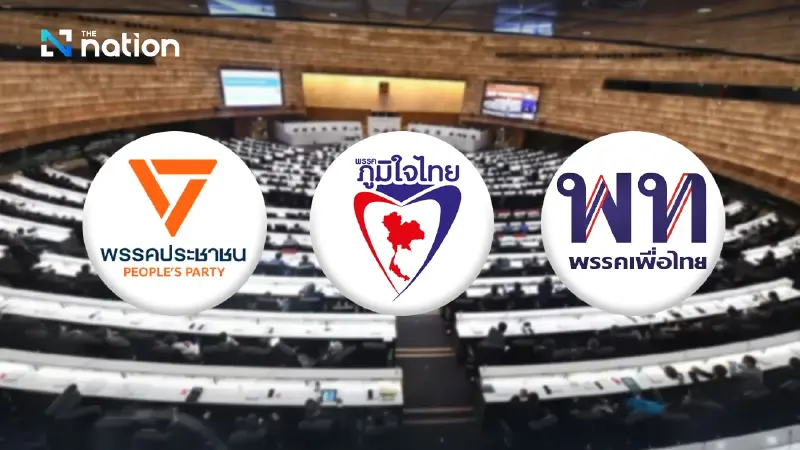


Thailand’s Feb 8 election is seen as an economic turning point as the People’s Party, Pheu Thai and Bhumjaithai unveil short- and long-term fixes
The general election on February 8, 2026 is being seen as a major “turning point” for Thailand’s economy, as the country grapples with multiple pressures including rapidly rising household debt, weakened consumer purchasing power and GDP growth at its lowest level in 30 years, excluding years marked by economic crises.
Public debt has also climbed close to the 70% of GDP ceiling. This has become a major test for whichever party forms the next government: short-term measures are expected to reduce living costs, while long-term plans must build new economic engines to lift growth and restructure the Thai economy.
Krungthep Turakij has compiled the short- and long-term economic policies of three parties regarded as potential leaders of the next government: the People’s Party, the Pheu Thai Party, and the Bhumjaithai Party.
People’s Party: Budget sufficiency and ready-to-run stimulus
The People’s Party, represented by Sirikanya Tansakun, deputy leader and prime ministerial candidate, said the party’s economic policy combines short- and long-term measures, with budgets assessed for adequacy.
For short-term economic measures, the party said it would submit proposals to the cabinet immediately within its first 100 days in office. These include a Khon La Khrueng (co-payment) programme, topping up 1,000 baht for 12 million people to buy goods from small retailers, and an SME receipt lottery budgeted at 1 billion baht per month to encourage SMEs to enter the tax system.
The party said it would use existing infrastructure such as the Pao Tang app. Shoppers who spend 500 baht at neighbourhood shops would receive digital lottery tickets, with total prizes of 500 million baht per draw, aimed at giving small retailers an edge against major chains.
It also proposed boosting liquidity and stimulating the economy through mechanisms that can be activated quickly, including 250 billion baht in loans for SMEs. This would be split into S-level loans worth 50 billion baht, with the Thai Credit Guarantee Corporation increasing its guarantee coverage to 30% from 15%; M-level loans worth 100 billion baht at a 3% low interest rate; and 100 billion baht in loans for the property and construction sectors to support first-time homebuyers, reduce housing stock and stimulate the construction materials supply chain.
On wages, the party would raise the minimum wage immediately to 350–420 baht per day, with annual increases adjusted using a formula linked to the cost of living. On debt, it would immediately cancel debt for farmers aged 70 and above, and cancel debt for farmers who have repaid more than the principal.
For long-term policy, Thanathorn Juangroongruangkit, former leader of the Future Forward Party and a key campaign figure, outlined a plan to invest 400–500 billion baht over 10 years in smart grid and smart meter infrastructure. This would upgrade transmission lines and replace 30 million electricity meters with digital units at no cost to households. The first four years would begin in Bangkok and the eastern region, which together account for nearly 70% of electricity use.
The party also supports a liberalised electricity market and aims to promote Thailand as an ASEAN energy hub, exporting clean power to Malaysia and Singapore while earning transmission fees. These measures would go hand in hand with restructuring electricity tariffs, cutting costs by 40–70 satang per unit, or around 10%.
On quality of life, the party prioritises universal welfare from childhood through retirement, including raising the old-age allowance to 1,500 baht per month.
Pheu Thai: Rapid cash injection and debt clearance
Pheu Thai, represented by Prommin Lertsuridej, said the first pillar is urgent economic stimulus through injecting money into the system. Its “More Than Plus 70:30” scheme resembles the co-payment policy, but with the state paying 70% and the public paying 30%.
The party also proposed a “Millionaire Creation” scheme, awarding one-million-baht prizes to nine winners daily, drawn from receipts of shops that are in the tax system and VAT-registered. The party said this is designed to bring more businesses into the VAT system and could generate an additional 100 billion baht per year in state revenue, while requiring an annual budget of 3 billion baht.
On debt, Pheu Thai proposed clearing bad household debts for unsecured NPLs of up to 200,000 baht, allowing borrowers to settle by paying only 10% to close the debt. It also proposed a three-year debt moratorium for farmers.
To reduce living costs, the party aims to cut electricity prices to 3.70 baht per unit and provide cash support to people earning less than 3,000 baht per month, which it defines as below the poverty line.
Medium-term policies include pushing the 20-baht flat-fare electric rail policy to completion and promoting a retirement lottery scheme as a savings mechanism that pays out when participants reach the age of 60.
For long-term restructuring, Yodchanan Wongsawat, Pheu Thai’s prime ministerial candidate, said Thailand needs clear flagship industries to drive a new economy, and should develop an AI hub focused on areas where Thailand has strengths:
Food — using agriculture as a foundation, leveraging biodiversity, improving productivity and adding value, with AI used to strengthen Thailand’s position in global food.
Healthcare — developing a Medical AI Hub and data infrastructure, with project-based development and foreign investment, including chip (IC) and related component manufacturing.
Bhumjaithai: “10 Plus” strategy and extending proven programmes
Anutin Charnvirakul, leader of Bhumjaithai and prime ministerial candidate, said the party’s platform is “Say it, do it — plus”, and it has positioned figures for key portfolios, including Ekniti Nitithanprapas and Suphajee Suthumpun.
Its short-term measures include stimulating the economy through Khon La Khrueng Plus Phase 2 to immediately ease the cost of living, alongside reforms to the state welfare card, including a new registration round, framed as policies that deliver short-term impact with longer-term benefits.
On debt, it plans to expand the “Close debts quickly, move forward” programme to cover more groups, offering a three-year debt moratorium with suspended principal and zero interest for participants. The party said around 300,000 people have already applied, with a target of 1.3 million. It also proposed an SME “lifeline” policy, including a new guarantee fund to encourage financial institutions to lend more to SMEs.
On electricity prices, it set a target of no more than 3 baht per unit for households consuming no more than the first 200 units.
For longer-term goals, Mr Ekniti said the party’s “10 Plus” policy targets GDP growth of about 3% and aims to lift national investment to 30% of GDP within four years. Priority sectors include electric vehicles (EV), data centres and AI, supported by the Thailand Fast Pass scheme in cooperation with the Board of Investment (BOI).
The party also aims to raise Thailand’s role on the global economic stage. It said that after discussions with the private sector during the World Economic Forum in Davos, it had helped draw investment into Thailand worth 500 billion baht, highlighting the importance of negotiations with global companies to promote investment.
