
Five parties offer policies to subsidise fares for electric trains and buses in Bangkok
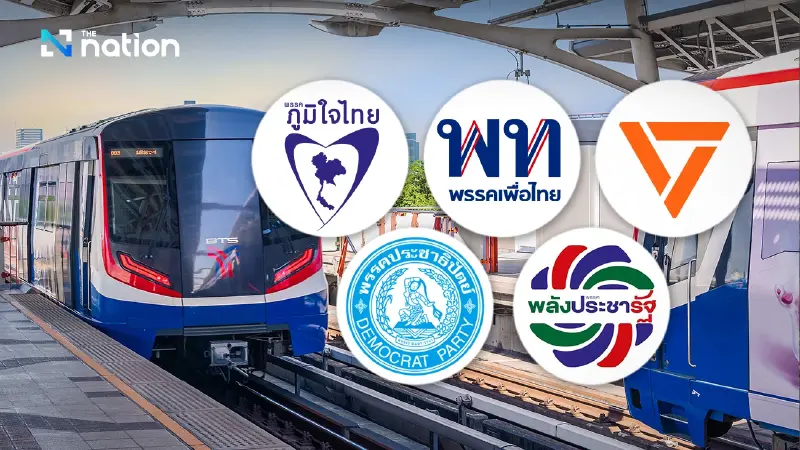


Five parties unveil plans to cut Bangkok mass-transit costs, from THB20 flat rail fares to integrated tickets capped at THB30–45 and peak-hour subsidies.
Five political parties, including the Pheu Thai Party, the People’s Party and the Bhumjaithai Party, are trying to win support from residents of Bangkok and surrounding areas by proposing policies to subsidise fares for electric trains and buses.
These three parties, along with the Democrat Party and the Palang Pracharath Party, have unveiled campaign proposals to cut the cost of travel by bus and electric train, aiming to help commuters in Bangkok and nearby provinces reduce their cost of living.
Around 14 million people live in Bangkok and surrounding provinces, yet only about 10% use the mass transit system, largely because electric train fares are seen as too expensive. Some commuters may pay more than THB100 a day to travel by electric train to and from work.
Why Bangkok commuters want cheaper mass transit fares
With daily travel costs rising, the parties are pitching different subsidy models to make public transport more affordable, particularly for commuters travelling between the suburbs and central Bangkok.
Pheu Thai Party: THB20 flat fare on electric trains, THB10 per EV bus trip
- Electric trains: THB20 for all lines — covering every line and route, with unlimited interchanges, aimed at reducing inequality for suburban commuters.
- Electric buses: THB10 per trip — phasing out non-air-conditioned buses and switching the entire fleet to EV buses.
- Target: combining bus and electric train fares, a return commute would cost THB60 per day (or THB30 per trip).
People’s Party: Integrated ticket THB8–45 per journey, with a THB45 cap
- Integrated fare: link buses and electric trains at THB8–45 for a complete journey from origin to destination.
- Maximum cap of THB45: regardless of how many bus routes or rail lines are used, the total must not exceed THB45 per trip.
Proposed fare structure
- Bus only: base fare THB8 + THB1 per km (capped at THB25).
- Electric train only: base fare THB15 + THB2 per km (capped at THB45).
App and data plan
- Develop a single app combining real-time information for buses, electric trains and boats, and collect origin–destination data to improve service frequency and routes based on actual travel demand.
Bhumjaithai Party: THB40 all-day electric train fare using a zoning model
- Set electric train fares on routes in Bangkok and surrounding provinces at no more than THB40 per day.
- Propose zoning the rail network, allowing travel within designated zones for up to THB40 per day.
- Travel outside the designated zones would be charged at a different rate, with the structure to be finalised after the rail network is fully mapped out.
Democrat Party: Zoning fares THB5–30, with a THB30 cap across buses and trains
- Fares of THB5–30: based on zone divisions — shorter trips pay less, while longer trips pay a higher but “appropriate” fare.
- Maximum cap of THB30: passengers would pay no more than THB30 across the system, with electric trains and buses integrated as a single network.
- The aim is to break the perception that buses are for low-income commuters while electric trains are for higher-income commuters.
Palang Pracharath Party: Peak-hour electric train fare subsidies for suburban routes
- Subsidise electric train fares only during peak hours, focusing on routes linking the suburbs with central Bangkok.
Integrated ticketing is the common goal, but pricing models differ
Overall, all five parties support moving towards an integrated ticketing system to make travel more seamless and cheaper. However, their fare-calculation methods differ, reflecting the commuter groups each party is aiming to target.
