
Thaksin parole process heads to final review before May release
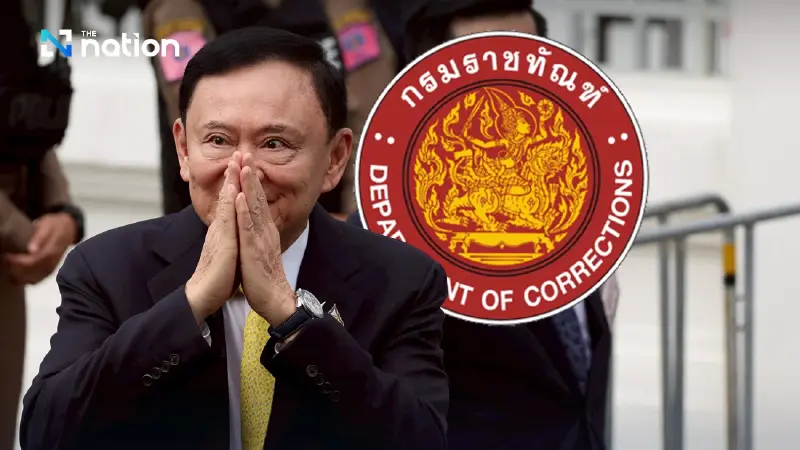


Justice Ministry says Thaksin Shinawatra’s parole case is moving through the normal legal process, with a final review due on April 29 and release expected on May 11.
- Former prime minister Thaksin Shinawatra's parole case is scheduled for a final review by a Justice Ministry subcommittee on April 29, 2026.
- His potential release on parole is set for May 11, 2026, after he becomes eligible by serving two-thirds of his one-year sentence.
- The request has already passed two lower committees, with the final approval resting with the permanent secretary of the Justice Ministry.
- If released, Thaksin will be on probation for the remaining four months of his sentence, and a decision is pending on whether he must wear an electronic monitoring bracelet.
Justice Minister Pol Lt Gen Rutthapon Naowarat said former prime minister Thaksin Shinawatra’s parole case is proceeding under the normal process, with the subcommittee responsible for considering and ruling on parole due to meet on April 29, 2026.
He said the request had already been filed and stressed that the case was moving through the regular mechanism ahead of Thaksin’s scheduled release on May 11, 2026.
Rutthapon also said the final approval is not in the minister’s hands, but rests with the permanent secretary of the Justice Ministry, after the case has passed scrutiny by three committees.
The process is being carried out under the Corrections Act 2017. Thaksin has been serving a one-year prison sentence since September 9, 2025.
As of April 21, 2026, he had served seven months and 12 days and was nearing the two-thirds threshold of his sentence, equivalent to eight months or 244 days.

On that calculation, he will complete the required period on May 10, 2026, making him eligible for release on parole on May 11, 2026.
He would then remain under probation for a further four months until his sentence ends on September 9, 2026.
The approval process has moved forward in sequence under the legal and administrative framework.
On March 31, 2026, the parole committee at Klong Prem Central Prison approved 10 inmates, including Thaksin, for consideration under the ordinary parole procedure.
The case was then forwarded to the Department of Corrections committee, which is scheduled to meet on April 24, 2026, to scrutinise the completeness of the documents and other relevant conditions before sending the names to the Justice Ministry level.
The final stage will be the April 29, 2026, meeting of the Justice Ministry subcommittee.
A decision on whether Thaksin must wear an electronic monitoring bracelet (EM) during probation will be left to the discretion of the Department of Corrections committee and the ministry-level subcommittee.
In making that decision, the authorities are expected to consider his health, his age of more than 70, the environment and safety of the residence where he would stay, and the risk of reoffending.
Any probation conditions, including the EM decision, are to be considered strictly within the legal framework and human rights principles.
If the parole is approved and he is released, the Department of Corrections will notify probation officers and local administrative officials in the area where he will stay.
Thaksin will then be required to comply strictly with all probation conditions and report to a probation officer within three days of his release.
