
Thai-Cambodian border stays shut amid political and military tensions
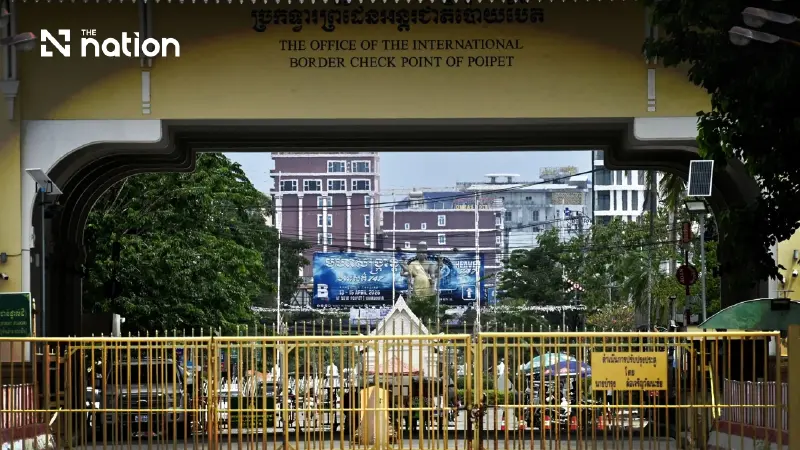


Political distrust and renewed military tension are dimming hopes that Thailand and Cambodia will reopen their border crossings after a year
- Despite diplomatic efforts, including an ASEAN meeting and China's offer to mediate, a lack of political trust has prevented the border from reopening after nearly a year of closure.
- Ongoing military tensions at the frontier, including unexplained explosions, warning shots, and Cambodian construction activity, continue to undermine confidence-building measures.
- Specific political disagreements, such as a dispute over maritime claims and Thai concerns about Chinese military equipment sales to Cambodia, have weakened the momentum for normalizing relations.
- Domestic political pressures in both countries, including upcoming elections in Cambodia and sovereignty concerns for the new Thai government, restrict the ability of leaders to make concessions.
Nearly a year after border crossings between Thailand and Cambodia were shut, intermittent diplomatic overtures have yet to produce the political trust needed to reopen them, leaving border communities and businesses facing an increasingly prolonged economic standstill.
Expectations of a possible thaw emerged in April following reports of informal contact between a person close to Cambodian Senate President Hun Sen and Thai officials operating near the border.
Attention initially centred on crossings in Chanthaburi and Trat, which fall under the Chanthaburi and Trat Border Defence Command. Relations in this sector have generally been viewed as less confrontational than those along Thailand’s northeastern frontier and in Sa Kaeo.
Rear Admiral Parat Rattanachaiphan, spokesman for the Royal Thai Navy, subsequently denied reports that crossings in the two eastern provinces would be opened to allow humanitarian supplies into Cambodia. He stressed that the border remained completely closed, although the reported informal contact itself was not addressed.

Regional diplomacy provided another opening after the Philippines succeeded Malaysia as ASEAN chair and offered its good offices to help reduce tension between the two neighbours.
Prime Minister Anutin Charnvirakul, Cambodian Prime Minister Hun Manet and Philippine President Ferdinand Marcos Jr met in Cebu on May 7 on the sidelines of the 48th ASEAN Summit.
The meeting produced an agreement to consolidate the ceasefire, exercise restraint and assign the Thai and Cambodian foreign ministers to develop confidence-building measures aimed at restoring trust and gradually normalising bilateral relations.
Anutin also informed Hun Manet of Thailand’s decision to terminate the memorandum of understanding governing overlapping maritime claims, commonly known as MOU 44, after the mechanism had failed to deliver progress over more than two decades.
Cambodia later initiated proceedings under the United Nations Convention on the Law of the Sea, or UNCLOS, seeking compulsory conciliation over the maritime dispute. Although the process can compel participation in conciliation, its recommendations are not legally binding.
The move exposed continuing differences over how the dispute should be handled. Thailand has maintained that bilateral negotiations remain the preferred route, while Cambodia has turned to an international legal mechanism following Bangkok’s withdrawal from MOU 44.

The disagreement weakened the momentum generated in Cebu, where both governments had pledged to rely on dialogue and diplomacy rather than force.
Conditions on the ground have meanwhile remained fragile. Thai military authorities have reported unexplained explosions, warning shots and Cambodian construction activity near several parts of the frontier.
According to Thailand’s Second Army Region, 19 explosions were recorded near the border from April to mid-July, including six during July. Thai representatives have asked Cambodia to investigate the incidents and avoid establishing operational positions too close to the border fence.
Cambodian and Thai authorities have also exchanged conflicting accounts of individual incidents. After an explosion injured four Cambodian soldiers in Oddar Meanchey province on July 5, Cambodia said the cause was being investigated, while Thailand denied Cambodian allegations linking Thai troops to the blast.
Efforts to revive dialogue gained fresh attention during Anutin’s visit to China for the 2026 World Artificial Intelligence Conference in Shanghai.
Following bilateral talks with Chinese President Xi Jinping, Anutin said Xi had offered to facilitate discussions between Thailand and Cambodia and help the two neighbours seek a way to restore their relationship.
Anutin reiterated that Thailand did not seek conflict with any country but remained obliged to protect its sovereignty and the safety of its people.
The two leaders also discussed Thai concerns about China’s delivery of military equipment, particularly tanks, to Cambodia.
According to Anutin, Beijing explained that the purchase agreement predated the border conflict. China had delayed delivery during the fighting because of the sensitivity of the situation but was ultimately required to fulfil its contractual obligations.
“China delayed the delivery of military equipment while fighting was under way because it recognised the sensitivity of the situation,” Anutin said.
“However, it eventually had to comply with its contractual obligations. China has assured us that an understanding is in place and that the equipment will not be used to cause harm to Thailand.”
China acknowledged Thailand’s concerns and gave assurances that the equipment supplied to Cambodia would not be used against the country.
Despite these diplomatic signals, the prospect of reopening the border remains remote. Domestic politics, public sentiment and security concerns continue to restrict the room available to both governments.
Cambodia is preparing for local council elections in June 2027 as it faces broader economic pressures. The vote is a local election rather than a national contest, but its political significance may encourage the government to maintain a firm public position on territorial issues.
Thailand, meanwhile, has only recently emerged from a general election. Anutin’s government remains under pressure to demonstrate that it will not make concessions affecting sovereignty or allow Cambodia to gain a political or strategic advantage from the border dispute.
Military developments are adding to the uncertainty. Thai authorities have reported Cambodian troop movements, the establishment of operational positions, bunker construction and trench digging near Thai defensive lines in areas overseen by the First and Second Army regions and the Chanthaburi and Trat Border Defence Command.
Thailand began imposing restrictions on Cambodian border crossings in June 2025 as territorial tension escalated. All crossings were subsequently closed during the outbreak of fighting in July.
One year on, the border remains effectively locked.
Businesses that once depended on cross-border trade are still waiting for commerce to resume, but reopening will depend on more than an agreement at the gates. Until Bangkok and Phnom Penh can narrow their political differences, restore military confidence and establish a workable framework for resolving their disputes, the economic lifeline connecting communities on both sides is likely to remain severed.
Source: Bangkokbiznews
