Thailand’s boating and marina sector is pitched as a high-value tourism driver within the blue economy, with Phuket, Krabi and Bangkok projects expanding capacity
The boating and marina business is a key mechanism for shifting Thailand’s tourism industry from a focus on volume to higher value, aiming to attract high-spending visitors and yacht owners.
The industry is an important part of the “blue economy”, with strong growth potential in line with global markets, and a pillar for driving the economies of Thailand’s 23 coastal provinces.
Thailand is accelerating the development of port and marina infrastructure in strategic areas such as Phuket, Krabi and Bangkok to meet rising demand, particularly from superyachts.
Phuket is being positioned as “Asia’s yachting capital”, backed by major deep-sea port projects and international boat shows designed to attract investment and quality tourists.
On Jan 21, 2026, as Thailand’s tourism industry transitions from prioritising “visitor numbers” to boosting “spending per head”, the boating and marina industry is increasingly being watched as a new economic mechanism with strong potential to create high value, while linking tourism with real estate, services and technology.
In 2026, Thailand’s boating and marina industry stands at a key structural turning point, set against a global backdrop of slower but more stable growth in specialised niche markets.
International assessments indicate the global marina market is valued at US$10.51 billion in 2026 and is expected to grow steadily to US$15.53 billion by 2035, with a compound annual growth rate (CAGR) of 5%. This expansion is being driven primarily by the growth of leisure water-based tourism, which is rising by 3.55% per year worldwide.
“Blue Economy”
For Thailand, the sector is not merely an add-on to tourism. It is presented as a pillar of the “blue economy”, spanning 23 coastal provinces and generating income estimated at around 30% of gross domestic product (GDP), while supporting employment for as much as one quarter of the national workforce.
Thailand’s economy in 2026 is expected to grow close to its potential rate of 2.5% to 3.0%, supported mainly by a strong tourism recovery. This recovery is creating opportunities not only in terms of volume, but also to attract high-spending travellers and yacht owners from around the world, consistent with a trend of luxury yacht ownership skewing younger. Yacht owners are now typically in their 40s to 50s and place greater emphasis on technology, sustainability and premium lifestyle experiences.
Global economy and implications for the maritime sector
Industry trends must also be viewed against the wider global economic picture. Between 2024 and 2026, global growth is expected to remain low as the post-Covid reopening boost fades, alongside a trend of fragmented globalisation that could intensify.
However, commercial shipping and water logistics have remained resilient—particularly in Asia, which accounts for more than 53% of global maritime transport. Shipping trade volumes are forecast to expand by 3.3% to 3.6% per year over 2025–2027.
For Thailand, cargo shipping is recovering unevenly across segments. Tankers—including petroleum products and chemicals—are expected to grow in line with energy demand in industry and power generation, with domestic demand for refined oil products projected to rise by 2.0%–3.0% per year. By contrast, bulk carriers are recovering more slowly, tracking demand for commodities and construction materials.
Globally, the marina industry and boating tourism are in an upswing. The global marina market is estimated at around US$10.51 billion and is expected to surpass US$15.5 billion within the next decade, while the yacht charter and marine services market is expanding at an average of more than 5%–8% per year.
In Thailand’s capital market, the marine and shipping industry had a market capitalisation of about 34.4 billion baht in early 2026, with combined revenue of 50.7 billion baht and net profit of 10.4 billion baht. Although the price-to-earnings (P/E) ratio stands at 3.3 times, reflecting a negative investor view on long-term growth compared with historical averages, profit forecasts still point to growth of 29% per year—seen as an opportunity for operators able to control costs and improve efficiency through technology.
Marina infrastructure development: a new ASEAN hub
Thailand is accelerating its ability to accommodate yachts and cruise vessels through large-scale development projects in several strategic areas. At present, the number of quality berths in Thailand is fewer than 2,000, which is insufficient for rapidly rising demand—particularly from superyachts, which require specialised facilities.
Phuket: world-class deep-water marina
Phuket continues to defend its position as “Asia’s Yachting Capital”. In 2026, the most prominent project is the development of a marina at Sapam Bay, covering more than 61,000 sq m of waterfront area, plus an additional 78,000 sq m of adjoining land. The project has drawn particular attention because it is one of the few locations that can be developed into a deep-water marina, helping overcome tidal limitations that other Phuket marinas often face.
The Sapam Bay development has support from the government and the Phuket governor, aiming to attract high-spending visitors. The project is designed to provide 200 berths and includes luxury residential villas, retail space and maintenance facilities such as dry docks, considered critical for sustaining skilled local employment. The project is expected to create 800 new jobs.
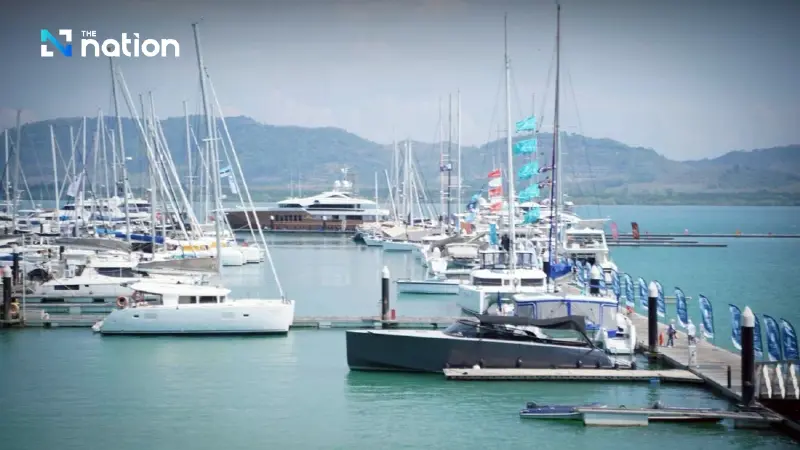
International boat shows are also being cited as key drivers of networking and waterfront investment. Thailand International Boat Show 2026 (TIBS), held at Phuket Yacht Haven Marina in January 2026, was described as drawing more than 5,000 participants—52% foreign and 48% Thai—reflecting global investor confidence in Phuket’s infrastructure.
David Hayes, chief executive officer of JAND Events, the owner and organiser of the Thailand International Boat Show, said the key was delivering a high-quality event and a memorable experience for visitors. He said the show offers something for everyone—from families and first-time visitors to buyers and investors—and is expected to attract several thousand Thai and international attendees across four days. He added that the event plays an important role in supporting Thailand’s marine and lifestyle industries and serves as a strong signal marking the start of Phuket’s high season.
The Thailand International Boat Show is also described as a main hub for the marine industry and luxury waterfront lifestyle, following the Thailand Yachting Conference held earlier in the week. The conference brought together industry leaders and policymakers to discuss the future of boating and marine tourism, reflecting the sector’s rising strategic importance within Thailand’s tourism and investment landscape.
At the show, Thailand Privilege Card Co., Ltd. (TPC)—operator of the “Thailand Privilege” membership card programme under the supervision of the Tourism Authority of Thailand (TAT)—joined the Thailand International Boat Show 2026 (TIBS) to reinforce Thailand’s potential as a world-class destination.
Manatase Annawat, president of Thailand Privilege Card Co., Ltd., said Phuket is no longer only a world-class resort destination but has advanced as a maritime hub and a strategic luxury hub with an increasingly important regional role. He said participation in the event was an opportunity to communicate and expand the customer base among ultra high net worth individuals (UHNWIs)—businesspeople, investors, superyacht owners and those drawn to the marine lifestyle. The key target audience, he said, includes customers seeking a second home in a world-class coastal city and those wishing to stay long-term in Thailand—particularly in Phuket, which he said has strengths across multiple dimensions and remains attractive with its “sea, sand and sun”, drawing large numbers of foreign visitors each year.
Krabi: expansion of Port Takola
Krabi is emerging as an alternative destination for boat owners seeking tranquillity and a natural environment. Port Takola Yacht Marina, located between Ao Nang and Krabi town, is developing phase two to add 80 more wet berths for boats measuring 10 to 25 metres, with full operations scheduled to begin in February 2026.
A distinctive feature of Port Takola is its family-style management approach aimed at building a sustainable yachting community. Development includes a modern capitainerie building with a swimming pool, meeting rooms and a chandlery.
Linkages with a mixed-use project and an international hospital in the Krabi area are also expected to strengthen the province’s potential to serve as a long-term home port for boat owners.
Bangkok and Pathum Thani: Riverdale Marina
Marina growth is not limited to coastal areas and is expanding into the Chao Phraya River basin to serve urban demand. Riverdale Marina in Pathum Thani has become a hub for water-based activities in central Thailand.
In 2026, the marina hosted the 4th Riverdale Marina Boat Fair, described as the largest fair for new boats, used boats and water sports equipment in the Bangkok metropolitan region. Riverdale Marina has received SHA certification for safety and hygiene standards and plans to expand berths and build a Marina Plaza to support a full ecosystem of Chao Phraya river tourism-related businesses.
Data from the Marine Department and related agencies show significant growth in boat trips and passenger numbers in the previous fiscal year and continuing into 2026. In sea areas, there were more than 874,476 service trips and 35.6 million passengers, while river areas recorded 7.05 million passengers. The overall number of trips increased by 72.79%, reflecting a full return in demand for water travel.
As for cruise ships and yachts entering and leaving Thailand over the past five years, figures have fluctuated with the pandemic. In 2023, inbound vessels rose to 148 and outbound to 159. For 2026, the figures are expected to return close to—or exceed—pre-Covid levels of around 170 vessels.
In the Asia-Pacific region, the number of operational superyachts increased by 19% in the latest year and is projected to exceed 600 vessels by the end of 2026, with Thailand described as one of the main destinations benefiting from fleet growth in the region.
References cited in the report:
Marinas Market Size, Share, Growth, and Industry Analysis
Yacht Industry Statistics 2026
Industry Outlook 2025–2027: Sea Freight Transport
researchnester
Phuket’s Future Redefined: Exclusive Deep-Water Marina Set to Make It Asia’s Yachting Capital
Thailand’s Premier Marinas: A Yachtsman’s Comprehensive Guide to Phuket, Samui & Pattaya