
Chinese hotels turn to street food as guests cut back spending
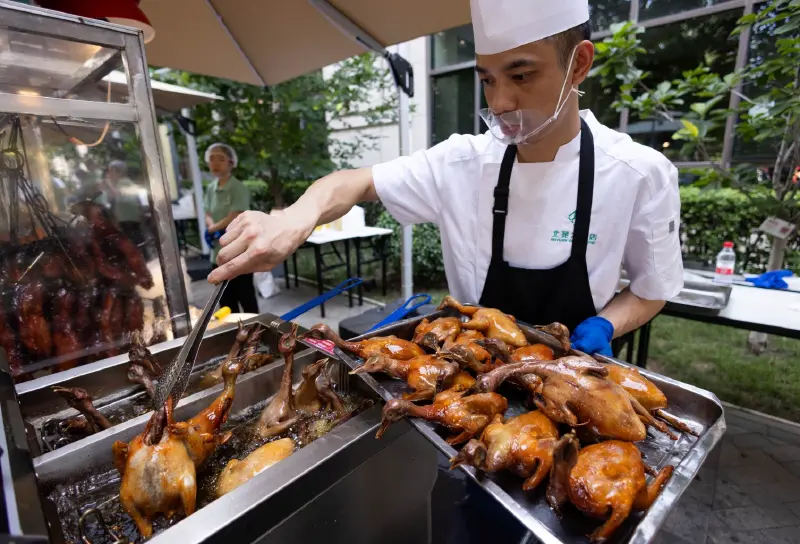


In response to declining revenue, Beiyuan Grand Hotel in Beijing has adapted by setting up street stalls each evening, offering freshly cooked gourmet dishes to passersby.
The move is part of a wider trend among Chinese high-end hotels seeking alternative revenue streams, as consumers and businesses scale back spending on travel, conferences, and banquets.
"Lowering prices or offering discounts alone won't bring customers back; they just won't come at all," explained Anwen Xu, the hotel's sales director, highlighting the need to innovate and diversify income sources.
Beiyuan is one of at least 15 luxury hotels across China turning to food stalls, according to local news and social media reports.
These hotels have seen significant revenue declines due to weaker demand, reduced corporate and government travel budgets, and fewer banquet bookings.
Xu cited Beijing's stricter austerity measures this year, which include limits on large-group dining and alcohol consumption for public sector workers and party members, as a major factor in the hotel’s struggles.

Experts warn that the increasing reliance on street food sales is a sign of deepening deflationary pressure on China’s economy, which is increasingly driven by manufacturing and exports rather than domestic consumption. Consumer prices were flat year-on-year in July, further indicating economic stagnation.
"High-end restaurants, especially five-star hotels, are having to adapt strategically to survive," said He-Ling Shi, an economics professor at Monash University. "This reflects the growing risk of deflation in China’s overall economy."
Signs of deflation are evident in the catering sector, where June's revenue growth slowed to just 0.9%, down from 5.9% in May. Additionally, the accommodation industry in Beijing saw profits drop by 92.9% year-on-year in the first half of 2025.
"The food and beverage industry is under heavy pressure," said Wei Zheng, a staff member at Grand Metropark Hotel in Beijing, which began selling street food in July. "Many hotels have turned to selling outside to boost revenue," Wei added, noting that the hotel earns an extra few thousand yuan daily from items like braised duck, fish stew, and crayfish.

Beiyuan's most popular outdoor dish is its signature crispy roast pigeon, priced at 38 yuan ($5.29), compared to 58 yuan on the regular menu. Since the stall’s opening on July 28, daily sales of pigeons have surged from 80 to around 130.
Despite the boost from street food, the hotel's indoor business remains sluggish. Private dining-room usage has dropped from full capacity to about a third, and average spending per person has halved to around 100–150 yuan.
Xu mentioned that the outdoor stall has a margin of 10% to 15%, which, while better than average, still doesn’t fully offset the decline in indoor revenue.
Yaling Jiang, founder of research consultancy ApertureChina, noted that consumers are "hesitant" to spend on high-end options during the economic downturn, instead seeking value and novelty.
Shopper Seven Chen, who purchased barbecue pork at Beiyuan’s stall, acknowledged the hotel's efforts but said he’s now staying in luxury hotels less often, citing insufficient income as the primary reason.
Other hotels also embracing the street food model include the JW Marriott in Chongqing and Hilton Wuhan Riverside, with the latter offering street food from 5 pm to 6 pm. The five-star River & Holiday Hotel in Chongqing reported a major increase in daily revenue, surging to 60,000 yuan after setting up food stalls in its car park.
Shen Qiuya, marketing and sales manager at River & Holiday, dismissed concerns about damaging the hotel's brand value, emphasising that "every industry is facing challenges this year," and that survival is the top priority. "Face isn’t worth anything," Shen said.
($1 = 7.1798 Chinese yuan renminbi)
Reuters
