
Thai envoy: Korea investors still confident in Thailand’s potential despite global challenges
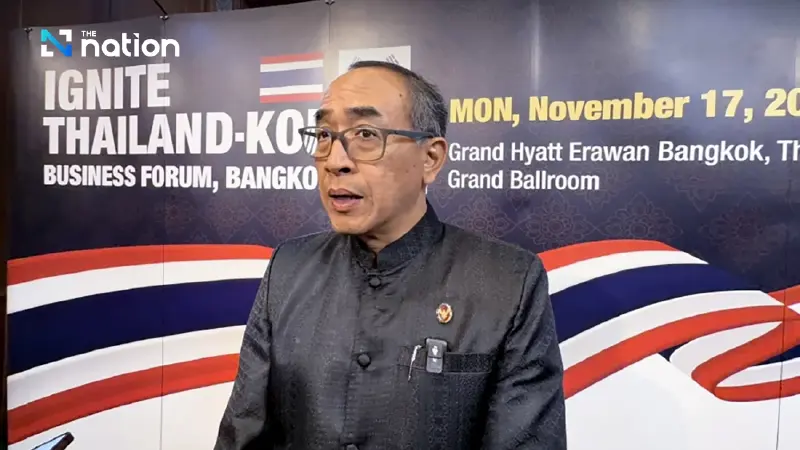


At the IGNITE Thailand-Korea Business Forum, Thailand’s ambassador in Seoul says Thai-Korean trade and investment ties remain strong despite geopolitical and US tariff pressures.
Thailand’s ambassador to Seoul, Tanee Sangrat, told the IGNITE Thailand-Korea Business Forum Bangkok 2025 that bilateral cooperation in trade, investment and business has moved forward without disruption, with both nations deepening economic ties since last year.
Tanee noted that Thailand hosted the Thailand Business Forum in Korea earlier this year, which resulted in a major investment announcement from a leading automotive parts manufacturer. Late last year, a Korean energy firm also committed to investing in Thailand. The collaboration is supported by partners including the Korea Industry Federation, Gero Media Group and networks from Korean industry clusters.

More than 100 Korean business leaders across digital, automotive parts, energy and construction sectors joined the latest visit to Thailand. Their programme includes trips to key sites in the Eastern Economic Corridor (EEC), meetings with Thailand’s prime minister and inspections of industrial estates and Laem Chabang deep-sea port.
Tanee said the visit allowed Korean investors to recognise Thailand’s strengths in S-Curve and New S-Curve industries, as well as creative sectors such as film, digital content and advertising — areas in which Thailand has demonstrated strong capability and consistent appeal for Korean firms.
“Even though South Korean companies are investing heavily in Vietnam and Indonesia, and shifting production out of China, Thailand still has a golden opportunity. Only around 400 Korean firms currently operate in Thailand, compared with more than 10,000 in Vietnam. The growth gap is huge,” he said.
Asked about Korean investor concerns, the ambassador acknowledged issues such as geopolitical risks, global economic slowdown, war and transparency, as well as political stability. But he stressed that Thailand remains a democratic country with a stable pro-investment policy, despite several government changes in recent years.
“Thailand maintains good relations with all major powers — the US, China, Japan, Korea and India,” Tanee said. “We are also a country with a high quality of life for expatriate experts, which strengthens investor confidence.”
US tariff pressure and trade strategy
On US tariff pressure — particularly Trump-era tariff mechanisms — Tanee said such measures are negotiation tools the US deploys globally. Thailand, he said, must diversify its export markets and accelerate talks on the Korea-Thailand Comprehensive Economic Partnership (KTCepa).
The agreement, expected to be signed by late this year, could increase Thai–Korean trade by US$1-2 billion, from the current US$15 billion. Thailand’s prime minister has set an ambition of raising bilateral trade to US$30 billion in the near future.
Tanee emphasised that South Korea is Asia’s fourth-largest economy, while Thailand is ASEAN’s second-largest. The two nations, he said, have the potential to create “leapfrog” growth in trade and investment if both sides fully harness their complementary strengths for the benefit of their peoples.
