
Doomsday Clock: what it is, how to read it, and what “midnight” means
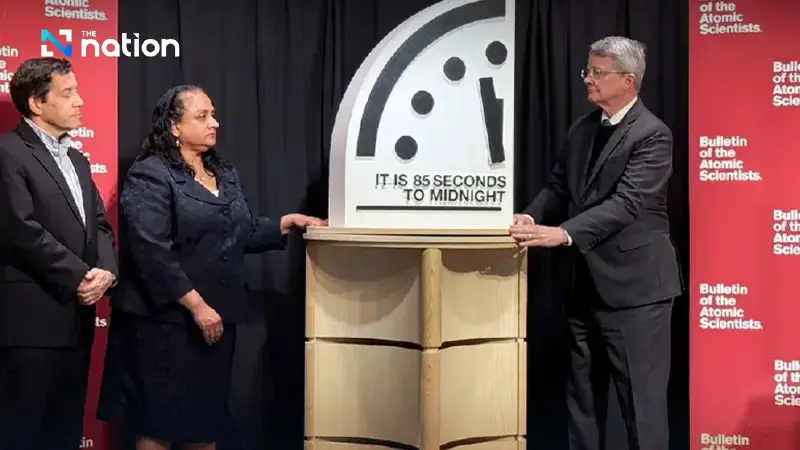


The Doomsday Clock has been set to 85 seconds to midnight for 2026—the closest ever—reflecting rising nuclear, climate, AI and biosecurity risks, and weakening global cooperation.
On January 29, 2026, the Doomsday Clock stands at 85 seconds to midnight—the closest it has been since the clock was created in 1947. The clock is maintained by the Bulletin of the Atomic Scientists, a Chicago-based non-profit founded by scientists who helped develop the first atomic weapons, and later joined by prominent public intellectuals and Nobel laureates.
What is the Doomsday Clock?
The Doomsday Clock is not a real countdown. It is a symbolic gauge of global risk—a way to communicate how close humanity is, in the Bulletin’s judgement, to a civilisation-threatening catastrophe driven by human actions and technologies. Each year, the Bulletin’s Science and Security Board reviews global conditions and then decides whether to move the clock’s hands.
How to read it
- “Midnight” represents a point of global catastrophe—often described as self-destruction or “annihilation” in the Bulletin’s framing.
- The closer the time is to midnight, the higher the assessed danger.
- The clock can move backwards as well as forwards, reflecting improvements or setbacks in global risk.
Historically, the clock has shifted widely: it was set as far back as 17 minutes to midnight in 1991, after major nuclear arms-reduction steps at the end of the Cold War. This year’s 85 seconds underscores the Bulletin’s view that risk has intensified and accelerated.
Why it moved closer in 2026
In its 2026 announcement, the Bulletin pointed to worsening risks across several fronts:
- Nuclear danger and arms-control strain, including heightened tensions among nuclear-armed states and concerns about the future of key frameworks such as New START.
- Climate risk, with the Bulletin warning that the climate crisis remains a central driver of long-term catastrophe risk.
- AI and disruptive technologies, including concerns about AI’s integration into military systems and its role in disinformation and biological threats.
- Biosecurity concerns, including the misuse of biotechnology and emerging risks at the intersection of AI and biology.
- A decline in international cooperation, with the Bulletin arguing that major powers have become more aggressive, adversarial and nationalistic, undermining collective action on shared threats.
Alexandra Bell, the Bulletin’s president and CEO, said: “The Doomsday Clock’s message cannot be clearer. Catastrophic risks are on the rise, cooperation is on the decline, and we are running out of time.”
Daniel Holz, chair of the Science and Security Board, warned that global fragmentation makes everything harder: “Our greatest challenges require international trust and cooperation, and a world splintering into ‘us versus them’ will leave all of humanity more vulnerable.”
So… are we “about to end”?
The clock does not predict a date or an inevitable collapse. Its purpose is to underline risk—and to argue that risk can still be reduced if leaders and societies act decisively. In other words: the hands can move away from midnight, but only if the world changes course.
