
Trump says US should have a say in Iran’s next leader as war intensifies
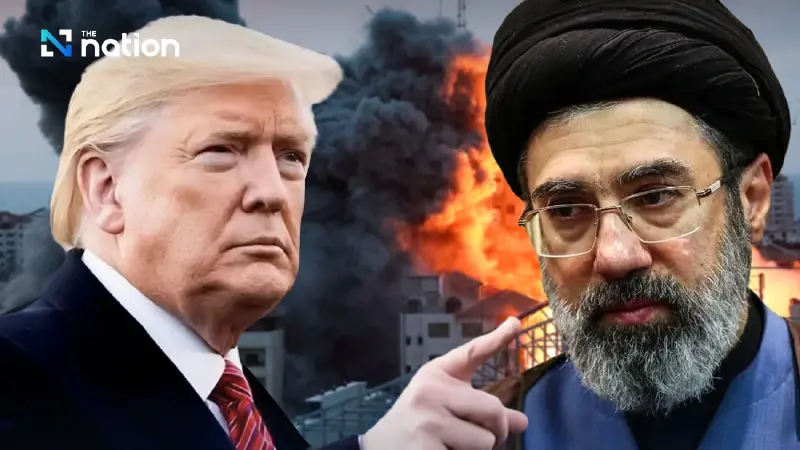


In a phone interview with Reuters, US President Donald Trump said Washington wants a role in choosing Iran’s next leader after the death of Supreme Leader Ayatollah Ali Khamenei, as fighting spreads across the region and markets brace for further disruption.
The war in the Middle East continued to intensify, as US President Donald Trump said the United States wants to play a role in determining Iran’s next leader following the death of Supreme Leader Ayatollah Ali Khamenei in US-Israeli air strikes.
In a telephone interview with Reuters, Trump said the United States wanted to be involved in “the process of choosing the person who is going to lead Iran into the future”, adding that the new leader should be someone who is “good for the people and good for the country”.
Trump also suggested that Mojtaba Khamenei, the late supreme leader’s son—widely seen as a potential successor—would be an unlikely choice for Iran’s future.
Trump backs Kurdish pressure on Tehran
Trump also voiced support for Kurdish forces in Iran launching military operations against Tehran, saying he would strongly back a new front being opened, while not confirming whether the United States would provide air support.
Reports said the US has been in contact with Kurdish groups since the start of joint operations with Israel. On the same day, there were reports of drone attacks hitting an Iranian opposition camp in Iraq’s Kurdistan region, as well as oil facilities operated by an American company.
Heavy strikes on Tehran, residents flee
Israel’s military issued warnings urging residents to evacuate multiple areas of Tehran, particularly in the east of the city, as Iranian media reported explosions in several locations across the capital. Reuters also reported that Iranian state television said an air strike hit a guesthouse in north-west Tehran, killing at least 17 people.
A resident quoted by Reuters described the situation as worsening, saying: “Today is worse than yesterday… It’s like a war zone.”
Conflict spreads across the region
On the sixth day of fighting, Iran launched retaliatory attacks against Israel and struck targets in the United Arab Emirates and Qatar, while a refinery in Bahrain caught fire following a missile strike, according to Reuters.
The conflict also widened further, with Azerbaijan accusing Iran of sending drones into its airspace—prompting a 12-hour closure of its southern airspace—an allegation Tehran denied. Reuters also reported that Cyprus and Türkiye recorded attacks, while European countries began deploying warships to the eastern Mediterranean in preparation for possible spillover.
Death toll rises, global economy hit
Iran’s Red Crescent was quoted as saying the number of deaths in Iran had risen to more than 1,200, with dozens more reported elsewhere in the Middle East.
The conflict’s shockwaves have also been felt across the global economy, as key energy routes in the Persian Gulf come under strain, disrupting oil and LNG supplies and adding turbulence to air travel and logistics.
Israel signals next phase
Israeli Prime Minister Benjamin Netanyahu said during a visit to an air base in southern Israel that strikes on targets in Iran had achieved “very great” success, but that there was still “much more” to do. Reuters reported that Israeli planning for a second phase would focus on underground bunkers used to store Iranian missiles, while Israel claimed it had destroyed 60% of Iran’s ballistic missile launchers.
Iran’s foreign minister warned the United States would “bitterly regret” the sinking of an Iranian warship by a US submarine in international waters, while Iran’s Revolutionary Guard commander said Iran was ready to “fight Americans wherever they are found”.
