
Thailand Songkran bus ticket sales slow on nationwide fuel fears
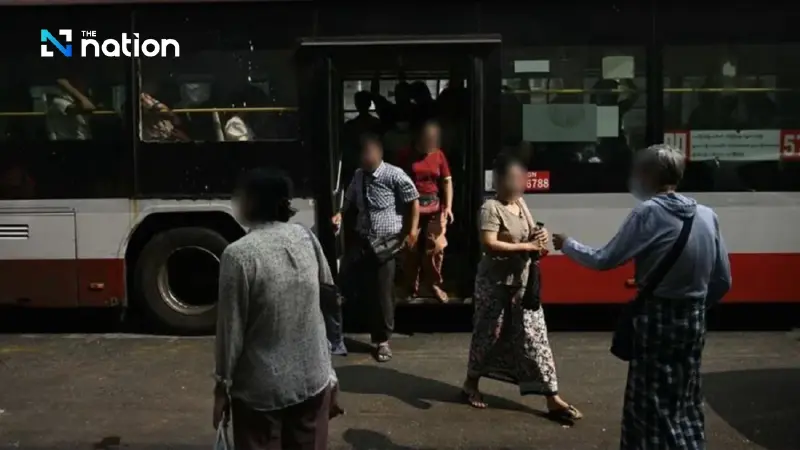


With the Songkran festival less than three weeks away, on April 13, many Thais would usually have bought advance bus tickets by now to return to their hometowns.
But amid uncertainty over the supply of fuel in the country, less than half of the bus tickets have been sold, operators told The Straits Times, compared with about 80 per cent in previous years at around the same time before the festival.
Some consumers are dragging their feet over buying bus tickets, worried about rising costs.
Transport operators are also monitoring the situation. The Thai Transportation Operators Association, which has 500 members with at least 15,000 tour buses plying roads across the country, said its members plan to sell tickets closer to Songkran.
This is so as to have a clearer assessment of the energy crisis and to know how to better price the routes, said its honorary adviser Wasuchet Sophonsathien.
“We don’t want to end up pushing the vehicles or leaving passengers stranded” along the way if the tour buses run out of fuel midway, he told ST.
Across Indochina, from Bangkok to Hanoi, anxiety over the supply of fuel has grown amid the threat of a prolonged and more widespread Middle East war ignited by the US-Israeli attack on Iran on Feb 28. About 20 per cent of the global oil supply passes through the Strait of Hormuz, which has since been blocked by Iran.
Thailand imports about half of its crude oil from the Middle East. The kingdom of around 72 million people has been encouraging industries and commercial buildings to reduce energy use, and buying crude oil from countries outside the Middle East.
Cambodia, which relies entirely on imported diesel and petroleum, has rolled out energy-saving measures such as limiting the use of air-conditioning in ministries, reducing the number of in-person meetings and cutting back on long-distance travel for civil servants.
The country of 18 million has said that it has oil reserves to last 21 days, and its energy minister told Reuters on March 18 that it is boosting fuel imports from suppliers in Singapore and Malaysia.
In Vietnam, Hanoi has reportedly asked Japan and South Korea for help in getting crude oil supplies.
In early March, Vietnam’s Industry and Trade Ministry warned that although the country operates two oil refineries, it still relies heavily on imported supplies. The ministry has been reported in local media as saying that the country’s petrol and diesel supply can meet local demand for between 30 and 45 days.
The government has assured its population of 102 million that it would monitor and prevent fuel hoarding and price manipulation, while encouraging greater use of public transport and electric vehicles.
A helping hand
Laos, a landlocked nation of around 7.8 million people, is sometimes referred to as “the battery of South-east Asia” as it has an extensive hydropower network.
However, it is still reliant on oil imports and had to shut down about 1,000 out of 2,538 petrol stations nationwide due to the lack of fuel supply earlier in March.
The authorities in Laos have also imposed measures, like reducing higher education classes to just three times a week and introducing a flat bus fare of 10,000 kip (60 Singapore cents) on selected routes for a period of time, to ease the impact of the fuel crisis.
Vietnam has stepped up to lend a hand to supply 50 million litres of fuel to Laos, after Thailand recently reduced its refined oil supply to Vientiane by 25 per cent to safeguard domestic needs.
Bangkok, which currently has oil reserves to last about 100 days, is said to be the supplier of almost all of Laos’ refined fuel.
Power outages already common in Myanmar
In Myanmar, the country’s military administration claims to have 40 days’ worth of petrol and 50 days’ worth of diesel in the national reserves as at mid-March.
The country of about 50 million people has not been completely electrified and power outages are common even in the commercial hub of Yangon.
Early in March, the military government introduced restrictions on the use of vehicles. Private cars and motorbikes can be on the streets only on alternate days, according to their licence plate numbers.
From next week, Myanmar will also regulate the purchase of fuel using barcodes and QR codes. Customers will be able to buy fuel only once or twice per week based on their vehicles’ engine capacity.
A Myanmar business owner, who declined to be identified for fear of reprisal, told ST that lines at petrol stations are getting longer, with average waiting time lasting up to five hours.
The price of fuel has gone up about 70 per cent from 2,800 kyats (S$1.70) per litre to 4,800 kyats per litre at the retail station, said the entrepreneur, who added that “we buy at more than 6,200 kyats per litre for generator usage” because of the frequent electricity cuts.
This latest problem is “very worrisome for the whole food supply chain”, said the local business owner of 30 years, who is considering reducing operational hours or even closing some stores, should the situation get worse.
Singaporean businessman feels the squeeze
The fuel crunch is bad news for 49-year-old Ryan Neu, a Singaporean who runs transport businesses in Myanmar and Thailand.
The company director of Orica, a car rental service in Myanmar, told ST that restricted vehicle use in the country means that some employees are working from home and customers are making fewer long road trips.
“The long queue at fuel stations is also taking up precious time, with vehicles and drivers spending hours simply doing nothing, again lowering productivity,” he added.
Mr Neu said the business cannot be sustained for more than six months in Myanmar if the current curbs continue or if even more restrictions are rolled out.
Likewise, the prospects for his motorbike rental business, which he has been operating in Thailand for the last four years, are not looking good.
“At the beginning of the year, we were expecting this year’s Songkran to perhaps do better than last year’s because we saw an uptick in tourist arrivals from December to February, a high season,” he said.
He said it is not just the “unavailability of fuel for our motorbikes but the cost of air tickets, too, will go up. So that will severely affect the tourist arrivals”.
Even going by a conservative estimate, he said the take-up rate for his bike rental business might drop by at least 30 per cent.
He said, “We may need to go into shutdown or halt the business completely after two to three months if Thailand completely runs out of fuel.”
The Straits Times (ANN)
